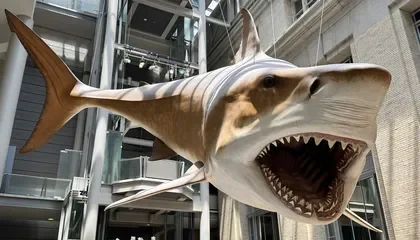
For more than one hundred million years, giant sharks have flicked their massive tails throughout Earth’s oceans. Some of these immense fishes have been filter-feeders, such as today’s whale, basking and megamouth sharks. But enormous predators with razor-sharp teeth have cut their way through our planet’s waters, too, from today’s celebrated great white shark to the extinct megalodon.
Huge sharks with an appetite for blubber did not evolve just once. Over and over again, since at least the middle of the Cretaceous, large and predatory sharks greater than 20 feet in body length have arisen from different branches of the shark family tree. Some of the earliest, like Cardabiodon, comparable in size to today’s great whites, had smooth-sided teeth suitable for catching fish and only just squeaked into the “giant” category. Nicknamed for a brand of kitchen knife, the “Ginsu shark” of 75 million years ago, scientific name Cretoxyrhina, was even larger, reaching lengths of 24 feet in waters full of coil-shelled ammonites and sinuous mosasaurs.
Then, of course, there were the megatooth sharks. Starting around 65 million years ago from a roughly 30-foot-long shark known as Otodus obliquus, this lineage kept generating larger and larger predators. The most famous and largest of them all, O. megalodon, likely exceeded 50 feet in length and thrived in every ocean for more than 20 million years.
Did you know? An even bigger megalodon
Last year, researchers estimated that O. megalodon might have been skinnier and longer than scientists had previously thought. If the predator had the proportions of today’s mako sharks or lemon sharks—rather than great whites, as previously assumed—the prehistoric sharks could have been 80 feet long.
Paleontologists have been assembling a clearer idea of how such enormous sharks evolved. These fish weren’t necessarily the most voracious. Quirks of their life histories, available prey species and the behavior of other marine carnivores all had their roles to play in allowing truly gargantuan sharks to become such an enduring feature of our planet’s oceans.
Here’s the evolutionary recipe for how the biggest carnivorous sharks were made.
Marine reptiles made room for sharks
Sharks started to inflate to mega body sizes during the heyday of the dinosaurs. At that time, the seas not only were full of a broad variety of fish, but they also hosted marine reptiles—such as tuna-like ichthyosaurs, long-necked plesiosaurs and the powerful-jawed pliosaurs.
The pliosaurs were apex predators, feeding on other reptiles and big fish, but they were not everywhere. Giant, carnivorous sharks might have first appeared where pliosaurs were absent. The crucial evidence for this, published in October 2025, comes from the roughly 115-million-year-old rocks of northern Australia known as the Darwin Formation. There, paleontologists have found very large, dish-shaped vertebrae from some of the earliest predatory sharks to emerge as true giants.
These fossils were found alongside the medium-size marine reptiles but not the enormous pliosaurs. Essentially, the sharks arose in coastal environments that were abundant with snack-size food and had less danger of being eaten. Giant sharks often fed on and scavenged marine reptiles, so the success of Cretaceous saurians in the sea helped underwrite the rise of these super-size predators.
Paleontologists can estimate prehistoric sharks’ size based on their sparse remains. Shark skeletons are largely made of cartilage, which usually decays too quickly to be preserved, but some parts are made of harder and more resilient stuff. Shark teeth, of course, are so durable that they are abundant as fossils, but sometimes the cartilage of shark vertebrae became ossified, or naturally replaced with bone tissue that could stand the test of time. Comparing individual fossil vertebrae or teeth with more complete shark fossils and the size of modern sharks helps paleontologists work out how big the extinct species were.
The early shark vertebrae found in Australia’s Darwin Formation belonged to relatives of the sharp-toothed Cardabiodon, their bodies estimated at up to 26 feet long and more than three tons.
Mammals enter the water
Around 50 million years ago, the first cetaceans—the ancestors of today’s whales, which initially walked on land—started to dip their toes into the water. They evolved into a vast array of fully aquatic species within about ten million years. Some became giants themselves—prehistoric forms more than 60 feet in length—and all developed insulating layers of fatty blubber to help regulate their body temperature in the sea. Then, about 25 million years ago, a group of weasel-like mammals began their own plunge into the oceans: They were the ancestors of today’s seals and sea lions. By two million years later, O. megalodon had arrived.
This creature, the largest predatory shark of all time, emerged from a lineage that co-evolved with marine mammals. At the time whales were stepping into the water, the roughly 30-foot-long megalodon ancestor O. obliquus was swimming in most of the world’s oceans. By the time seals were becoming more aquatic and ancient whales were rapidly spinning off new filter-feeding and toothed species, the megatooth lineage was represented by the 31-foot-long O. auriculatus and the even-bigger O. angustidens.
The last and largest of the megatooths was so much grander, though—O. megalodon was perhaps twice as long as some of these earlier species. When whales and seals filled the seas, they brought so much calorie-packed blubber that large, predatory sharks had an enduring and diverse food supply.
O. megalodon didn’t even feed on the largest cetaceans all that often. Fossil bones of the relatively small whale Piscobalaena found in Peru sometimes bear cut marks from the giant shark’s teeth, as do pinnipeds comparable in size to those alive today. Zinc isotopes from O. megalodon teeth suggest the predator ate animals from all levels of the food chain, not just those near the top. Essentially, the big shark became so large because of the sheer abundance of fatty prey, not necessarily the giant size of the morsels it consumed.
Big bodies get bonuses
The impressive size of O. megalodon and other Cenozoic sharks isn’t simply a matter of a marine mammal smorgasbord. The abundance of fat, blubbery mammals allowed sharks to develop larger body sizes, and those giant proportions opened up a suite of benefits that helped maintain the species’ populations worldwide for millions of years.
O. megalodon was what paleontologists call a transoceanic predator—its geographic domain stretched across the planet. The shark’s teeth are found in wide-ranging places, from deserts in Australia to boggy coastal swamps in the United States. Part of the reason this shark was able to cross entire oceans was because the muscles of its massive body could propel it along at a cruising speed of about three miles per hour. The massive muscles of O. megalodon allowed the shark to move farther in a day and encounter more potential prey compared with smaller sharks of its time.
An adult O. megalodon required about 98,175 calories a day, equivalent to about 45 pounds of whale blubber or 40 pounds of shark liver. That is not terribly much for such a big animal, which could weigh roughly 67 tons. In fact, the caloric needs of adult O. megalodon seem so small that even regularly eating entire orcas—which they could do in as little as five bites—would not have put undue pressure on orca populations. This means that the sharks could survive in more places and over a broader range without causing populations of their potential prey to crash. The rise of energy-rich prey allowed this dynamic to evolve.
Other predators add pressure to grow
Apex predators can still be prey. Despite the popular idea that these creatures eat but are never eaten, top carnivores are at least sometimes hunted and consumed by something else—especially when they’re young. Imposing as O. megalodon was, the fish lived alongside other giant sharks, carnivorous whales with banana-size teeth, and other potential predators that likely fed on its juveniles. Quickly growing to a large size allowed O. megalodon to have a better chance of survival in waters full of other large predators.
At birth, a baby O. megalodon was as large as an adult human. That’s not exactly small. And yet the newborn fish swimming around their coastal nurseries were pretty puny compared with the ancient great white sharks and adults of other Otodus species. Young O. megalodon had to watch out for whales, too. Large dolphins with scissor-like smiles lived at the same time as O. megalodon, as well as early killer whales and, perhaps most threatening of all, the large sperm whale Livyatan.
It took years for young O. megalodon to pack on enough pounds to grow larger than most of its competitors and predators, a harsh threshold for sharks that could ultimately get to be as old as 100. The abundance of relatively large adult teeth compared with heart-shaped baby O. megalodon teeth in the fossil record speaks to how harsh life must have been for the younger sharks.
Cannibalism in the womb
Even a six-foot-long baby O. megalodon is bigger than the average adult shark swimming around today. To be born so large, the baby sharks had to get a great deal of nutrition in the womb. They did so through intrauterine cannibalism—or eating their siblings before birth.
Sharks reproduce in a variety of ways, from laying cases of eggs to birthing live young that have been nourished by a placenta-like yolk sac. O. megalodon used a more common method, in which fertilized eggs are held internally until the babies are born live. Some sharks that do this have large litters of pups, but paleontologists think that O. megalodon had only one or two babies at a time. The very large size of young O. megalodon relative to the adults indicates that only one would have been able to fit in each of the shark’s two uteri, a pattern seen in some distantly related modern sharks like the sand tiger.
In modern lamniform sharks—the group that included O. megalodon—the first embryonic sharks to develop teeth begin to eat what’s around them in the dark, consuming the other eggs and developing sharks. The nutrition allows these early risers to develop more quickly and become better able to feed—so they eat their would-be siblings until there’s just one large baby left. When baby O. megalodon were born into their nurseries, they were already survivors and practiced predators, ready to take on the world on their own.