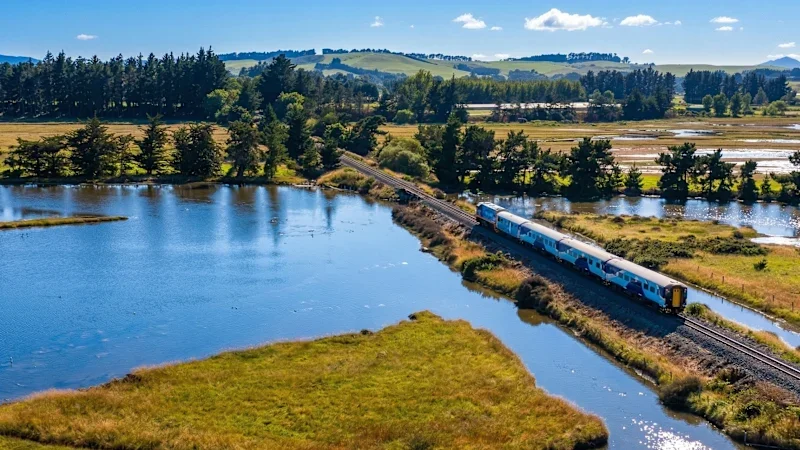
There’s pure excitement at a railway crossing in New Zealand’s remote Southland. Train enthusiasts gather trackside to wave and photograph a yellow-faced diesel engine. Passengers onboard happily return the greeting as the train chuffs past with a cheerful blast of its whistle.
The reason for the curiosity? The Mainlander, a tourist train run by Pounamu Tourism Group, is the first passenger service to ply the tracks between Dunedin and Invercargill in more than 20 years.
In the time since the 2002 demise of The Southerner, a passenger express train that travelled along the South Island Main Trunk, stations en route are run down or have been demolished. Residents of the region also feel abandoned, isolated by a lack of public transport connecting them with other parts of the South Island.
The launch of The Mainlander service from Christchurch to Invercargill in January 2026 brings hope that a golden age of rail travel may return to the oft-ignored region, providing tourists with a new scenic route, as well as reconnecting communities.
And it couldn’t have come at a better time.
Get exclusive travel deals delivered straight to your inbox. Sign up now.
As I board The Mainlander’s second scheduled journey during the Easter school holidays in Otautahi/Christchurch, petrol prices are sitting at NZ$3.54 a litre ($2.93); and while the fuel crisis may dissipate, the great New Zealand road trip remains under threat.
I join 159 passengers on The Mainlander’s three-day return journey from Christchurch, choosing a Rail & Stay package that includes accommodation in Dunedin (Otepoti) and a day trip to Invercargill (Waihopai).
The majority of my fellow passengers are locals, many of whom have memories of travelling this route on the Southerner between 1970 and 2002.
Some sit, with old maps open before them, following the celebrated route along the Otago coastline. Others chat to their neighbours about journeys past, when The Southerner represented the ultimate in comfort and convenience for long-distance, express travel.
The Southerner, incidentally, returned to the rails for a sell-out limited season in May 2025. This year there were more special departures over four days in May. These tourist trips only run between Christchurch and Dunedin, however there is ongoing discussion about reintroducing regular passenger services on the route.
Meanwhile, the privately owned Mainlander has taken on the full route to Invercargill, using a rebuilt DC4375 diesel engine to pull ex-British Rail S series carriages, built in the 1970s but refurbished by Pounamu Tourism Group two years ago.
While comfortable enough for the seven-hour journey between Christchurch and Dunedin, this is a modest, rather than luxurious train. Designed for day travel, there are no sleeper cars; each carriage carries 60 people, with four-seater configurations separated by a table, plus double seats with tray tables. There are racks overhead for hand luggage, while suitcases are placed into an open car at the end of the train. There’s no Wi-Fi, though power plugs beneath the seats are handy for charging devices.
A simple cafe serves salads, sandwiches, pies and muffins, as well as tea, coffee and alcoholic beverages. Plastic cups of NZ sauvignon blanc do a roaring trade throughout the journey.
Sadly, there’s no observation carriage for photo opportunities, and with my allocated seat facing backwards and on the wrong side for optimum coastal views, I find myself dashing between available spare seats and doorways, soaking up the vistas wherever possible.
Not that the “wrong” side views are bad – the Canterbury Plains scenery is straight out of a children’s book, of rolling emerald hillsides and tranquil fields of cows and sheep that buck and startle as the train choofs by.
Bridges take us across braided rivers, milky blue from glacial run-off, and through wetlands rich with birdlife. A pre-recorded commentary shares information about towns we pass, such as the pottery village of Temuka or the quirky, steampunk culture of Oamaru, the largest town in the Waitaki region; while landmarks of note are also pointed out, such as the mystical spherical boulders of Moeraki, scattered along the beach like huge alien eggs.
The friendly staff on board is happy to answer questions about the train, its history and the route. Curiosity about a bluestone cairn on top of a hill at Palmerston, for instance (observed during a prolonged stop as a freight train passes) leads to a quick response as the staff research its significance, a memorial to local politician Jock McKenzie.
But it’s as the train approaches the settlement of Waitati that things get really interesting. As we hug the tidal mudflats of Blueskin Bay, some passengers question why our anticipated arrival time into Dunedin is still two hours away when, by road, we’re less than 20 kilometres from our final destination.
“It doesn’t make sense, we should be nearly there,” I overhear one disgruntled passenger huff. What this person forgets is that this is a tourist train that takes the scenic route, and what unfolds over the final hours is the journey’s highlight, as the train follows a historic track forged during the gold rush, clinging to the clifftop along the Huriawa Peninsula as the Pacific Ocean crashes onto rocks below.
The approach into Dunedin is equally spectacular, with views across Otago Harbour to the evocative hills of the Otago Peninsula where royal albatross soar. Running parallel to the foot and cycle pathway of Te Aka Otakou, we hover above Blanket Bay on a dedicated causeway before making the final descent into Dunedin, tucked into the folds of an extinct volcano.
The most photographed building in New Zealand, the grandeur of the Dunedin Railway Station belies its humble use these days as a launch-pad for scenic day trips.
In its heyday, this magnificent Flemish Renaissance edifice – a gingerbread confection of basalt and Oamaru limestone with towers and arches resembling Harry Potter’s Hogwarts – was New Zealand’s busiest railway station, handling up to 100 trains a day. But the 480-metre platform is deserted as we pull in and are whisked away by bus to our accommodation.
After a night exploring this quirky city – often described as “the Edinburgh of the South” but with a buzz characteristic of university towns – we’re back at the station by 7.30am. Before reboarding the train, there’s enough time to admire the station’s grand lobby and intricate mosaic floor, as I grab a coffee from the Farmers Market held each Saturday at the northern end of the station.
This leg of the trip, I have the prettiest views as The Mainlander makes its way south along Lake Waihola, its mirrored surface reflecting the moody sky as black swans feast in its shallows.
Barely used in more than 20 years, Invercargill Station, a brutalist concrete slab erected in 1978, bears an air of tired neglect, with passengers ushered past cyclone fencing and through a side passage to the gloomy streets of Invercargill.
I’ve been told by cynical New Zealanders that two hours should be ample to experience Invercargill, and indeed, beyond the famous motorcycle museum housing Burt Munro’s 1920 Indian Scout immortalised in the movie The World’s Fastest Indian, there are few attractions within the city confines to boast about.
Arriving at lunchtime, however, most passengers’ minds turn to food. Some seek out Southland’s prized Bluff oysters, currently in season; but I’m determined to try the region’s other culinary delicacy, the humble cheese roll – white sliced bread stuffed with grated cheddar cheese and a curious mix of Worchestershire sauce and onion soup mix, rolled and lightly fried, although the ingredients can vary.
“You haven’t lived until you try a cheese roll in Invercargill,” a celebrated Christchurch chef, on the cusp of receiving a Michelin star, had drolly told me. With that sort of endorsement, however ironic, how could I not indulge?
A little research leads me to what is widely acclaimed as Invercargill’s best cheese roll, served in The Batch, located a few blocks from the city centre. Being a toastie lover, I’m not disappointed: buttery, crispy and elevated with a dash of herbs, Batch’s gooey, cheesy offering really hits the spot, the ultimate comfort food on a chilly day.
Invercargill, welcome back to the fold.
THE DETAILS
TOURA Rail & Stay Package including three nights’ accommodation in Dunedin, a day trip to Invercargill and return travel from Christchurch to Dunedin costs from NZ$1646 ($1356) twin share. The Mainlander runs on select dates from now until September 2026. See mainlander.co.nz
MOREnewzealand.com
The writer travelled as a guest of Enterprise Dunedin, ChristchurchNZ and The Mainlander.