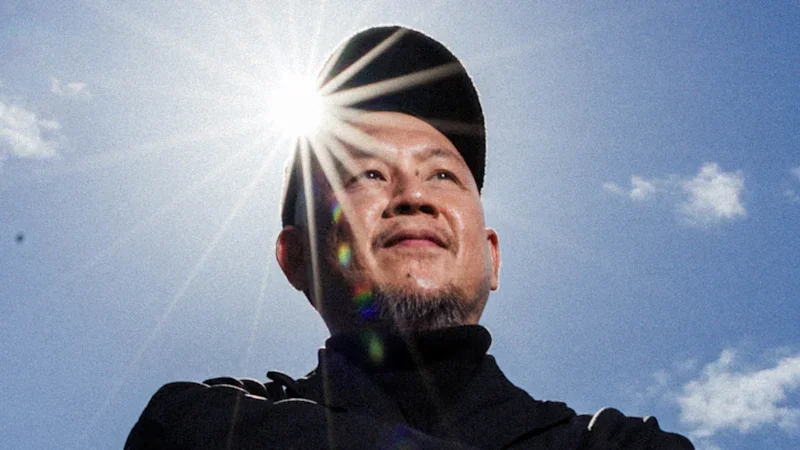
Three weeks ago, Low Kee Hong spent an exhausting 48 hours without sleep, assisting Ai Weiwei as the acclaimed artist ate, slept, exercised and washed inside a replica of the Chinese jail cell he was secretly held in 15 years ago.
Based in Manchester, Low serves as creative director at Factory International’s Aviva Studios, a northern England contemporary to London’s Tate Modern, where Ai’s blockbuster show has just opened.
Now the Singaporean-born curator has been tapped to direct the 2028 Biennale of Sydney, bringing a breath of calm following the controversy that surrounded this year’s director, Emirati princess and notable arts curator Hoor Al Qasimi.
With a master’s in sociology and a background in dance and theatre, Low is not your typical artistic director. NSW Arts Minister John Graham describes him as someone who has “made a career out of curating fun and joyous creative programs that bring people together, activate unexpected spaces and transform cities from Singapore to Hong Kong to Manchester – and next, Sydney”.
Boasting friends from every corner of the arts and festival world, Low wants the next Biennale to feature more activations, performance art and work that can speak to politics while “insisting on the capacity for beauty and joy”.
“Social media cannot deal with the complexities of everyday life like contemporary art can,” he says. “For too long, a like, a share or a tick has been enough to say ‘I’ve engaged’.
“We don’t even fact-check information any more and that’s an issue for me. It’s why I believe contemporary art is a space where we can unpack and engage in difficult conversations.”
It’s a delicate needle to thread. Recent biennials in Venice and Sydney have drawn flak for allegedly prioritising political posturing over beauty, wonder and emotional depth.
Sydney’s latest edition faced fierce backlash over claims it sidelined Jewish artists in favour of pro-Palestinian voices, leading to an official complaint – later dropped by police – over a DJ’s allegedly incendiary opening-night remarks at White Bay Power Station.
Low remains unfazed by the friction.
“That’s the strength of contemporary art,” he says. “It carves out a space for nuanced discussion and deep listening. It’s not always about agreeing but about preserving a space for conversation.
“For me, that’s vital to protect. It’s about raising awareness and consciousness but, ultimately, it’s also about accountability and responsibility.”
Few know the dangers of navigating the line between art and activism better than Low. The founder of the Singapore Biennale, he was head of theatre and performing arts at Hong Kong’s West Kowloon Cultural District Authority during the pro-democracy Umbrella Movement.
For one production, he staged the personal stories and perspectives of 100 Hong Kong citizens. Under the cover of darkness, the audience was asked a taboo question: did they miss Apple Daily – the city’s only mass-circulation pro-democracy tabloid, which had been forcibly shut down by authorities?
Their anonymous answers, illuminated on screen, brought the crowd to its feet. During an open-mic session attended by a media reviewer, outspoken remarks were made, leaving Low panicked: “I thought, ‘I’m going to be put in jail. I’m dead.’”
Two weeks later came a glowing review.
Low has not ruled out bringing Ai Weiwei’s Manchester exhibition, which the 48-hour performance anchored,to Sydney. He is currently exploring potential collaborations between his base in Manchester, where he will take extended leave to plan the Biennale, and considering touring options before and after the Sydney event.
He already has a theme in mind, has begun approaching artists and plans to consult with First Nations elders and artists in Australia while deeply researching a personal interest: native plant species and medicinal herbs.
That curiosity dates back to his decision to walk away from a place at the Royal College of Surgeons in Ireland to pursue degrees in social work and linguistics before performing across Europe.
Low is a passionate admirer of the diversity and richness of Australian art, particularly First Nations artists and the rising crop of Indigenous choreographers.
“I love how artists here do deep research, and I appreciate their commitment to longevity in their practice,” he says. “Looking at a subject over a long period, rather than constantly flipping and flopping, allows the work to truly mature.”
The 26th Biennale of Sydney will open to the public on March 11, 2028.