People who know poverty in their youth can grow up to be ruthless about money in their adulthood. Perhaps that explains Alan Joyce’s determination when it comes to Qantas’ finances.
No one leads Qantas for 15 years without having the blend of skills Joyce was known for: both managerial discipline and a flair for marketing. But it’s when he has to make “unpopular” decisions that his readable, if somewhat self-justifying, account of his time at Qantas sharpens.
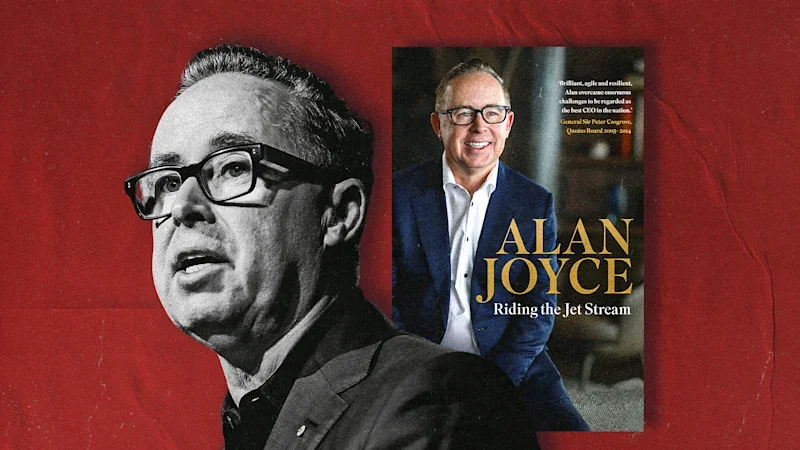
Alan Joyce: Riding the Jet Streamwas always going to recount Joyce’s side of the story: the response to lockdown, the “ghost flights” scandal, even the sacking of 1820 ground crew in 2021.
Rather than presenting these as lofty, dispassionate executive decisions, Joyce frames them as real-time responses to a grim financial reality, made with imperfect knowledge of a rapidly evolving situation.
Yes, the “ghost flights” happened, yes, $1 billion in flight credits were withheld and customers were insulted for not being prepared for travel, but it all happened for reasons.
Repeatedly, Joyce shows he was willing to take nearly any action to ensure that Qantas survived the pandemic. Referring to the 2001 demise of another Australian air carrier, Joyce pledges: “I’d never let an Ansett collapse happen on my watch”.
The aversion to financial failure could very well be a lesson that he absorbed growing up in working-class Dublin, which he portrays with satisfying detail at the beginning of the book.
Perhaps Joyce would have led Qantas through the same choices even if he were earning just a fraction of the $125 million that he pocketed in his time as CEO there.
His individualised perspective brings to mind Margaret Thatcher’s claim that “there is no such thing as society” – emphasising personal responsibility to the exclusion of collective obligation (or even awareness).
In a way, this might be the legacy of Joyce, whose career rise dovetailed neatly with the triumph of the until-recently unchallenged notion that the CEO exists first and foremost to return shareholder value, an idea that came out of the 1980s in Britain and the US.
Such a conception conveniently ignores the collateral effects a company’s operations can have on society, such as the vague and troubling reality of 1820 people being turfed from their jobs, or indeed thousands of customers who paid for non-existent flights.
Joyce is a well-known champion of causes including marriage equality, LGBTQ rights and the Indigenous Voice to parliament, but the cause of basic economic fairness for staff, for customers, and for broader society? Well, those things come downstream from ... shareholder value.
This perspective is sustained throughout the book. Joyce is a man on a mission. And that mission is the success of Qantas and, when the pandemic hit, the survival of the airline he ran.
For an aviation CEO’s tell-all, the book is well paced and has plenty of action, and attitude. It is, after all, Alan Joyce. Whether measuring how fast a meal service can be completed on Aer Lingus flights, setting up and leading Jetstar, or telling Simeon Boikov (the Aussie Cossack) to “feck off” on Sydney’s streets, he’s never at a loss for words.
Rather than presenting these as lofty, dispassionate executive decisions, Joyce frames them as real-time responses to a grim financial reality.
An unexpected highlight is Joyce’s account of how COVID-19 shut down Australia’s borders and his role in advocating for their reopening. Here, Joyce’s style of leadership is on display as he contemplates the shortcomings of the decisions on COVID-19 closure by state and territory leaders. Joyce writes: “Too often, those decisions seemed driven by a pursuit of zero risk. Borders were closed or kept closed not because the data demanded it, but because the politics of absolute safety prevailed.”
He notes that if we applied “the standard of zero risk in daily life, we wouldn’t get out of bed in the morning”. Moreover, airlines “wouldn’t allow metal tubes with rockets attached to take off multiple times a day.
“But we do. We minimise risk, we manage it, and we weigh it against the benefits ... That’s how life works. And that’s how leadership should work, too ... Leadership in a crisis means making decisions – sometimes unpopular ones – and standing by them.”
Joyce then steers the point into an argument for COVID-era cost-cutting: “Playing it safe wasn’t an option. We took over $1 billion out of the cost base, including the difficult but necessary decision to outsource ground handling.”
As CEO for 15 years, Joyce put his stamp on the company. His shadow hangs over the Chairman’s Lounge, too, due to allegations – which he rejects – that he used free access as a magic wand to influence politicians, including the prime minister.
Rather, the search for status through Qantas’ masterful loyalty program is remarkable for a country whose identity was once centred on the economic fair go.
It is precisely this tension between financial success and societal fairness that makes Joyce, and his account of his legacy, so deeply polarising.
Alan Joyce: Riding the Jet Stream is published by Hardie Grant ($50).