Sign in. It’s quick, free and it’s up to you.
An account is an optional way to support the work we do. Find out more.
(Seo alt ónár bhfoireann Gaeltachta. Is féidir an bunleagan as Gaeilge a léamh anseo)
FOR THE PAST few weeks a theatre company has been conducting a nationwide search seeking an actor to take on the starring role in a new play, an Irish language version of George Bernard Shaw’s Pygmalion, updated and relocated to the Belfast’s Irish language community in 2026.
Pygmalion producer Bríd Ó Gallchóir, director of Aisling Ghéar, the Belfast-based theatre company, said that more than 40 young actors had attended auditions held across the country, including in Galway and Dublin.
And in her view, this is a timely development because it shines a light on a long-standing mostly unspoken tension in the Irish speaking community focused on the question of who owns the language. Is it right that native speakers from the Gaeltacht should have precedence over young people who are acquiring Irish and fighting on its behalf — particularly in urban areas such as Belfast and Dublin?
Pygmalion is the Shaw-penned drama that inspired the celebrated musical My Fair Lady, with Rex Harrison and Audrey Hepburn in the leading roles.
And the role Ó Gallchóir is seeking to fill is that of Eilís — Eliza in My Fair Lady — for the new production.
In Pygmalion, Henry Higgins (Harrison) bets a fellow professor that he can teach proper English pronunciation to a young woman, Eliza Doolittle (Hepburn), whom he meets selling flowers on the streets of London, and that she will become so accomplished that the most refined people will believe she is one of their own.
In the reimagined version of Pygmalion being produced by the Belfast company, two professors are attending an event at Belfast City Hall when they afterwards encounter two teenage girls outside who are trying to make a TikTok video. Higgins hears them speaking Irish to each other and he and his fellow professor are contemptuous, mocking the Belfast Irish they are speaking.
He bets that he could train her in Irish pronunciation in a way that would leave people at the Oireachtas Festival in November — the great Irish language festival — believing she is a grandniece of the great Donegal writer Seosamh Mac Grianna.
The producer of Pygmalion was very taken with the number of actors who came forward to take part in the auditions. “We put it up on social media and whoever registered received an email and a range of time slots to choose from for the audition — they had a piece to read and we asked them to sing a song,” she said.
She explained that she had spoken with every actor who auditioned and that the process had made a great impression on her. “There was a range of talent but they were all eager to be involved and that was special,” she said. “We are going to write to every actor who took part in the auditions.”
Rehearsals with the full cast — nine people in total, including the actor who will play the role of Eilís — will begin in September, with the first performance at the Everyman Theatre in Cork the following month.
The play has been in development for around ten years. The original concept belonged to Gearóid Ó Cairealláin, to whom Ó Gallchóir was married until his death in 2024, and he had begun writing the story and the dialogue.
Aisling Ghéar received a theatre award worth approximately €400,000 last year to develop, produce and tour this play. The Arts Council and its northern counterpart came together to fund this award — one of the largest ever for an Irish-language theatre production.
And thanks to that award, Ó Gallchóir had the funding to commission another Belfast writer, Nuala Ní Néill, to complete the work that Ó Cairealláin had begun.
Just as Pygmalion raised questions about class in Britain — a class system in which the way people spoke told the world what class they belonged to — this new version of the play, set in Belfast, raises questions about the various attitudes that exist towards Irish in the 21st century.
“The play deals with this contrast in a way that is playful — Pygmalion is a comedy, it is a satire in a way,” she said.
“We are asking those questions, talking about the Gaeltacht and the non-Gaeltacht world and the urban Gaeltacht.”
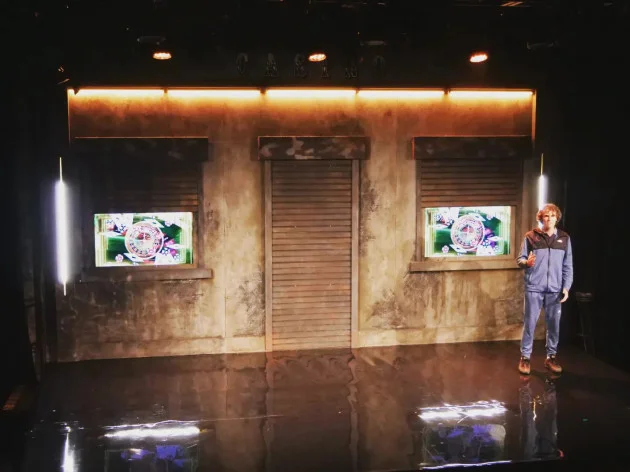
This is not the first theatrical work that Ó Gallchóir has produced with Aisling Ghéar in which the urban Gaeltacht is discussed. Last year she produced a play at Smock Alley Theatre, Minimal Human Contact, a work written by Gearóid’s son, Naoise Ó Cairealláin (Moglaí Bap from Kneecap).
That story involved a gambling addiction and a night the main character spent in a casino putting money he had stolen from his mother into a roulette machine.
According to Ó Gallchóir, the heart of the story in this case is a young girl finding her voice for the life ahead of her.
The first performance of Pygmalion will take place at the Everyman Theatre in Cork on 19 October and it will also be staged in Dublin, Galway and Belfast.
The Journal’s Gaeltacht initiative is supported by the Local Democracy Reporting Scheme.
This article was originally written in the reporter’s native Irish and has been translated to English here. AI was used as part of the translation process before final edits.
To embed this post, copy the code below on your site