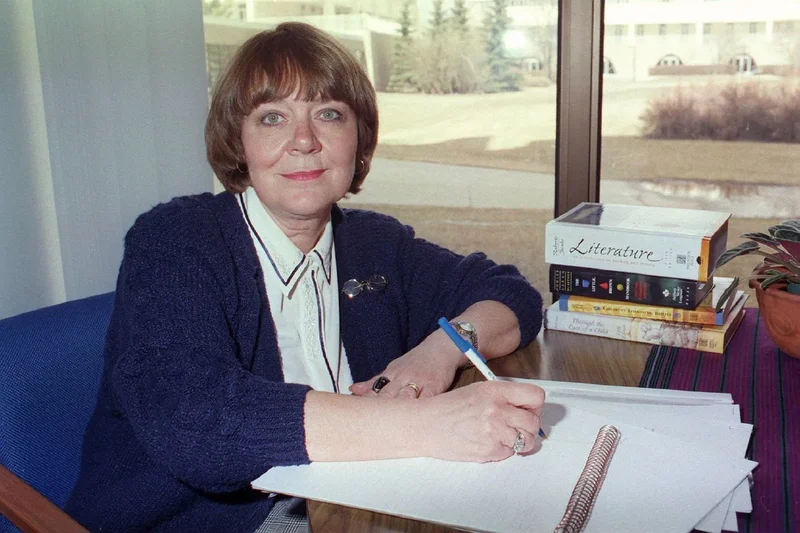
There was no mystery to the Regina murder case, but crime novelist Gail Bowen couldn’t shake its grip on her work.
In 1983, JoAnn Wilson was found dead in her garage – blocks away from Ms. Bowen’s home – after her ex-husband Colin Thatcher, then a member of the Saskatchewan provincial legislature, hired people to kill her as she tried to file for divorce. Mr. Thatcher was convicted of first-degree murder and sentenced to life in prison a year later.
Ms. Bowen was haunted by the case of a woman trying to get away from an abusive partner and would talk about it for years, as she frequently drove or walked past the garage.
That feeling sparked her pursuit of writing murder mysteries. She named the main character of her 23-book series, sleuthing political science professor Joanne Kilbourn, after Ms. Wilson.
The 83-year-old award-winning author died of cancer on June 25. Ms. Bowen’s storied career raised Saskatchewan’s profile, establishing the province as a compelling setting for crime fiction.
Ms. Bowen was born in 1942 in Toronto. She said she learned to read by looking at the tombstones in the city’s Prospect Cemetery. She studied at the University of Toronto and received a bachelor of arts degree in 1964, later earning a master of arts degree from the University of Waterloo in 1975.
She pursued postgraduate studies at the University of Saskatchewan and after graduating in 1979, Ms. Bowen taught at the Universities of Regina and Saskatchewan, the Saskatchewan Indian Cultural College and the Saskatchewan Indian Federated College, now called First Nations University of Canada.
Ms. Bowen became an associate professor at that institution and headed its English department. Her debut book was a 1987 novella titled 1919: The Love Letters of George and Adelaide, about fictional letters sent during the First World. But as she taught students and absorbed details about her community, Ms. Bowen ventured into the crime genre and wrote her first of many Joanne Kilbourn novels.
Released in 1990, Deadly Appearances describes the suspicious death of a Saskatchewan politician, mid-speech on a podium. His speech writer, middle-aged Joanne Kilbourn, is thrust into uncovering the culprit in the whodunnit.
Ms. Bowen’s writing carries the echoes of her home. A footbridge in her neighbourhood would often feature in her novels. One book was set at Saskatoon’s former Mendel Art Gallery. Throughout her books, the interconnected, small-town feeling of a Prairie city shone through in her characters.
Ms. Bowen was deeply offended by injustice and critical of power structures, rigorously researching racism, domestic abuse and gender inequality for her novels. She used the medium of mystery writing to raise awareness of social issues in the hopes that once people became concerned, change would happen.
Playwright and retired CBC producer Kelley Jo Burke, a neighbour and friend, remembers Ms. Bowen’s family being fixtures as she balanced her home life with work and writing. She was passionate about exposing hard truths that lingered in their community, Ms. Burke said.
“Gail saw how cruel the world that looks nice and friendly, with green lawns and tidy gardens, can be, and she channelled that anxiety into a tremendous energy for writing these books,” she said.
Ms. Bowen received numerous accolades. She won the Crime Writers of Canada Grand Master Award in 2018. And she was invested with the Saskatchewan Order of Merit, the highest honour in the province, the same year. Her novels have been translated into six languages and widely distributed internationally.
The author routinely refuted suggestions of parallels between her life and that of her sleuthing heroine. In a 2000 profile in The Globe and Mail, she said, “I caution my students not to confuse me with her.”
But in fiction and reality, both were academics, mothers, afraid of flying and had a granddaughter named Madeleine.
Starting in 2000, Ms. Bowen’s first six novels were adapted for the small screen and broadcasted on Canadian television, something Ms. Bowen was ambivalent about at the time. While calling the adaptations “very lucrative and very flattering,” she took issue with the setting being moved from Regina to Ontario, and with the lack of Indigenous representation in the made-for-TV movies.
She told The Globe and Mail then that she was “still pushing” for Indigenous characters in the series. “I’ve worked among Aboriginal peoples for 25 years,” she said. “I portray [them in my books] as ordinary people, cops, nurses, businessmen. That’s not a face you ever see in the media.”
Despite her misgivings, she still encouraged other authors to pursue television, including Murdoch Mysteries author Maureen Jennings.
The two writers met as members of Crime Writers of Canada, a professional association for authors of the genre.
When negotiations were under way on a potential small-screen deal for Ms. Jennings’s novels, she sought advice from Ms. Bowen, whom she credits as saving the Murdoch Mysteries show from falling through.
Ms. Bowen pushed Ms. Jennings to call the production studio and accept a deal. That call set off a chain reaction for the creation of the long-running CBC crime drama, which marked 19 consecutive seasons this year.
“She was very supportive of other writers. Absolutely, her voice was so strong. She was so concerned that she didn’t want me to lose this possibility,” Ms. Jennings said.
She views Ms. Bowen’s work as crucial to changing attitudes toward Canadian crime writing, which many saw as the “poor cousin of literature.” Ms. Bowen often advocated for authors of the genre to be better respected for their work, Ms. Jennings said.
Ms. Bowen was generous with her time for up-and-coming authors who were tackling the genre, always willing to stop and engage in conversations. She loved connecting with people and her community, and her books were a vehicle for that.
She enjoyed stints as a writer-in-residence at the Toronto Reference Library, Calgary’s Memorial Park Library and the Regina Public Library.
One of the authors who sought her mentorship was crime writer Anthony Bidulka, who also focused his stories around Saskatchewan.
He said Ms. Bowen made his impossible dream of writing about his home province possible, because her work showed that someone from Saskatchewan could set a novel’s location there while still being successful.
The two writers would often visit each other’s book launches and fundraisers, as Mr. Bidulka soaked up everything he could from her.
Among the lessons Ms. Bowen imparted that stuck with him the most was the way she would allow time to pass for characters between each novel in her series, an approach he’s emulated in his own writing.
Joanne Kilbourn aged alongside her creator throughout the run of the series. While each novel was centred around a mystery, plotting out the crimes wasn’t Ms. Bowen’s favourite part of the process. She liked writing about people best.
She sought to parse out a character’s motivations and layer them with social nuances, such as living with a disability or dealing with issues faced by Indigenous people in Saskatchewan.
“I stand on the shoulders of Gail Bowen. She really established the Prairies as a place where, you know, a sophisticated, character-driven mystery can really thrive, and it can have national appeal,” Mr. Bidulka said.
Along with her novels, Ms. Bowen loved the theatre and wrote both stage and audio dramas. She penned Dancing in Poppies, Beauty and the Beast, The Tree and an adaptation of Peter Pan, which were performed at the Globe Theatre in Regina.
A side character from her mystery series, radio announcer Charlie D, was the inspiration for a CBC audio drama. Ms. Bowen would later return to CBC Radio as a frequent political guest and arts columnist.
Ms. Bowen continued writing as her health declined, finishing her 24th and final Joanne Kilbourn book, titled Homecoming, in the months before her death. The book will be published posthumously.
She leaves behind her husband, Ted; their children, Hildy, Max and Nathaniel; their spouses, Brett, Carrie and Willow; and her grandchildren, Kai (Britt), Madeleine (Masan), Lena (Mason), Chesney, Ben, Peyton, Lexi, Val, Daxx, Drake and Lynx.
You can find more obituaries from The Globe and Mail here.
To submit a memory about someone we have recently profiled on the Obituaries page, e-mail us at obit@globeandmail.com.