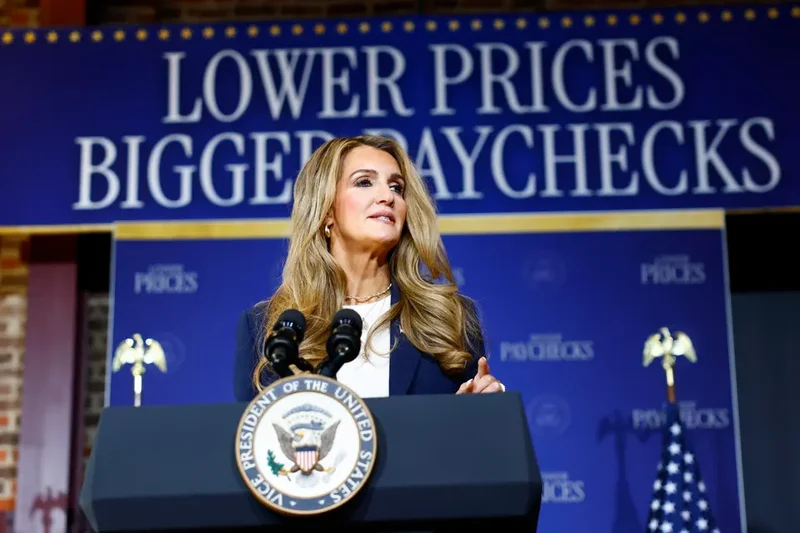
Current Small Business Administration head Kelly Loeffler is not one to go off script. In an interview with Forbes, the former business executive, Republican Senator from Georgia, and (with her husband, billionaire Jeff Sprecher) major MAGA donor, declared that small businesses are doing far better today than under the Biden Administration, which she characterized as a time of rampant inflation and regulation. She brushed aside concerns over the impact of Trump Administration tariffs, higher fuel costs (due to the war in Iran) and labor shortages (due in part to the Trump Administration’s immigration crackdown) and bragged the U.S. economy is “growing again,” despite recent findings that many small businesses are holding off on hiring.
But in the interview and follow-up emails Loeffler also offered some valuable insights for those looking to use or fund SBA guaranteed loans. Among them:
- She “absolutely” supports raising the $5 million cap on small business loans - though two such loan programs with the same limit, 7(a) and 504, were recently decoupled - and believes an increase to $10 million could pass as part of a Defense authorization bill.
- The SBA is looking into changing the 12-month-rule, which prevents buyers of small businesses from keeping the previous owner on for more than a year.
- There’s no flexibility on some SBA changes businesses have complained about. (For example, it has limited access to SBA-backed loans for non-citizens.) She framed the changes as in line with Trump Administration policy or efforts to reduce what she characterized as a surge in fraud during the Biden Administration.
- She blamed the drop in guaranteed loans from fiscal 2025 to this year on multiple government shutdowns, not policy decisions.
- The SBA is committed to helping train entrepreneurs on best uses of artificial intelligence for their companies, to help them grow and hire more staff.
Here are edited excerpts of Loeffler’s interview with Forbes.
Forbes:
There was some pretty significant SBA loan news not long ago with the decoupling of the $5 million cap from the 7(a) program and the 504 loans [allowing businesses that tap both programs to borrow $10 million], I’ve had several sources ask if there's been any possible movement on raising the $5 million cap, specifically for the 7(a) loans. They point out if the cap was just adjusted for inflation, it could be millions of dollars higher. Has there been any movement on increasing that limit, for SBA 7(a) loans? Is that something that you might support?
Loeffler:
I absolutely would. And we’ve been very vocal about returning to the mission of the small business administration. Our loan limits stopped going up in 2010. So 16 years ago was the last increase. And we have decoupled now our 504 and 7(a), two of our core loan products, from being a single loan cap of $5 million to being a cap of $10 million per project, which alleviates some of the friction in access to capital. But we know that building out a factory, which, 98% of all of America's factories are small businesses, (and) we know it costs today much more than $5 million. You look at the cost of robotics and automation and machining, which is all done through CNC machines and software and precision optics tooling, and then training the workers to do that, costs much more than $5 million.
So we’ve been a big advocate of what is the Made in America Manufacturing Finance Act, MAMFA. And it's passed on a bipartisan basis out of committee in both the House and the Senate, and it's passed from the House floor. And so we're hoping for passage as part of defense funding, because a lot of our manufacturing is in support of re-industrializing our industrial base for defense.
We’ve seen manufacturers by the hundreds hit the cap at that $5 million. And certainly we're testing the default rates at every size. We're modeling what that looks like to go forward. So we would just want to make sure that it comports with our commitment to be cost-neutral to taxpayers. That means the loan programs should operate at zero subsidy by taxpayers.
Forbes:
On the numbers regarding the 7(a) loan program, there’s actually been a pretty significant dip between fiscal year 2025 and the current fiscal year. In 2025, there’s just over 63,000 7(a) loans approved and this year it's so far just over 43,000. Why there was such a big dip there?
Loeffler:
Well, there’s a number of reasons. First of all, we've had a couple government shutdowns; one of them went for 43 days, probably cost us $2 billion to $2.5 billion dollars in lending opportunity. So that's pretty significant, particularly as we head into the end of the year, and small businesses were trying to establish themselves or plan for the new year.
The second one is, under the Biden administration, they applied a standard called “do what you do.” Now, what does that mean? It meant that underwriting standards that the SBA traditionally upheld to protect taxpayers from defaults were completely eliminated. And people could submit loans and get approvals on any kind of risk framework they wanted to apply to a given loan. It meant a lot of loans got approved that shouldn’t have, loss ratios skyrocketed. We ended that as quickly as we could when we came in.
But in 2025, you saw people rushing to get loans in under that lax underwriting standard. So we managed the agency with an eye toward risk management, not headline numbers. Our first duty is to our taxpayers. And as part of the Trump administration, we have a major focus on waste, fraud, and abuse. And these were abusive lending practices that needed to be ended. So we continue to focus on the quality of the portfolio as opposed to quantity.
Forbes:
There was also a fairly significant rule change just in March this year around SBA loans for non-citizens. I’ve had several different sources raise that and ask what the impetus was? And what’s the impact it may have had so far? Are there any possible changes to that policy in the near future?
Loeffler:
When we came in, the practice of the agency was to test 81% of the ownership, and there was 19% that wasn’t reviewed. And what we found was, in order to protect taxpayer funds, we wanted to look at the entire stack of ownership in a government-guaranteed loan that was going to a business. And this is where we discovered that foreign nationals were getting loans. And I think as we've rolled this out, the American people have been shocked to see that part of the business was guaranteeing loans to non-citizens. And so this is a part of the commitment of this administration to putting Americans first, and to be an American citizen not only comes with rights, but it comes with responsibilities. And we think they should be prioritized in government-guaranteed lending. And so we've not had a tremendous amount of pushback, and we've had a tremendous amount of support, coupled with a decent amount of shock that the agency was guaranteeing loans to non-citizens in the first place.
Forbes: Why does SBA require sellers to exit all operational roles within 12 months, regardless of the needs of the business? In licensed industries, that may not give a buyer enough time to qualify for the necessary license. Why not eliminate the arbitrary 12-month limit and allow SBA lenders to use their credit judgment to approve a longer transition when doing so would make the business—and the SBA-guaranteed loan—safer?
Loeffler:
The SBA is actively evaluating the 12-month rule to ensure new small business owners can succeed independently while preserving flexibility for sellers to assist during the transition. The agency presently allows for the partial sale of a business, which uniquely permits a buyer to own and operate as a partner with the seller.
Forbes:
And there was also some news recently as well from the SBA banning at least 150,000 borrowers from future lending over connections to Paycheck Protection Program and Economic Injury Disaster Loan fraud in multiple states across the country. But how do banks know if a loan applicant is ineligible? Are the folks who are barred from borrowing, are they listed on the sam.gov list? Have the people on the list who have been banned, have they all been notified of their status?
Loeffler:
Well, John, when we came in, all of the risk guardrails had been let down. For example, the last administration did not require looking at Treasury’s do not pay list. Not only have we reinstated adherence to the Treasury do not pay list, we're creating an SBA suspension list. And so as part of our broader fraud risk framework, people will be verified against certain criteria as to Treasury and SBA's database, an age database. SBA has never required a birthdate. And we saw during the pandemic that the Office of Inspector General had marked about $200 billion worth of loans as fraudulent. And the last administration did nothing about it.
And so when we came in, we started looking at all the factors that would go into managing risks so that these loans wouldn’t ever go out in the first place. And you'd look at birthdate, you'd look at Social Security database for any death around that social security number. You'd look at citizenship. And we just restored a fraud risk framework that weeds out those that should not be applying for SBA loans. And that includes people that have potentially defrauded the government. And so far in about six states, we've announced 150,000 borrowers totaling about $10 billion. We've already referred $22 billion to the Department of Treasury for collection. And that totaled 562,000 loans that are eligible to go to the DOJ for federal law enforcement review.
Forbes:
The SBA spends significant resources helping people start businesses, yet far less attention is given to helping successful owners transfer them. Should SBA treat succession readiness as an economic-development priority and use its nationwide Small Business Development Center network to help owners prepare their businesses for sale several years before retirement?
Loeffler:
SBA continues to review and expand its holistic approach to supporting ownership transfers. We are reviewing policies to expand flexibility in areas such as partial buy-ins, phased ownership transitions, and structures that allow employees or managers to acquire ownership over time. Additionally, resource partners such as Small Business Development Centers (SBDCs) offer transition support to help owners keep businesses viable through a transition.
**Forbes: **
Tell me about the SBA Main Street Artificial Intelligence accelerator program. What will that do for small businesses? What would you want small businesses to know?
Loeffler:
Artificial intelligence has become an increasingly vital tool across the small business economy, as job creators leverage the technology both to start and grow their businesses. Today, 89% of small businesses say they are using some form of AI tools but most also want more training in how to leverage it. For this reason, SBA is exploring new ways to train job creators in the use of AI, particularly as President Trump’s AI Action Plan seeks to make America the global leader in AI development and deployment.
Forbes:
*If you were still an entrepreneur, what business would you choose to start today if you were still in the private sector? *
Loeffler:
I had been in the private sector about three decades. And I grew up working on our family’s farm and waiting tables in a range of local restaurants. Building a business that has local impact, a manufacturing shop, doing machining, a small operation that is helping train the workforce of the future, would be incredibly rewarding because I think there's the importance of building things. We are a nation of builders again, thanks to President Trump. But I would also say that just seeing people's lives be transformed by having good paying jobs with good benefits, what it does for their families and local communities, is incredibly rewarding.
Forbes:
What are the biggest challenges facing the small business community today in your opinion?
Loeffler:
Well, we’ve just seen a round of data that shows that small business confidence is strengthening as this economy recovers from four very challenging years under the Biden administration, where inflation cumulatively rose 21%, (and) regulatory burdens accumulated to about $6 trillion. If you break that down, that costs small businesses about 350 hours of extra regulatory compliance a year.
You put on top of that the uncertainties around our energy supply, where our biggest product of export, oil, was getting shut in. Oil prices, gas prices were skyrocketing. Natural gas was about three times the cost it is today. Gasoline was $5 a gallon. So all of that weighed on small businesses. I would say today, when you look at strong small business confidence, that’s one metric. But then look at the hard economic data of record business formation in this country. We've got, on average, 513,000 businesses being registered each and every month of 2026.
You’ve got things like factory starts, and the ISM PMI data showing that our factory production is rising. And then you've got our employment data, which is one of the most important indicators of the health of small business, because small businesses create two out of every three new jobs in this country. And so when you think about small business confidence, nothing says “confidence” like taking on a new employee, bringing them in, training them, paying benefits. So we see a healthy and vibrant economy, in which growth is the main theme.
Forbes:
There have also been plenty of hurdles over the past year and a half for the small business community. New tariffs, rising fuel costs, inflation keeps rising, and other hurdles. What impacts to small businesses have you been seeing since the start of your tenure from all those issues?
Loeffler:
Well, again, small business confidence has been generally above its 52 year average for the bulk of this administration. You contrast that to the NFIB data during the Biden administration, for 34 months in a row, it fell below. And that was because of rampant inflation. In fact, four years ago this month, inflation was reported to be 9%. Gas prices averaged $5 a gallon. And so today we're in a very different environment, because now we've had the working family tax cuts. We've had massive deregulation, deregulating to the tune of, for every new regulation we're cutting hundreds of regulations. So small business owners and business formation is on the upswing because of tax cuts, deregulation, a manageable energy price climate.
And then fair trade has been a net positive for small business. When you hear the word “tariffs,” it is fair trade. Think about what happened over the last 50 years for our country. Our industries were hollowed out by bad trade deals, bad corporate policy, bad political policy, sent 5 million jobs out of this country, shut down 90,000 factories, hollowed out our local communities. Certainly, in my local community in central Illinois, a town of 600, the last major business there was the Union Apprenticeship Training Center. That left because the jobs left. The manufacturing went overseas.
President Trump believes in the American worker and the American industry, which is why these tariffs are bringing jobs and new factories and new shifts back. So here's a couple examples. Coosa Steel in Georgia, they were down to one shift a couple days a week because China was taking all of the business. When President Trump came in, applied the tariffs, they're now up to two shifts, six days a week. They're hiring and considering a third shift.
This is a story I see playing out everywhere I go, from coast to coast. I was just in New York at the concrete pouring for Micron, a major chips producer. You think about reassuring an industry that we only have about 17% of production domestically. It might sound like that’s a big business impact. Well, onsite, you have hundreds of small businesses building this factory, servicing that multi-billion dollar investment in that region, and then the thousands of jobs that are coming out of that, permanent full-time jobs.This is the power of the Trump administration for Main Street, and it's happening across the country. That's why small businesses are investing. That's why they're hiring and that's why this economy's growing again.