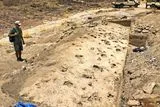
Twenty-one footprints cross a muddy lakeshore in northern Kenya, left there 1.4 million years ago. They belonged to eight adults traveling together. Researchers believe most were male, with no females or children. Hippos, antelope, and other animals marked the same shoreline.
The track makers were Paranthropus boisei, a human relative whose oversized teeth and powerful jaw dominated its skull. A new analysis, published in the Proceedings of the National Academy of Sciences, found that some members of the species were much larger than earlier estimates based on fossil bones.
“The special thing about footprints scientifically is that they preserve an instant in time,” Kay Behrensmeyer, who discovered the fossils, said in a press release. “They also allow people to relate to these fossils much more easily than an isolated piece of bone or jaw.”
Read More: Ancient Ash in an Australian Cave May Have Helped Track the Footsteps of Spirit-Beings
Identifying the Paranthropus boisei Footprints
In 1978, some of Behrensmeyer’s Kenyan colleagues were excavating a trench near Lake Turkana when she noticed a deep, rounded indentation in the rock. It was a hippo footprint, and clearing the surrounding surface revealed two hominin tracks beside it.
After studying the initial prints, researchers covered the site with sand to protect it. When teams returned in 2016 and 2023, they exposed a much larger trackway, now known as GaJi10. Volcanic ash in the surrounding rock dated the surface to approximately 1.43 million years ago.
To identify their maker, lead author Kevin Hatala of Chatham University worked with colleagues in Kenya and the U.S. to map the impressions in two and three dimensions. They compared their proportions and walking patterns with those of modern humans and other Early Pleistocene tracks. GaJi10 most closely matched earlier prints assigned to P. boisei.
Footprints Reveal Unexpectedly Large Bodies
Most P. boisei fossils are skulls, leaving little evidence of the species below the neck. The GaJi10 prints gave the team a different way to estimate how tall and heavy their makers were.
Some individuals may have stood as tall as six feet and weighed around 165 pounds. Those sizes rival Homo erectus, a species thought to have been considerably larger than Paranthropus. The measurements also offered insight into each track maker’s age group and likely sex.
At a slightly older site nearby, the team found P. boisei and H. erectus footprints pressed into the same mudflat. The discovery shows that both species used the Lake Turkana shoreline for hundreds of thousands of years, though researchers cannot tell whether they crossed paths or how they divided its resources.
Mostly Adult Males May Have Traveled Together
The mud surface formed quickly, meaning the footprints came from a short period rather than separate visits years apart. The male-heavy group therefore appears to have moved along the lakeshore together.
Researchers think P. boisei may have organized into large single-sex groups, in which males competed for mates but also had reason to stick together. Crocodiles shared the shoreline, and moving in numbers may have offered protection.
GaJi10 belongs to a regional record that now includes hundreds of hominin impressions at more than half a dozen sites. Deposited across more than 100,000 years, they show generations of ancient human relatives returning to the eastern shore of Lake Turkana.
The team plans to return to Kenya in 2026 to study how so many footprints survived and what kept drawing hominins back to the lake’s edge.
Behrensmeyer has worked in the region since 1969; before that, the first hippo print led her team to the hominin tracks.
“I never dreamed when we found these in 1978 that it would develop into such a large assemblage and provide such widespread insights into the ecology of these hominins,” she said.
Read More: Prehistoric Elephant Footprints Trace Their Movements Through Spain 125,000 Years Ago
Article Sources
Our writers at Discovermagazine.com use peer-reviewed studies and high-quality sources for our articles, and our editors review for scientific accuracy and editorial standards. Review the sources used below for this article:
- This article references information from a study published in the Proceedings of the National Academy of Sciences:New insights into hominin body size, locomotion, and behavior from Early Pleistocene trackways in northern Kenya