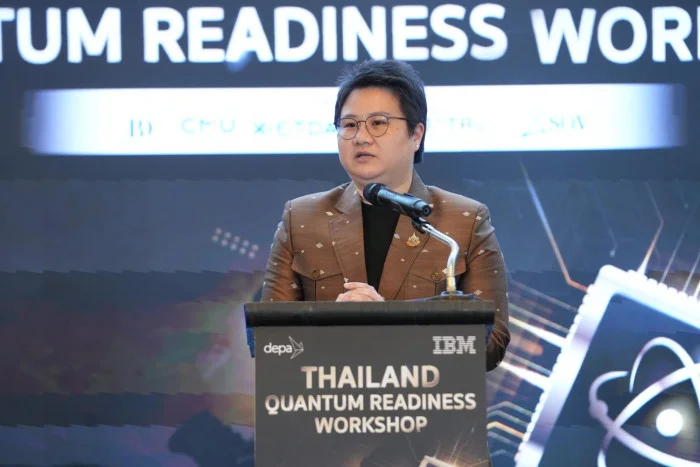
The Digital Economy and Society (DES) Ministry plans to accelerate the development of the national quantum technology roadmap, aiming to leverage advanced supercomputing capabilities to support public services.
The initiative focuses on public health and agriculture, with the goal of transforming Thailand into a food powerhouse.
The supercomputing scheme could also help address the challenges of a rapidly ageing society.
Speaking at the Thailand Quantum Readiness Workshop on July 24, Nan Boonthida Somchai, deputy DES minister, said quantum technology has moved beyond theoretical research to become a critical industrial necessity.
The push for readiness comes as global awareness ramps up, with the US recently issuing an executive order mandating that all federal agencies prepare for quantum technology, particularly regarding encryption and data security.
While artificial intelligence (AI) has dominated global tech trends, Ms Nan noted that Thailand has been monitoring developments in quantum technology for several years.
The government's role is to provide a legal and regulatory framework that allows the private sector, which often moves faster than the state, to innovate with confidence.
"Technology often outpaces the law, and the government is working to update legislation as quickly as possible to ensure safety and stability for private investment," said Ms Nan.
The quantum workshop was held by the Digital Economy Promotion Agency (depa) in collaboration with IBM Thailand and other agencies under the ministry, such as the Electronic Transactions Development Agency.
She said it was too early to elaborate on which state agencies would lead the development of the quantum roadmap and promote its adoption.
In the near future, a quantum technology subcommittee would be established under the National Board of Digital Economy and Society Office, said Ms Nan. The government currently has an AI committee.
Quantum technology differs from AI in some respects, as the former is regarded as a supporting tool or backup system for future innovation development rather than being in direct contact with end users, she said.
A pillar of the roadmap is the application of quantum supercomputing to address social issues.
Ms Nan said quantum computing's ability to reduce calculation times from years to mere hours is expected to revolutionise medical research, drug discovery and diagnostic accuracy, helping people live longer, healthier lives.
She said the ministry aims to ensure that people of all ages benefit from this advanced technology, as the government seeks to apply it to support the basic elements of human life -- food, medicine and energy -- amid global instability and rising oil prices.
"Thailand should not just be the 'Kitchen of the World', but a massive food powerhouse," she said.
By utilising Thailand's geographical advantages and quantum-enhanced logistics and research, the nation aims to secure its position as a global leader in food production, Ms Nan said.
Supakorn Siddhichai, acting president of depa, said the agency identified quantum as a disruptive force in 2017 that would significantly impact both the economic and social sectors.
Thailand's banking sector is already on high alert, preparing for the shifts in encryption and cybersecurity that quantum computing will bring.