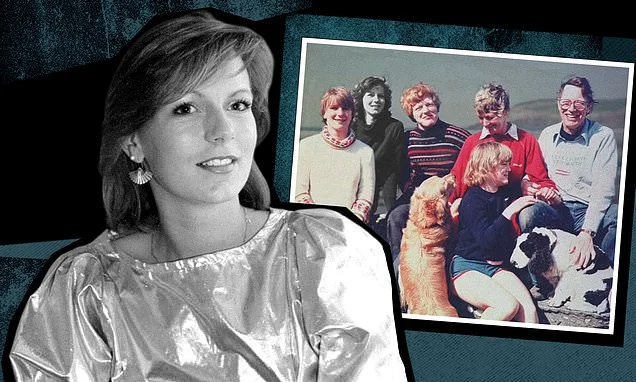
London was riding the crest of a boom in the summer of 1986. Power dressing was in, wine bars were packed and house prices had risen by almost 20 per cent in a year.
So, it’s no surprise to hear that when Suzy Lamplugh, 25, a former beautician on the QE2, applied for a job as an estate agent, she was ‘hired on the spot’.
Suzy was middle-class, good-looking, with an effervescent personality, and her bosses weren’t slow to exploit these attributes.
‘The company puts me in the window desk, as the most attractive female,’ she later noted in her diary.
‘That’s how it is, the most attractive female on display for any man to see.’
It proved to be a distressingly prescient observation. Because on July 28, 1986 – 40 years ago today – Suzy left her office in the upmarket area of Fulham for a 12.45pm viewing of an empty house, with a client known only as ‘Mr Kipper’, never to be seen again.
That night, her white Ford Fiesta was found a mile away in a quiet street that runs past Craven Cottage, the home of Fulham football club, with Suzy’s purse – containing £15 – still in the door pocket. But of the young woman herself there was no sign. To all intents and purposes, she had disappeared off the face of the earth.
The case of the Cheltenham-born, daughter of a solicitor who grew up in London immediately attracted huge public interest and the local police force assigned 40 officers to its investigation.
Suzie Lamplugh left her office in the upmarket area of Fulham for a 12.45pm viewing of an empty house, with a client known only as ‘Mr Kipper’, never to be seen again
Suzy's mother Diana was a tireless campaigner on behalf of her missing daughter and was awarded an OBE in 1992 for her work
There was wall-to-wall media coverage as Suzy’s mother Diana emerged as a tireless campaigner on behalf of her missing daughter and, in the years that followed, book publishers and TV documentary makers vied with each other to produce the most explosive exposes of the case.
In a bid to explain why it caused such a sensation, one commentator observed: ‘The disappearance of Suzy Lamplugh sent a shiver down the spine of every young woman as people thought: “That could be me”.’
Despite interviewing dozens of witnesses, however, the police probe came to nothing. And today they will finally close their file on Britain’s biggest ever missing-person case.
But two people who will never forget the young woman who disappeared all those years ago are Lizzie Bingham and Tamsin Tomlin, Suzy’s younger sisters.
Mother-of-two Tamsin, 64, told the Daily Mail’s Crime Desk: ‘Suze is very much part of our lives still, and of discussions as a family group. My daughter’s 25 now, so she is the same age as when Auntie Suze disappeared. A lot of our children are the same age. We celebrate Suze’s life with them. They are very much included.’
She adds: ‘As a family, we’re probably a bit more anxious than most people because we know bad things can happen. But we certainly don’t stop our children from doing anything.
‘We just make sure that they do it safely and to be conscious there are elements that are not good.’
This might not have been obvious to Suzy all those years ago. To a young woman making her way in the world, 1980s London appeared to offer infinite possibilities.
Mother-of-two Tamsin, 64, told the Daily Mail’s Crime Desk: ‘Suze is very much part of our lives still, and of discussions as a family group' (seen, Suzy a week before she disappeared)
Prince Andrew – then seen as a dashing navy officer and Falklands War hero rather than the sleazy associate of a paedophile – had just married Sarah Ferguson. Gary Lineker had signed for Barcelona for £2.8million, a sum then considered ‘big bucks’. And The Lady In Red by Chris de Burgh was at No 1 in the charts. Suzy, who shared a flat with a male friend in Putney, was an outgoing type who enjoyed swimming, windsurfing, skiing, parties, restaurants, nightclubs and wine bars.
She socialised at trendy hangouts such as the Crocodile Tears Wine Bar – three doors down from the office of her employer, Sturgis Estate Agents, at 654 Fulham Road – and Tokyo Joe’s nightclub in Piccadilly.
On the morning of her disappearance, she was concerned that she had mislaid her cheque book, pocket diary and a postcard, and had cancelled the cheques by phoning her bank.
Shortly afterwards, the bank called back to tell her that the items had been found at a pub round the corner from her flat in Putney called the Prince of Wales and she spoke to a member of staff to arrange to pick them up at 6pm that evening.
At 12.40pm, she left the office wearing a grey skirt, dark jacket and low heels, to fulfil an appointment she had recorded in her diary as: ‘12.45 Mr Kipper – 37 Shorrolds Road O/S’.
Witnesses interviewed later reported that they has seen her arguing with a man outside a house in Shorrolds Road. Others saw them walking away from the property a few minutes later.
After Suzy failed to attend another appointment, her boss called her mother to ask if she had gone home for lunch. After hearing that she had not, the manager reported Suzy missing at 6.40pm.
Her car was found abandoned with the doors unlocked and the handbrake off in Stevenage Road at 10pm. There were no unexplained fingerprints and no signs of a struggle.
The investigation into Suzy’s disappearance was closed in 1987 after failing to produce any leads and, despite the absence of a body, she was officially declared dead in 1993.
But that was not the end of the saga. In 2002, police named convicted killer John Cannan, who had a long record of violent and sexually motivated crimes and was in prison at the time, as their prime suspect.
In 2002, police named convicted killer John Cannan, who had a long record of violent and sexually motivated crimes and was in prison at the time, as their prime suspect
This was a highly unusual move, as the police rarely name suspects until they are charged, and a clear sign that Metropolitan Police detectives wanted to prosecute Cannan, a Bristol-based former public schoolboy. Cannan certainly bore a resemblance to an e-fit of a man, thought to be the mysterious Mr Kipper, with whom Ms Lamplugh was seen talking on the day she went missing, and he had access to a BMW of the type Mr Kipper is thought to have driven.
There were also reports he had been nicknamed ‘Kipper’ during an earlier prison sentence because of his habit of taking frequent naps and, at the time of Ms Lamplugh’s disappearance, Cannan was on day release at a bail hostel in Fulham, having served seven years for rape.
And when Cannan was first interviewed by murder detectives over Suzy’s disappearance, he bragged that there are ‘one or two things I haven’t been caught for’.
What is more, Suzy’s mother Diana remembered her daughter being pestered by an unwanted suitor with links to Bristol who was sending her bouquets.
But the Crown Prosecution Service considered this sort of circumstantial evidence insufficient to justify a trial.
In October 2023, the parole board ruled Cannan was too dangerous to release after hearing that, while the category A prisoner still maintained his innocence, he had not engaged in any accredited jail programmes to address the risk of reoffending. In a letter released by his lawyers in 2023, Cannan insisted he had been in Birmingham ‘treating my mother to a spot of lunch’ on the day Ms Lamplugh went missing.
In November 2024, Cannan died in prison of natural causes aged 70, while serving life for the 1987 rape and murder of newlywed Shirley Banks, another infamous case of that era.
The 29-year-old factory manager was abducted after heading out on a shopping trip in Bristol and her body was found in a shallow stream in Somerset more than six months later.
Following Cannan’s death, a mother of two called Melanie Gregory came forward to claim that she had been kidnapped, raped and almost choked to death by the killer at the age of nine.
Ms Gregory described how Cannan grabbed her off the street, bundled her into an abandoned launderette and ‘gleefully fulfilled every sick sexual fantasy’ before she was able to escape.
In 2018, cold case detectives searching for Ms Lamplugh’s remains excavated the garage of a semi-detached house in Sutton Coldfield, West Midlands, once owned by his mother. The search was a response to a tip from an inmate that Cannan may have buried Ms Lamplugh under the garden patio.
Police twice carried out digs at sites in Worcestershire – first near Norton Barracks in 2000 and then near the village of Drakes Broughton in 2010. They also mounted a week-long search in Quantock Hills, Somerset, an area known to Cannan and where Shirley Banks’ body was discovered. All without success.
Cannan is known to have been writing books in prison, and Ms Lamplugh’s brother Richard once speculated that they might contain a ‘hidden message or a note’ about what happened to his sister.
Officers also probed Suffolk Strangler Steve Wright’s links to Ms Lamplugh after it emerged the ex-steward and former beautician worked together on the QE2.
Wright’s former wife, Diane Cole, said the pair knew each other, but police said Wright’s involvement was ‘not a strong line of inquiry’.
Earlier this year, Wright was jailed for life with a minimum term of 40 years for the murder of 17-year-old Victoria Hall in 1999, who disappeared after leaving a nightclub in Felixstowe, Suffolk.
For their part, Suzy’s family appear to be satisfied that Cannan was the man who murdered her. ‘When the police went forward with naming John Cannan, we all felt that was it for us and that was who it was,’ says her sister Lizzie. ‘As a family, we accepted that.
‘The amount of manpower that they’ve put into it – they have tried absolutely everything and are continuing to do so. You still feel that support.’ Tamsin insisted she had been ‘constantly amazed’ at the energy and resources deployed when ‘there are so many people that go missing’.
She said: ‘We have to be grateful as a family that they have given us that time. You always wonder what happened to Suze.’
And the Lamplughs have certainly done what they can to raise awareness of the dangers facing young women in modern society.
Ms Lamplugh’s late parents, Paul and Diana – who had seven grandchildren – set up the Suzy Lamplugh Trust, which is now the UK’s leading personal safety charity, with a particular focus on violence against women and girls.
Paul and Diana Lamplugh set up the Suzy Lamplugh Trust, which is now the UK’s leading personal safety charity
Since 2010, it has run the National Stalking Helpline, which has helped more than 100,000 victims since its inception.
Suzy’s sister Lizzie, 56, who has three children, says when they left the family home for university all she could do was ‘make them aware’ of dangers, adding: ‘We see Suzy in them and her presence is always there.
‘When we are saying this [explaining safety concerns] it’s because we know and are more realistic about what’s out there. We’re very honest.’
Tamsin agrees: ‘All of the grandchildren know about Suze and we have photographs everywhere. We talk about her all the time. There’s no point sugar-coating. It’s much better to be honest and realistic.’
Ms Lamplugh’s heartbroken mother Diana, 75, a fitness club manager, died in August 2011 after suffering a stroke following a battle with Alzheimer’s. Her father Paul passed away in June 2018 at the age of 87.
Emma Lingley-Clark, interim CEO of the Suzy Lamplugh Trust, said it was ‘a moment of sadness’ that, four decades on, the charity is still fighting to eliminate abuse, aggression and violence in society.Their campaigns raised greater awareness of stalking issues, which can lead men to kill women. The trust also influenced public policy and demanded the licensing of minicab and private hire vehicle drivers.
Ms Lingley-Clark adds: ‘Diana believed – as she found out more about stalking – that that’s what happened to Suzy. Diana and Paul started something which arose out of a tragedy but really took it upon themselves to make sure what happened to Suzy didn’t happen to anyone else.
‘Forty years should have been enough, but yet we continue to have violence, abuse and aggression in workplaces, the street and at home.’
Around 60 of Ms Lamplugh’s closest loved ones gathered at Tamsin’s house in May – on what would have been Suzy’s 65th birthday – for a celebration of her life, raising a few glasses of champagne.
There were equal amounts of tears and laughter as an ‘uplifting’ slideshow of photos and cinefilm of her taken from birth until she vanished were shown. Lizzie and Richard, now 66, gave emotional speeches. Today, the family will spend the afternoon in quiet reflection with a minute’s silence at 12.40pm, the time she left work to meet Mr Kipper.
Because Ms Lamplugh’s body has never been recovered – despite the police testing the DNA of 800 unidentified bodies and skeletal remains that matched her description – the only physical focal point of their grief is a stained glass window at All Saints Church in East Sheen, which was commissioned by Diana and Paul, who were members of its congregation.
‘Every year is the same for us in terms of we’ve had ten years, 20, 30 and now it’s 40,’ says Lizzie. ‘More than looking back, we’ve been so happy that we had Suzy in our lives for 25 years.
‘For us Suzy’s life was not wasted. It may just be her name that is helping people now [through the trust] but it’s an amazing thing.
‘Mum and Dad wanted to raise awareness of something that most didn’t believe could happen: that you’d disappear during your own work day.’