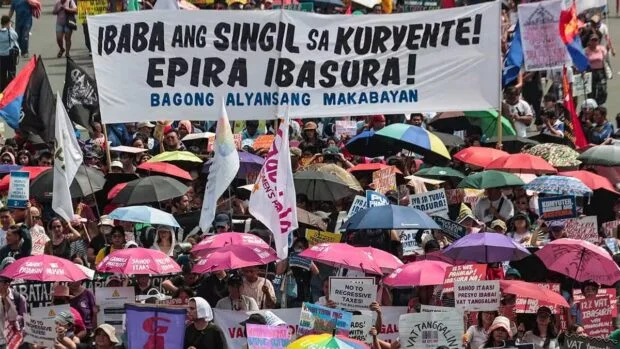
Marcos pushes EPIRA overhaul to cut power costs
MANILA, Philippines — President Ferdinand Marcos Jr. on Monday called on Congress to swiftly amend the Electric Power Industry Reform Act (Epira), proposing the removal of system loss charges imposed on electricity consumers, saying it is unjust for the public to bear the cost of inefficiencies in the power sector.
During his fifth State of the Nation Address (Sona), Marcos reaffirmed his administration’s commitment to reducing electricity prices, emphasizing that consumers should no longer be made to pay for power losses incurred during electricity transmission and distribution.
“We, the people, request—no, we demand the immediate amendment of Epira and to prohibit the charging of system loss against consumers, including the value-added tax (VAT) thereon,” the President said, drawing prolonged applause and a standing ovation from lawmakers and guests at the Batasang Pambansa.
Marcos said the government recognizes the public clamor to reduce electricity prices, which remain among the highest in Southeast Asia.
Consumers should not pay
“It is time for us to get rid of the system loss that is passed on to the consumers,” he said in Filipino, noting that the charge is also subject to VAT.
“It is not the consumer’s fault that system loss happened. So it is not right that they are the ones made to pay for it,” he added.
Epira, enacted in 2001, restructured the power industry by separating generation, transmission and distribution while opening the sector to competition under the Energy Regulatory Commission. Distribution utilities are allowed to recover part of their system loss—electricity lost due to technical inefficiencies and pilferage—from consumers through monthly power bills.
The President also asked Congress to pass the proposed Sariling Kuryente Act, which seeks to make the installation of rooftop solar panels and battery storage systems easier and more affordable.
Marcos said the administration is monitoring nearly 200 energy projects with a combined capacity of almost 10,000 megawatts that are targeted for completion before 2028. Of these, 45 have already been completed, 31 are expected to go online this year, and 124 more by the end of his term.
He added that the government is developing energy storage facilities with a capacity of more than 1,700 megawatts to strengthen energy security for nearly 30 million households and industries.
Gas, hydrogen, nuclear
“In addition to several plants powered by crude oil, we have added more than 60 plants powered by geothermal, solar, hydro, wind and biomass,” he said.
The President also cited the extension of the Malampaya service contract until 2039, saying newly discovered reserves of 222 billion cubic feet of natural gas could sustain the country’s premier gas field until 2034 and supply power to about 1.6 million households over the next eight years.
He said the government has awarded 14 petroleum service contracts—the highest under any administration—including four for hydrogen production and two jointly managed with the Bangsamoro Autonomous Region in Muslim Mindanao.
Hydrogen power projects are also in the predevelopment stage in Marinduque, Masbate, Zamboanga Sibugay, Basilan and other areas.
Disclaimer: The comments uploaded on this site do not necessarily represent or reflect the views of management and owner of Cebudailynews. We reserve the right to exclude comments that we deem to be inconsistent with our editorial standards.