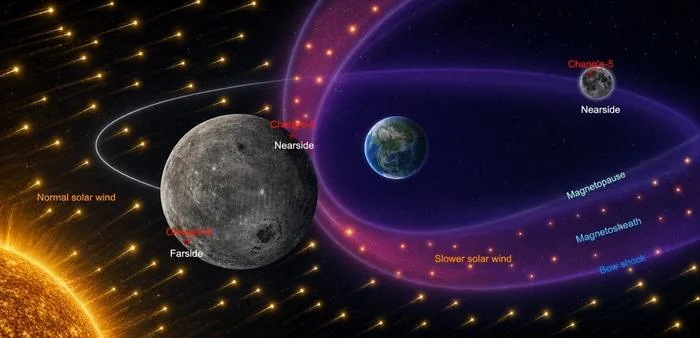
Samples obtained by China's Chang'e-6 mission are revealing a great deal about the Moon's far side. The study of these rock and regolith samples is not only shedding light on the far side's geological history, which differs from that of the near side, but also on how the two halves of the Moon have interacted differently with space weather. In essence, like the near side, the far side of the Moon has been bombarded by solar wind particles, but at different speeds and energies.
Before these studies, the lack of far-side samples prevented direct experiments on the differences in solar-wind interaction between the two hemispheres. In a recent study, a team from the Institute of Geology and Geophysics (IGG) of the Chinese Academy of Sciences (CAS) revealed that Earth's magnetosphere is responsible for the difference. The findings provide new insight into the dynamics of the Sun and the Earth-Moon system, which have been preserved in lunar regolith for billions of years.
Since their formation (roughly 4.5 billion years ago), the Earth and Moon have been bombarded with solar wind, a continuous stream of plasma consisting mainly of protons and electrons. Earth's magnetosphere and atmosphere prevent most of these particles from reaching the surface, channeling them towards the poles where they cause aurorae. On the Moon, an airless body with no magnetosphere, these particles reach the surface and leave their mark on lunar regolith.
This global map of the Moon, as seen from the Clementine mission, shows the differences between the lunar near side and far side. Credit: NASA.
As a result, the lunar regolith has preserved a record of this bombardment in the form of solar-wind-derived volatiles, including the noble gases (helium (He), neon (Ne), argon (Ar), krypton (Kr), xenon (Xe), and radon (Rn)). These elements are highly reliable indicators of solar wind implantation, providing a natural record of this ancient process. Thanks to China's Chang'e-6 mission, which returned 1.935 grams of regolith from the South Pole-Aitken basin, scientists can at least make direct comparisons of solar-wind implantation on the near and far sides of the Moon.
For their study, published in Nature Geoscience, the CAS team conducted a noble-gas isotopic investigation of these samples, determining the concentrations and isotopic compositions of He, Ne, Ar, Kr, and Xe. The results showed that the isotopic composition of Ne is highly distinctive, with a 20Ne/22Ne ratio substantially lower than that measured in the many near-side lunar samples returned since the Apollo missions.
What's more, this ratio is close to the theoretical composition expected after strong solar-wind implantation, implying that the far side experienced greater bombardment. The team also noted differences between the near and far sides for Kr and Xe. As the samples were heated, Xe was released predominantly at high temperatures, producing a single release peak. This contrasts with the samples retrieved by the Changâe-5 mission from Oceanus Procellarum, the largest lunar plain on the Moon's near side.
When heated, these samples exhibited a distinct double-peaked release pattern at both low and high temperatures. This suggests that solar-wind ions penetrated much deeper into the regolith on the far side, indicating that the far side was exposed to higher-energy particles. The team attributes the difference to Earth's magnetosheath, a buffer zone around the magnetosphere, which the Moon periodically passes through. When it is within the sheath, ambient solar wind is slowed from 400 km/s (248.5 mi/s) to about 200 km/s (124.25 mi/s).
This slower solar wind primarily reaches the near side, resulting in shallower implantation. The far side, which is permanently facing away from Earth, remains directly exposed to solar charged particles that are not subjected to this deceleration. These results provide the first direct empirical evidence of how solar wind interacts with regolith on the lunar far side and confirm the speed-governing effect of Earth's magnetosphere. These effects are permanently preserved in lunar regolith, providing an archive of past interactions between Earth's magnetosphere and solar wind.
The findings also show that interactions within the SunâEarthâMoon system are more complex than previously thought. They further provide a window into the ancient dynamics governing space weather and the Earth-Moon system.
Further Reading: Chinese Academy of Sciences HQ, Nature