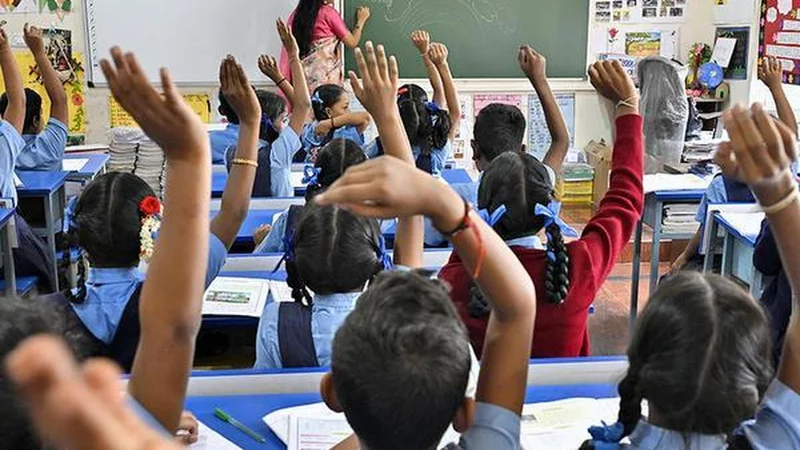
“What students carry from classrooms is rarely written on the blackboard.” Years after leaving school, students rarely remember the exact chapters they studied or the formulas they once memorised with precision. The details blur. The pages fade. The blackboard lessons dissolve into fragments, and memories become a facade.
Somewhere between trigonometry, calculus, equations, proof by induction, and countless ‘ma’am, one last doubt…’ moments, a classroom quietly becomes a collection of memories for both teachers and learners. Those moments of laughter, debates, anger, resilience, and the warmth are memories that eventually fade along with the ticking clock.
What stays
Yet, something remains. A tone of voice. A voice that one loved to hear every day. A passing remark. A moment of encouragement or its absence. The time the bench mate waited in the corridor. The way a teacher looked at them when students answered or could not live up to the expectation. The thunderous applause from cheerleaders, the lost baton during a relay event, the frowning faces after losing, the headache or stomach ache during Math periods... the list is endless.
Classrooms are often defined by what is taught: syllabi, concepts, assessments, never-ending comparisons, fear of judgment, teachers’ anger due to failure, and an environment filled with stress and anxiety. But beneath this structured surface lies another layer of learning; one that is neither written nor formally acknowledged. It is subtle, continuous, and deeply influential. A layer that grows gradually with each passing day, and helps each learner to choose a life of his/her choice.
Students are constantly reading in the classroom, even when they appear disengaged. They observe everything around and learn even the finer details of their surroundings: the deep gestures, mannerisms, verbal and non-verbal communications, acts of knowledge sharing, collaborative project work, unsuccessful tasks, youth festivals, educational trips, unruly behaviours, and so on. They sense whose mistakes are corrected gently with a pause and whose are dismissed without any move to rectify them. They become aware, often silently, of where they stand and move on with deep thought and reflection.
Silent observers
A student who is repeatedly encouraged using positive reinforcements may begin to see himself/herself as capable. Another who is consistently ignored or corrected without care may begin to withdraw and disengage, not necessarily because he/she lacks potential but because he/she no longer feel seen and heard. They do not announce these experiences but it shapes confidence, participation, and, eventually, identity. They learn to create their own world where their self-worth is unlocked without any bias.
In subjects like Maths, the focus often rests heavily on correctness. Answers are either right or wrong. Marks follow. But what accompanies this process is the teacher’s response, the stressful classroom atmosphere, the space to attempt and fail that often leaves a deeper imprint than the outcome itself. In the process, there is less scope for trailblazers. The system and its norms outweigh emotions and fear. The capable ones will climb the ladder effortlessly and the marginalised ones are overlooked.
Students may forget how to solve a quadratic equation, but will remember the hesitation that followed and how they felt before raising their hand, the reassurance they received when they struggled to give the correct solution, the silence that followed their effort, or the happy moments when they got the right solution on their own. Over time, these moments accumulate, internalise, and form a narrative about ability, belonging, and whether one’s voice deserves to be heard.
For teachers, this is an invisible responsibility and one among many. Beyond completing the syllabus lies the task of shaping an environment where students feel acknowledged, not just for their performance, but for their presence. Students remember those moments they shared and efforts taken to nurture their hidden talents, and so on. This does not require grand gestures. Often, it is found in small acts, pausing to listen, responding with patience, recognising effort, and allowing space for uncertainty. The blackboard may carry the day’s lesson, but the classroom carries something far more lasting. Long after the formulas are forgotten, students remember how they were made to feel. In that memory lies the true measure of education, leaving a remarkable and lasting imprint. The blackboard is erased each day. What we teach may be forgotten; how we teach is rarely erased.
The writer is a Maths teaching professional, Central Board of Secondary Education, Hyderabad.
Published - July 28, 2026 07:39 am IST