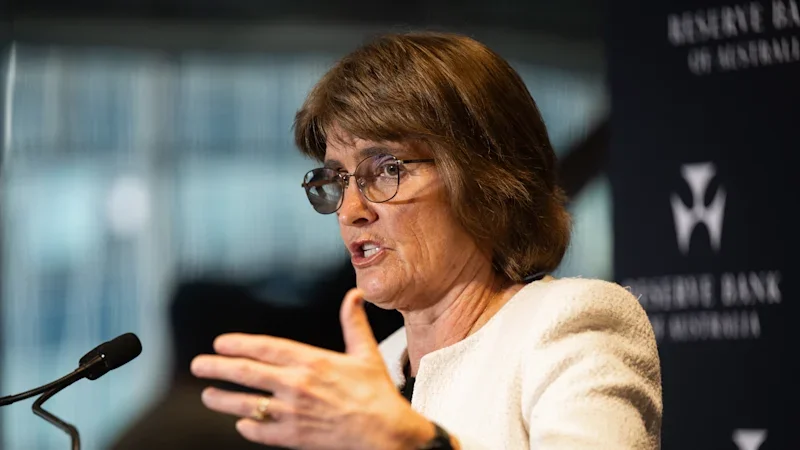
Reserve Bank governor Michele Bullock has put an interest rate hike on the agenda for the bank’s August meeting while warning that without a lift in productivity, Australians will struggle to get real wage increases.
In just her second formal speech of the year, Bullock told a charity event in Sydney today that while there were signs inflation had not lifted as high as feared following the surge in oil prices, it remained too high.
The bank has lifted rates three times this year, taking the official cash rate to 4.35 per cent. Bullock said the full impact of those rate hikes had yet to work their way through the economy.
But she made clear ongoing underlying inflation pressures remained a key concern for the bank’s board, which next meets on August 10 and 11.
“Against a backdrop of ongoing capacity pressures, the board remains focused on preventing elevated cost pressures from entrenching inflation,” Bullock said.
“This does mean that some further easing in the growth of demand is likely to be required if we’re to bring inflation back down sustainably to target.
“The board is prepared to act as required to achieve its mandate, including by increasing the cash rate further if needed.”
Bullock used her speech to warn about the long-term impact of poor productivity growth across the economy.
Australian productivity has flatlined since 2021 – with actual falls in areas including housing construction and mining – while a greater share of government spending is flowing into so-called “non-market” areas such as disability support, aged care and health.
Bullock said setting monetary policy had become more difficult for the world’s central banks over the past few years by major economic shocks such as the COVID pandemic and the Russian war against Ukraine.
But the slowdown in productivity growth had also made it more difficult to set interest rates.
“In Australia, these shocks have occurred against a backdrop of persistently weak productivity growth, which has weighed on real incomes and wages for many years. Reversing that is central to improving Australians’ living standards over the longer term,” she said.
“One thing monetary policy can’t do, however, is address the economy’s slow productivity growth.
“While this persists, the ability of the economy to grow without generating inflation is constrained, and Australians will continue to experience limited growth in real wages.”
Economists are unsure about key inflation figures to be released on Wednesday. The Reserve Bank had forecast it to reach 4.8 per cent by June, but most analysts believe both headline and underlying inflation will come in under the bank’s expectations.
Bullock suggested that while the economy may be a little weaker than the bank had believed it would be, the overall impact of poor productivity would weigh on the country.
“Domestic demand has eased broadly as expected and labour market conditions have softened somewhat,” she said.
“But with continued weak productivity growth, the economy can’t grow strongly without putting pressure on inflation. This is a fundamental challenge for the Australian economy over the next few years.”
While being bullish on interest rates, Bullock noted that overall demand in the economy is moderating in line with what the bank had expected, while the spike in oil prices had not generated the surge in inflation the RBA had feared.
Underlying inflation, she said, had evolved “broadly as we expected”, although it remained too high.
Bullock said the housing market had been weaker than anticipated, saying this reflected both the RBA’s three rate hikes earlier in the year and the federal government’s changes to property taxes.
Some commentators have raised fears of mass “negative equity”, the situation where a home is worth less than the mortgage over the property.
But Bullock said despite recent price falls, less than one per cent of all borrowers were in negative equity with a smaller proportion of that group facing difficulty on their home repayments.
“That is not to downplay that this would be stressful for those affected. But it does indicate that financial stability risks are contained, and borrowers, in aggregate, have built up considerable savings buffers over recent years,” she said.
Ahead of her speech, financial markets put the chance of a rate hike next month at one in three.