India will never be the same after July 20.
Something moved, something changed in a country that had for too long been broken by fear and hate.
We saw the beginning of the mending of this fractured land.
And this was accomplished by the uprising of hundreds of thousands of young people around the country, young people of every faith, caste, class, language and culture. They were the satyagrahis of the Instagram generation.
The July 20 march to parliament
On July 20, the morning when the protesting students had announced a march from Jantar Mantar to the national parliament, I reached the protest site early. Young people had already begun to pour in massive numbers from the night before. All efforts by the police to block the passage of young people to the protest site had failed: their usual playbook of road blocks, closure of metro stations, jamming of the internet and a massive display of armed police and paramilitary soldiers.
The crowd still swelled well beyond the furthest expectations of both the organisers and the security establishment.
The surging gathering became restive when some of the leaders tried to discourage the march to parliament, fearing for their safety. But the young people were determined: their only response was the chant, “Sansad, Sansad, Sansad!”
The march could no longer be halted. And as I walked in the middle of this huge surge of young humanity, I had a powerful sense that I was witnessing history being made.
I was stirred first by the sheer diversity of the crowd of which the average age was 20. Every section of young India was represented here. Hindus, Muslims, Sikhs, Christians, Buddhists, Dalit, Adivasi, people of every caste, language and identity, men, women and other genders, elite, middle class and working class. There was even an animated group communicating in sign language.
A young man who I walked beside for a stretch asked me, “Have you before this in your long life ever experienced a mass uprising like ours?”The young people were immensely conscious – although often without clear articulation – of the rare worth of what they were setting out to accomplish.
What was in effect a leaderless crowd displayed both discipline and a sense of purpose. Volunteers emerged. They regulated themselves. I often heard them reminding each other of the importance of non-violence and of remaining calm.
Police assault on the students
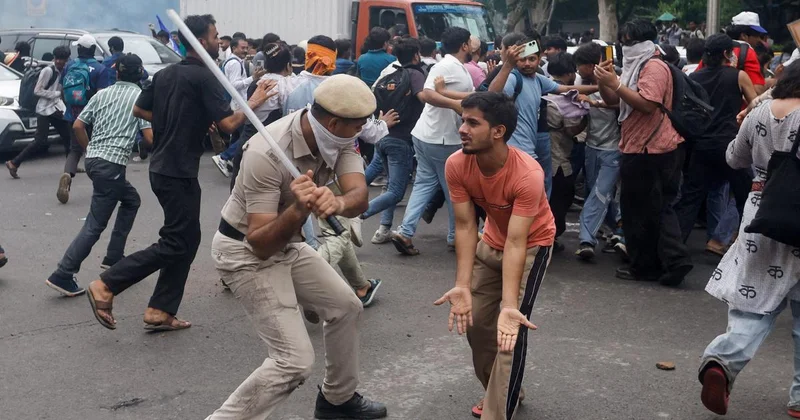
And then the police bared their faces, and fell upon the crowd of marching students. They were armed with batons, some of these rendered more dangerous with nails and electric shocks, and with tear gas shells and pellet guns. They brutally assaulted the students, and male policemen even attacked women, sometimes tearing their clothes and groping their bodies.
The young people had of course never experienced anything remotely like this in their lives. But their instincts were extraordinary. They reached out to protect those who were near them, often at great risk to themselves. These were frequently strangers. Their religion, caste, class, gender, language – none of this mattered at that moment. What mattered was that they were all in this together. Men protected women, and many women protected men.
The police stopped at nothing. It lobbed stones to discredit the students. It even fired pellet guns that could blind the protesting students.
Fight back in a carnival of protest
The brutality with which the police had turned upon the country’s children shook the conscience of the nation. The next evening, I decided to drive to the protest site in a small personal bid to offer solidarity to the battered young people who I expected to be demoralised and frightened.
But what we encountered, when my wife and I reached Jantar Mantar, staggered and exhilarated us. The mood was far from sombre. It was a carnival of defiant protest.
The state had entirely miscalculated the mettle of the young. The police violence had only made them much more determined. The students who had been beaten by the police were back at the protest site with their bandages. Th ousands more had joined them. And their anger had shifted entirely to one target, and this was prime minister Narendra Modi.
Their anger they expressed through an outpouring of creative satire lampooning the prime minister. Many held up their posters posing with Melody chocolates in their mouth, making fun of the gift he had made of Melody chocolates to the Italian prime minister Giorgia Meloni.
One poster said, “Bure din hi acche the”. The “bad” days were much better than the promised “good days'“. Another, “Democracy Ha Ha Ha”. “They try to bury us, they don’t know we are seeds.”
A poster showed Modi and his cabinet colleagues dressed in British colonial army uniforms with the words “Hamare Zamane ki East India Company” – the East India Company of our generation. One was titled “List of 5 Best Works by Modi”, was followed by a blank sheet. Another poster showed a skeleton with the words: “Waiting for government exams that do not leak.” And a lovely one, “Proud mother of a cockroach.”
Many posters mocked the massive scandal of temple trust authorities stealing the temple offerings to the Ram Temple in Ayodhya. One showed Modi begging Lord Ram to save him. Ram replies, “First return my money!” In another, a young man describes his plight in the Modi era. Before appearing for a competitive examination, he drove his scooter to the temple and made a cash offering. But the paper leaked, the government added ethanol to the petrol for his scooter, and the money he had donated to the temple was stolen by the temple priest!
Many protestors also joked about the absurd claim that the protest was funded variously by Pakistan, China and the perennial bugbear George Soros. One young man stood on the dais announcing that he was definitely funded. Pakistan had paid his bus fare from the hostel, China the metro fare. He hoped maybe Nepal would pay his return fare!
I loved a poster held up by a scowling young man. It read: “No one funds me. I hate this corrupt government for free!”
And there was an explosion of songs, dances and feverish slogans created for the occasion. These pierced the humid night sky as a challenge to the hubris of all unaccountable authority.
The protest site – just like in the site of the 13-month farmers’ protest at the borders of Delhi in 2020-’21- also grew quickly into a site of friendly sewa or service. At every turn, young people would smilingly urge you to accept food packets, burgers, cold drinks and water bottles. Young doctors volunteered to help treat wounds or participants who collapsed briefly with heat exhaustion. Another group of young people took on the role of picking up the litter. Volunteers regulated the crowds.
There was humour here as well. A young man urged us to accept a banana. When we politely declined, he said, “You cannot refuse. This is the prasad from Modi’s tehervi (his 13-day funeral prayers)!”
People from around the country ordered food from food delivery apps to be delivered to any of the assembled protesters at Jantar Mantar. I loved a cartoon by Sandeep Adhwaryu depicting the police interrogating a delivery man. Who ordered this, he is asked. The reply – India. What’s the destination? Reply – Democracy. Who’s paying for this? – is the next question. The delivery man replies – Hope.
Gurudwaras also organised meals and both gurudwaras and mosques opened their doors to the young people who had travelled long distances to join the protest and those who were injured.
Meanwhile, the police responded in the only way that they knew. They began to pick up young people randomly – sometimes even pulling them off autorickshaws – and detaining them in police stations, threatening that their careers would be destroyed.
Our young lawyers stayed awake many nights trying to free the young people – sometimes as young as 18, frightened about what they would do if their parents found out. The food outlets were warned against accepting food delivery orders to the protest site. The gurudwaras and mosques were directed to not open their doors to the protesting students. Delhi University, the IIT and then educational institutions around the country issued warnings to the students to not join the protests.
But nothing worked. The young people and students just continued to crowd their protest site, with their funny and defiant posters, their friendship with strangers, their offers of food, their slogans, their dancing and singing.
Defying the police
What began as a protest just in Delhi quickly spilled to cities around the country. A friend began to compile the cities where the protest spread overnight. His began his list with this: Kurukshetra, Chandigarh, Jammu, Dharamshala, Jaipur, Jodhpur, Lucknow, Prayagraj, Unnao, Rampur, Bhopal, Indore, Ahmedabad, Surat, Mumbai, Pune, Patna, Bilaspur, Raipur, Indore, Kolkata, Jadavpur, Bangalore, Davangere, Kalaburgi, Guwahati, Aizawl, Itanagar, Shillong, Agartala, Hyderabad, Visakhapatnam, Vizianagaram, Rajahmundry, Chennai, Thiruvananthapuram. And then he gave up. The list kept growing every hour.
Their defiance of the police attempts to terrorise them were delightfully cheeky. Young women would walk to the policemen surrounding the protest site and ask, “Uncle ji, do tell us when you plan to beat us up next. You see, I will then wear shoes, because last time my chappals got lost in the melee!” Many young men would hold up posters, “Police, why have you not beaten us up yet?” A man in Bihar turned to the police contingent to ask, “Uncle, why have you not used teargas yet? I want to experience it”.
When police turned their water cannons on the protesting young men in Patna, they broke into a rain dance.
And there is this delicious video of a police bus packed with protestors stopping at a traffic light. A young person creeps up, opens the back door, and the students run out, free.
There was audacity and mischief, yes, but also raw courage. A woman in Mumbai saw a bus full of protestors, and just walked to the front of the bus, putting out her hands as a signal that she would not allow this bus to move. Many passing people cheered and joined her. The bus was unable to proceed.
Why did young people crowd the streets around the country?
In the midst of all of this, hundreds of people put out reels and painted posters to explain why they had joined the protest.
One poster read – “Now it is not just about the education minister’s resignation. It is also about protecting democracy.”
It was clear that the protest had far outgrown its original scope of demanding the resignation of the education minister for failing to control examination paper leaks. Young people were protesting because they did not see a future for themselves, and the government did not care.
More than a lakh government schools have been closed down. Those that remained were starved of the most essential resources. These cater to children born to India’s poorest families. Education budgets fell even below their paltry levels of the past. No university made it to any global lists of excellence. Teachers were recruited for subscribing to an ideology rather than academic competence. Universities had become stifling centres of mediocrity.
Even more grimly, there were no jobs. Unimaginable levels of wealth accumulated in the hands of just a few men – perceived to be the cronies of those holding power – but growth just did not yield decent work opportunities for the millions.
A young person of 18 or 20 years has only known a government led by Modi. It is probable that a large part of the demographic that came on to the streets were BJP supporters in the past. At least 40% of the youth had voted BJP in the recent national elections. If we exclude around 20% of minority youth, more than half of the country’s young Hindus voted BJP.
A young man in a protest site held up his bandaged index finger, saying, “It is good that the police fractured this finger. Because it is this finger that pressed the lotus button in the last elections!” The commitment of their parents to this ideology is even more likely.
The young people have long been fed hate against Muslims. Some of them may also have subscribed to this.
But their participation in the protests meant that they had set aside, and some may even have rejected the Hindu-Muslim binary. They were telling the government – get down to work. Make our lives better. Mend our education system. Design the economy in ways that ensure jobs for the millions.
The protests went further even than this. It was not just an uprising against a government that they saw to be uncaring and corrupt. When young women were speaking out, screaming slogans and holding up posters mocking Modi, calling out the police, dancing into the night with male protestors, they were also rebelling against patriarchy, against their parents and elders, their WhatsApp uncles, and the constraints and bigotry that stifled their lives.
Is it correct to describe the student uprising to be a satyagraha in the Instagram era?
I am convinced that it is.
There are two essential features to satyagraha against an unjust state which Mohandas Gandhi had taught us. The first of these is courage, which was in abundant display. The students returned to the protest site after their battering by the police, determined to continue even if they were beaten again.
And the second is non-violence. This for me was also a luminous feature of the protest. When students were beaten by police batons, they did not hit back. I recall the image of a young man who kneeled before a policeman who was beating him with his baton, his hands folded, his head bowed, inviting him to beat him more.
It brought back to me sepia-tinted memories of the satyagrahas led by Gandhi, during which line after line of satyagrahis would march to the police. They would be beaten but would never raise their hands against the policemen or run away. And more would come to take the place of those who had been beaten down.
I saw a lot of anger against the government and a penetrating, aching sense of betrayal. But never hate.
The grammar of resistance that young people adopted was their own – with memes, irreverence, satire, laughter, reels, memes, songs and dances. It was vastly different from the more serious and contemplative mood of satyagraha and resistance movements of earlier generations. However, it was marked by the same courage and the absence of hate.
Breaching the citadel of fear
I said at the start of this essay that India has changed since July 20. In what ways? Has India turned away from the republic of fear and hate into which it had been transformed?
One change is undeniable – and I hope enduring – and this is the breaching of fear. Young people are hectoring, challenging, even abusing Narendra Modi, displaying their faces. This would have seemed impossible before July 20. There would have been too much fear of the repercussions. Their parents, teachers, friends would have restrained them. They would not even have allowed themselves to do this.
But suddenly Mr Modi’s citadel does not seem so impregnable. Suddenly they see Modi as the fountainhead of the authority of the state that has so profoundly failed them. Suddenly they see him also as vulnerable and worthy of lampooning.
Have India’s young left behind the politics of hate?
However, has India thrust behind the project of hate targeting Muslim and Christian minorities with persecution, violence and expulsion? Of this I am not so sure.
Two messages on social media really lacerated me.
One message was addressed to a young man with a name that sounded Muslim who was fasting with his other friends. The message said, Mat kar, mat kar mere chhote bhai. Baqi sab bach jayenge, par teri zindagi barbad kar denge. (Don’t, don’t, my younger brother. The others will all be saved. But your life they will destroy).
Many young Muslim friends said that they longed to join the protests but held back for exactly this fear. Their fears were not unfounded. My young lawyer colleagues spent sleepless nights at the Nizamuddin police station to try to free the large numbers of students from Jamia who the police specially targeted.
From the first day of the protest on June 20, a young man Junaid of visible Muslim identity in a skullcap and white kurta pyjama set up a stall to serve water, tea and snacks free to the protestors. He continued this for all 34 days of the protest. But the evening when the education minister resigned and the protest ended in victory, the Uttar Pradesh police detained both his father and his sister’s father-in-law, and threatened to not release them unless Junaid surrendered before the police. One piercing poster came up – “Jab jab Modi darta hai, ek Junaid arrest hota hai.” But until I write, the leaders of the movement have not stood by Junaid.
The other message that wounded me said – “Remember this. Your parents hated Muslims more than they loved you. Remember this.”
When the young people, so justly triumphant after their historic victory against the state, return to their homes, to their parents, to their everyday lives, to their older social media feeds, will they continue to remember this? Will they stand now against hate and prejudices the next time this is thrown at Muslims - in their living rooms, their classrooms, their workplaces, their Instagram feeds?
We must be mindful that this is not the first protest uprising of students and young people. There was another, no less brave. In December 2019, Muslim and left students rose up in protest against the discriminatory Citizenship Amendment Act. At that time, the police beat up and jailed students in the Jamia university library, and lobbed stun grenades normally used against terrorists into the hostel rooms in Aligarh Muslim University. Students who led the protests then were jailed for many years without trial. Umar Khalid and Sharjeel Imam still remain in prison for the sixth year although no court has found them guilty of the crimes that they are accused of.
Some questions hang unanswered in the air. Why did the state not negotiate with the protesting students as they did in 2026? Why did they not assure the young people of India that no student would be targeted for protesting?
These wounds run very deep, and so far the targeted students of Muslim identity have felt profoundly alone. Will this change now?
I spoke of July 20 as the beginning of the mending of a country broken by years of fear and hate. I feel confident that the fortress of fear has been breached and will crack and fragment.
But will the same cracks appear in the fortress of hate?
A young Muslim man stood with a poster challenging the trope thrown at Muslims routinely: Go to Pakistan. He asks – “why should I go to Pakistan? This is my home. I love my country enough to admit that it is broken. I’m not going. I’m staying to fix it.”
I hope that this time round, this young man does not feel alone.
Harsh Mander, peace and justice worker and writer, leads Karwan e Mohabbat, a people’s campaign in solidarity and support to victims of hate violence. He is a visiting faculty in the South Asia Institute, Heidelberg University. His recent books are Under Grey Smoggy Skies: Living Homeless on the Streets of India’s Cities; and A Matter of Life and Death: The Unfinished Journey to Secure Healthcare for All.
We welcome your comments at letters@scroll.in.