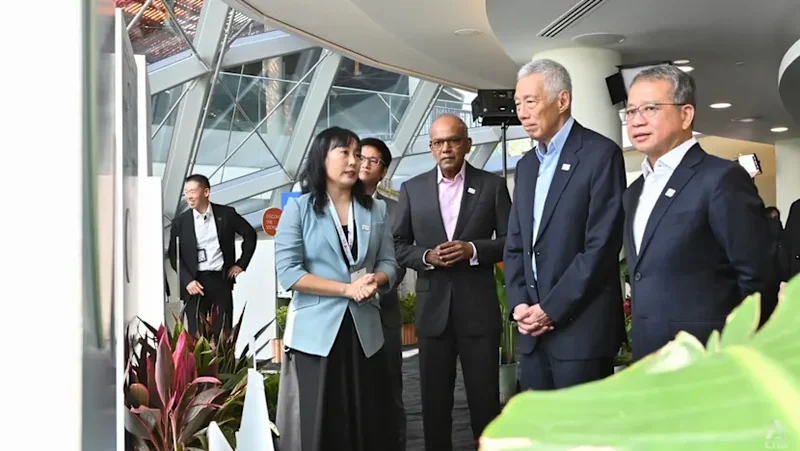
Singapore's rule of law a ‘continuing endeavour’ as future generations face unfamiliar challenges: SM Lee
He was speaking at the launch of a book series by the Ministry of Law, which looks back at the past 25 years of law reforms in Singapore.
SINGAPORE: The rule of law in Singapore is a "continuing endeavour" for future generations as they face novel and unfamiliar challenges, such as artificial intelligence, online harms and misinformation, as well as climate change and geopolitical uncertainty, Senior Minister Lee Hsien Loong said on Tuesday (Jul 28).
While the country has been served well by sound laws, strong institutions and civic trust, Mr Lee said the rule of law "is never a finished project" amid these challenges.
"Artificial intelligence will raise new questions about accountability, responsibility, and human agency. Digital technologies will continue to test established legal concepts," said Mr Lee, adding that there will be difficult policy and governance challenges arising from demographic shifts, climate change and geopolitics.
"Such issues will not have straightforward answers," he said.
To that end, Mr Lee said the next chapter of Singapore's legal story is not about preserving what was inherited, but will be about building upon its foundations "to keep our laws relevant, our Constitution fit for purpose, our institutions trusted, and our society imbued with the values and norms that make the rule of law possible."
Each generation must adapt the legal system to new realities and pass it on, "updated and improved", to the next generation, he added.
Mr Lee was speaking at the launch of a four-volume book series documenting Singapore's legal reform journey over the past 25 years, held as part of SGLaw200, which marks the 200th anniversary of the country's modern legal system.
Held at the Gardens by the Bay, the event was attended by about 200 guests, including members of the legal sector, as well as the editors and contributors to the series. The four-volume series covers criminal, public and family law; civil justice, restructuring and insolvency, and intellectual property; international dispute resolution; and legal innovations and the COVID-19 pandemic.
Mr Lee delivered the keynote address alongside Minister for Home Affairs K Shanmugam and Minister for Law Edwin Tong.
Mr Shanmugam noted that parliament has passed close to a thousand bills in the past 25 years, adding that about 20 per cent of those were handled by MinLaw.
On the significance of these legal reforms, Mr Tong said they are not abstract legal exercises, but "have strengthened institutions, supported our businesses, and improved lives, shaping the social compact that we enjoy."
They also reflect Singapore's philosophy that law reform is "never pursued for its own sake".
"It is undertaken to strengthen trust, to support progress, and to ensure that our legal system continues to serve the needs of both Singapore and Singaporeans."
LAWS MUST KEEP PACE WITH CHANGE
In his keynote speech, Mr Lee highlighted how today's challenges are vastly different from those faced by Singapore's pioneers.
He noted that technology has transformed how people live and communicate, economic activity has become more global and complex, social norms and expectations of governance have shifted, while new physical and digital threats have emerged.
"To sustain the rule of law, our legal system must keep abreast of all these changes," he said.
Law reform has never been treated as an occasional or one-off exercise. Instead, each generation must review the legal system it has inherited, decide what remains "fit for purpose", update or repeal outdated laws, and design new ones to address new circumstances.
Mr Lee said the book series chronicles one chapter of that continuing journey while examining a broader question of what a good legal system should achieve. In that regard, laws must fulfil four broad functions.
They must address enduring national imperatives such as safeguarding racial and religious harmony, responding to new challenges like online harms, responding swiftly in times of crisis and also addressing social change, such as evolving values and norms.
On responding swiftly to crises, Mr Shanmugam said the first COVID-19 legislation was conceptualised and drafted in a record nine days.
"We were introducing novel legislation, with no precedent anywhere in the world with impact on thousands of people, commercial tenants all across Singapore, couples who had paid deposits to hold weddings, receptions in hotels and restaurants, others who had made event bookings. The economic impact was tens of billions of dollars," Mr Shanmugam said.
The legal framework was amended eight times as conditions on the ground evolved, Mr Shanmugam said, adding that more than S$100 billion (US$77 billion) worth of contracts were impacted.
He said the measures provided swift and practical relief to tens of thousands of people, including businesses, commercial tenants and couples whose weddings were disrupted by the pandemic.
As for how laws should respond to social change, Mr Lee cited the example of how Section 377A, the law that criminalised sex between men, was repealed in 2022.
Alongside the repeal, the Constitution was also amended then to affirm parliament's authority to define, regulate and support the institution of marriage.
Mr Lee said the Section 377A debate demonstrated a distinctive feature of Singapore's approach to law reform.
"Instead of going for winner-takes-all outcome, we accommodated opposing concerns. Instead of treating dissent as something to be quelled, we managed it constructively.
"And instead of allowing a divisive issue to fester into a lasting social schism, we worked to preserve the common space where Singaporeans with different convictions could continue to live together harmoniously and with mutual respect."
Mr Lee then went on to say that the Constitution itself cannot remain unchanged indefinitely.
While constitutional amendments require a higher threshold than other legislation, constitutional arrangements must continue to serve Singapore's changing needs by providing an effective framework for governance, accountability and the protection of fundamental rights, he said.
STRONG INSTITUTIONS, CIVIC TRUST ESSENTIAL
Beyond legislation, Mr Lee stressed that the rule of law depends on institutions that can translate legal principles into reality.
Good laws alone are insufficient, he said.
The rule of law flourishes only when legislation is translated into a functioning system that enforces these rules, ensures law and order, and enables the efficient conduct of business, he said.
Ultimately, society plays a critical role, added Mr Lee.
For laws and institutions to function effectively, citizens, businesses, public agencies and community organisations must embrace values such as trust, responsibility, restraint and mutual respect, he said.
"The rule of law requires a shared understanding and acceptance that serious disagreements should be resolved through legal processes, that legitimate institutions acting lawfully should be respected and obeyed, and that rights must be balanced with responsibilities."