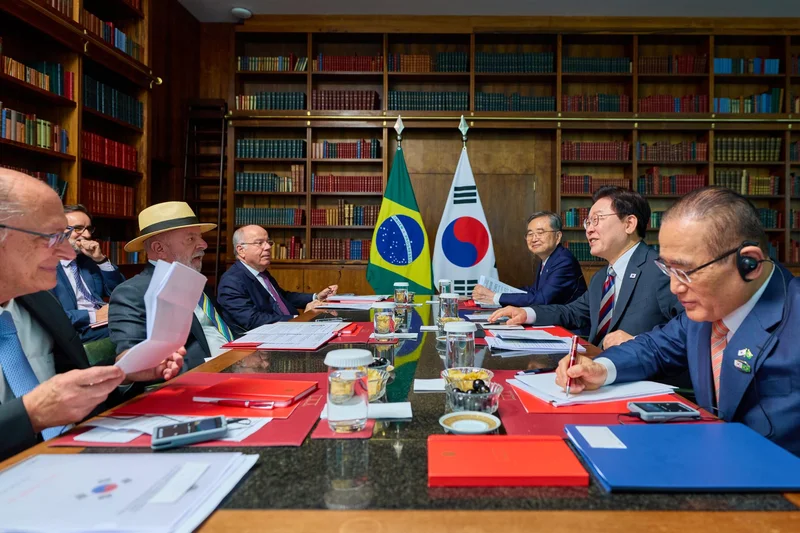
SAO PAOLO — Korean President Lee Jae Myung and Brazilian President Luiz Inacio Lula da Silva agreed to further enhance their countries' strategic partnership, also stressing the need to resume negotiations for a free trade deal between Korea and the South American trade bloc Mercosur, presidential spokesperson Kang Yu-jung said Tuesday.
Lee and Lula met Monday in Brasilia, their second bilateral summit this year following their February meeting in Seoul.
The two leaders adopted a joint statement, in which they stressed the need to further enhance their countries' cooperation as strategic partners linking South America and Asia that will help both sides tackle various complex challenges in the international community, the spokesperson said in a release.
They had agreed to upgrade their countries' relationship to a strategic partnership when they last met in February.
Lee and his Brazilian counterpart also highlighted the need to resume negotiations for a trade pact between Korea and Mercosur, to which Brazil is a member.
To this end, the leaders agreed to launch a joint working group that will work to declare the resumption of negotiations for a Korea-Mercosur trade deal at the upcoming summit of Mercosur states in December, according to Kang.
Korea and Mercosur began negotiations for a trade deal in 2018, but the talks have stalled since late 2021.
Mercosur is one of the world's largest trade blocs, whose members include Argentina, Paraguay, Uruguay and Bolivia, along with several associate members.
Lee is currently on a three-nation South America tour that will also take him to Argentina and Chile. His state visit to Brazil, which began Sunday, comes amid Seoul's efforts to diversity its trade portfolio as part of efforts to address shifts in the global trade environment.
Lee and Lula also agreed to expand mutually beneficial cooperation across the entire critical minerals supply chain by combining Brazil's abundant critical mineral resources with Korea's state-of-the-art industrial and technological capabilities, Kang said.
At the start of their meeting in the Brazilian capital, Lee pointed out that Brazil is the primary destination for Korean corporate investment, asking for Lula's support in helping Korean firms invest stably and expand their businesses in Brazil.
In response, Lula hailed Korean firms' contributions to his country's economy and industry, pledging active support to ensure they can expand their investments and conduct business activities in a stable manner.
In a joint press announcement after their summit, Lula invited Lee to visit Brazil again in September to attend the scheduled joint launch of a space launch vehicle at Brazil's Alcantara Space Center.
Lee responded that he hopes to attend the launch in person, adding, "I will watch virtually if it is impossible (for me to come)."
The summit was followed by a music performance and a reception hosted by the Brazilian first couple at the Itamaraty Palace, the foreign ministry headquarters.
Along with the Korean and Brazilian leaders, executives from more than 10 Korean companies operating in Brazil attended the reception, including those from POSCO, Korean Air, Samsung Electronics and Amorepacific Corp., according to Kang.
During the reception, Lee conveyed his commitment to Korean business leaders to proactively support their efforts to expand into new markets and explore new business opportunities through economic diplomacy, the spokesperson added.
In the guest book, Lee wrote, "I hope we can open the future together toward everlasting friendship and shared prosperity between Korea and Brazil."
On the occasion of Lee's visit to Brazil, the two countries signed seven memorandums of understanding (MOUs) aimed at strengthening cooperation in aerospace, supply chains and cultural sectors.
One of the MOUs, on aerospace cooperation, aims to streamline regulations and procedures for Korean firms using Brazilian launch facilities while pursuing cooperation in lunar exploration, the space sector and satellite data sharing, according to Seoul's presidential office.
Under the signed MOUs, the Korean government will also strengthen supply chain cooperation and expand exchanges in education, sports and the film industry.