- Published
A planned solar panel installation has drawn criticism due to it being proposed for a what is believed to be a greenfield site.
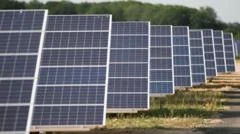
If approved, the installation in St Sampson would see 72 ground-mounted panels on agricultural land which has had no previous permanent construction on it.
Critics said the choice of site was inappropriate because of wildlife concerns, and that the roof of the applicant's house beside the proposed site would possibly be more suitable.
The applicant told the BBC he disputed it was a greenfield site and there had been greenhouses on the land which were later destroyed and buried. No decision date is currently set.
Islander Chris Chadwick said he was against the application, saying: "It just didn't gel with me that they were going to cover a greenfield site with solar panels."
He said he was "all for" renewable energy sites "but not at the expense of covering the greenfield sites".
"They've got a very large house there that they could put solar panels on the roof."
He said there should be an emphasis on "preserving natural field which provides habitat for insects, bugs, moths and caterpillars that need to incubate underground there."
"The greenfield sites that Guernsey is losing, they're not going to make more of them," he added.
However, applicant Mr L Shephard told the BBC he disputed the area was a greenfield site.
He said, due to the former presence of greenhouses on the land, which then were destroyed and buried under a layer of top soil, it was reverted to agricultural designation.
He said the site was also now not suitable for agriculture due to the presence of buried structures, and that the solar equipment would power his house and up to seven other properties.
However, Simon De La Rue, commercial director for renewable energy company Little Green Energy, said there were "many obstacles" to putting panels on houses.
Having had "a brief look at the roof space" on the applicant's house, he said things such as dormer windows could reduce roof space, meaning "less panels" could be installed.
De La Rue stated that, for the "same amount of cost in terms of labour, wiring and access", it would mean the "levelized cost of energy is going to be very high whilst also not meeting the property's electrical demands".
He said planners needed to look at allowing people to "reduce their reliance on the network but do it in a cost-effective way".
"What we all need to look at is how can we achieve that whilst looking after and protecting our natural environment," he said.
He added that he believed that "good planting policies when it comes to biodiversity" around the solar panels and ensuring that "infrastructure that's going in the ground is low impact" could be a solution.
"There are ways to do it in a sensitive manner", he said.
De La Rue also said he believed installing solar panels on greenfield sites should be decided on "a case-by-case basis".
Follow BBC Guernsey on X, external and Facebook, external and Instagram, external. Send your story ideas to channel.islands@bbc.co.uk, external.