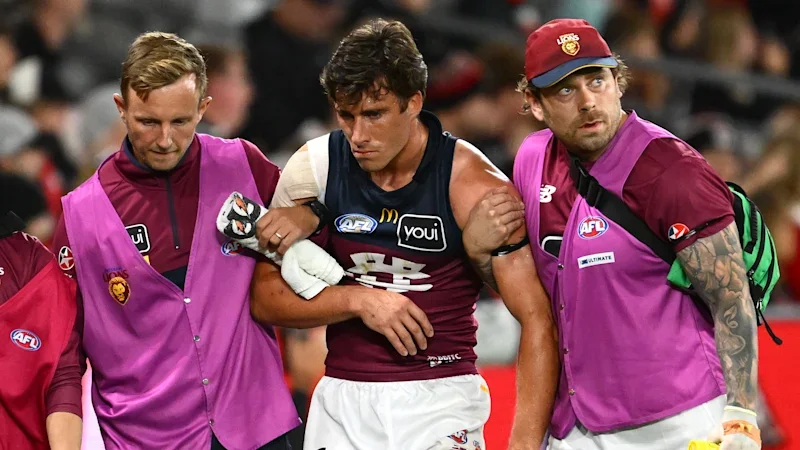
Even after suffering two concussions within three weeks, Noah Answerth insists the thought of premature retirement has never crossed his mind.
“Not really, no. Concussion is going to happen in our game, I guess, and you can’t really help it – I signed up to play,” he said.
“I got concussed when I was a young kid playing, and I just love the game, so concussion isn’t really going to stop me from getting my chance to play AFL.”
After copping a knee to the head in round three against St Kilda and missing two weeks under concussion protocols, Answerth suffered another blow upon his comeback against Melbourne, leading teammate Harris Andrews to voice his concern for the 26-year-old’s wellbeing.
The Lions were diligent in his recovery – sidelining him for five weeks – and he has returned to become a pillar of Brisbane’s top-four charge.
Having averaged six touches and 1.6 rebound 50s in his first five games of the season, his past six have yielded 14.17 disposals, 2.5 rebound 50s, and 2.5 tackles an outing.
Ahead of his 100th AFL appearance on Saturday, against Carlton, Answerth revealed it was other injuries – a ruptured Achilles suffered at Marvel Stadium last year, and a back concern from his teenage days – that had left him fearing this milestone would be unattainable.
“When I was 17, I fractured my L1 vertebrae. I thought about not playing ever again after that, but just the confidence [my coaches] had in me to keep going, and obviously Brisbane to take a chance … I’m lucky enough to still be here,” Answerth said.
“The club looked after me really well [during the concussions]. Coming back from my Achilles as well, it gave me a bit more time to prepare and play at the level I wanted to.
“I think coming back, you’re a bit hampered from the Achilles, and a bit slower, and it probably affects you a little bit, so having that time actually allowed me to probably improve.
“I haven’t had any effects. I’m happy and love playing footy and working and studying. If anything, it’s probably put myself more into focus.”
Concern for the long-term impacts of head trauma is at an all-time high, with young Lions defender Ty Gallop drawing the ire of pundits after he tackled Port Adelaide rival Mitch Georgiades.
Georgiades had just returned from a concussion lay-off, and the sight of Gallop appearing to slam him back down, with his head hitting the turf, garnered a serious misconduct charge, for which he will face the AFL Tribunal on Tuesday night.
“For Ty, it’s a competitive game, and we all try and be competitive. Sometimes you may have a brain fade like that, which is always hard, but you don’t mean it in that way – sometimes you’re playing the game and things happen,” Answerth said.
“I think he’s a gentle giant really, he’s doing a lot of work with Harris – I actually sort of see him as that Harris Andrews-type of character.
“I daresay he’ll be a very good leader for us in the future … [the incident] was very out of character.”
According to the AFL Players’ Association’s Insights and Impacts Report, 82 per cent of players had a “high level of concern” for the long-term implications of concussion.
While 86 per cent reported their concussions, a fifth still “somewhat, or completely, downplayed the severity of their symptoms”, with concerns about losing their spot on the team the overwhelming reason.
With each instance of concussion, according to UQ’s Queensland Brain Institute expert Professor Fatima Nasrallah, the likelihood of further concussions increases. That is why she has a greater fear for those playing at the grassroots, where there is less attention and medical support.
Nasrallah is nearing the end of a three-year study into adolescent concussions to find a more concrete biomarker assessment of a head trauma, but said a cultural stigma hindering concussion reporting made recruiting participants a challenge.
She appealed for greater funding to be injected into schools and junior clubs to ensure they are better equipped to protect and inform athletes.
“You’ll go to a game which has under-12s – if it’s soccer, they’re heading the ball; if it’s rugby, they’re going full force – and there is no mandate for them to actually follow guidelines,” Nasrallah said.
“We know the developing brain is a lot more vulnerable to change. A lot more effort has to go into the children to change the culture – it’s peer pressure, it’s wanting to have a career in the space.
“People are reluctant to be involved in research studies because the moment they label themselves as having a concussion, they can’t go back to play. Parents don’t want to know about it – the children are influenced by the parents – and there has to be a change in culture from an early age.
“If you look at a broader scale, particularly in regional and remote areas, you’ll find that number is much higher in terms of the under-reporting.”