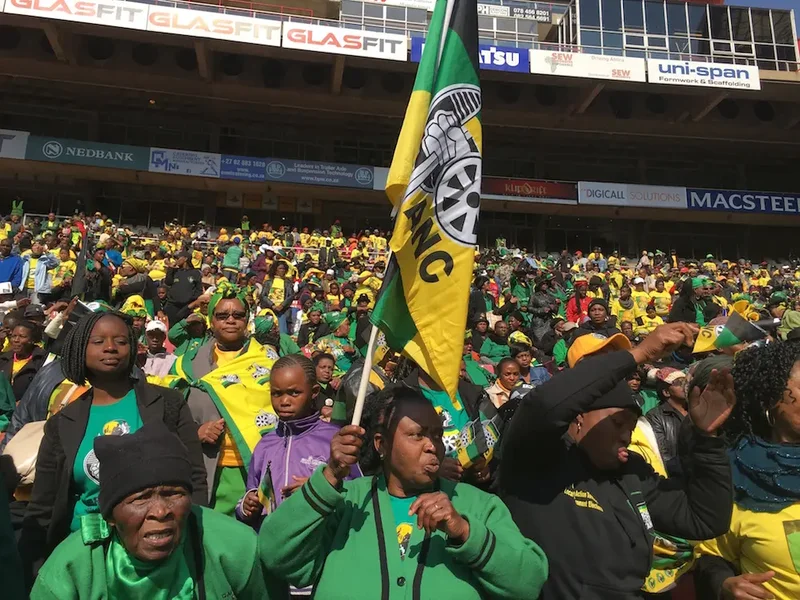
Last week, Thabo Mbeki stood before the Thabo Mbeki Foundation's African Renaissance Podcast Seminar and said something the ANC has been saying, in one form or another, for fifty-seven years: "National democratic revolution is about two things. It's about national liberation, the liberation of the oppressed, and it's about democratic rule. Political liberation is not sufficient; it has also to be economic liberation." He was not the only one arguing about it this year — a sociologist, an activist, a former Youth League leader and a sitting Cabinet minister have all answered him differently in print, within months of each other. Fifty-seven years on, the argument about what it actually means is getting louder, not settling down.
The phrase comes up constantly — January 8th statements, conference resolutions, the language of praise and the language of attack alike. It has been called a Trojan horse for socialism, a euphemism for expropriation, the movement's moral compass, and its most convenient excuse. But what is the National Democratic Revolution, where did it come from, and how far has South Africa come in achieving it? That last question does not have an answer yet.
Morogoro, Tanzania, 1969. Just over seventy delegates, ANC branches in exile, units of Umkhonto we Sizwe, the Indian and Coloured congresses admitted to ANC membership for the first time at this same conference. Oliver Tambo chaired; Albert Luthuli, the president in title, was banned and immobilised at home. Mandela was two years into a life sentence on Robben Island. The conference came off failure, MK fighters killed or captured crossing into Rhodesia the year before, none reaching South African soil.
Out of that reckoning came Strategy and Tactics, the document that gives the National Democratic Revolution its name. Liberation could not mean the vote alone: "It is inconceivable for liberation to have meaning without a return of the wealth of the land to the people as a whole... does not represent even the shadow of liberation." Four years earlier, at Kliptown, the Freedom Charter had already said as much: "The People Shall Share in the Country's Wealth." "The Land Shall Be Shared Among Those Who Work It." Not slogans. Inventories, naming specific things, land, minerals, banks, soil, water, and specific people meant to hold them.
Twenty-five years between Morogoro and freedom, the United Democratic Front inside the country and sanctions outside it forced the same argument into practice: political power had to be won, and economic power forced with it. What came in 1994 was Stage One, real, won at real cost. But the revolution was never only about the vote. Economic freedom, the return of the wealth of the land, without which liberation is only its shadow, remains the unfinished task.
That admission keeps being made, and it keeps meaning something different depending on who is making it. Mbeki calls the sustained hollowing-out of the state since 2008 a Counter-Revolution, tracing its lineage back through apartheid's own security apparatus. Devan Pillay reads it as design: 1994 produced an elite pact between white capital and an aspirant black elite, the revolution's language repurposed to hold the Alliance together. Kefentse Mkhari blames weak institutions and lost discipline; Andile Lungisa calls it progress interrupted, needing renewal, not a structural reckoning. Four diagnoses of the same gap, and none of them, on their own, closes the argument.
Numbers do not argue back. Since 1994, millions gained electricity, water and sanitation for the first time. Grants reach over eighteen million people. And still: 32.7 percent unemployment, youth unemployment above sixty percent, a Gini coefficient barely moved in a decade despite one of the most redistributive fiscal systems in the world. Something in that gap is not being asked.
Much of the country's wealth leaves without beneficiation, a pit-to-port economy built to move bulk mineral material out, the value captured elsewhere. Underneath the industrial policy meant to fix that sits the same trickle-down assumption GEAR was built on: grow the economy first, and jobs will follow. They have not. Mining extracts; it does not replenish. What has not yet been attempted at national scale is a different relationship to what the country has, an economy built from assets that regenerate rather than deplete: water, soil, people, knowledge.
Sixty years of this argument has mostly been a fight over the ownership of wealth, who holds the title, who sits on the board, rarely a fight over how wealth is actually created. Rivers are wealth. Soil is wealth. A community's skill at working its own land is wealth: capacity that turns into something people need, year after year. Money measures wealth. It has never been the wealth itself. Somewhere in sixty years, the country stopped debating how wealth is made and settled for arguing about who owns it. That question has an answer. It has simply never been part of the argument.
Where the theory could finally be tested
Kharivhe is a community in the Western Soutpansberg, Limpopo, farming the slopes above the Muengedzi River since the seventeenth century, evicted outright in 1973 under apartheid legislation dressed up as administrative reorganisation. They filed a land claim in 1996. The land, over nine thousand hectares, was formally restored to the Kharivhe Communal Property Association in 2011.
The statistics show poverty spread across the whole district: unemployment above a quarter of the working population, closer to half among the young. The land itself makes the statistics stop making sense: the Muengedzi still running, depleted, and the surrounding slopes potentially still capable of slowing, spreading, sinking and storing rain, a productive landscape, sitting idle, waiting on a plan that has not even been discussed, let alone committed to. The district's own bioregional plan has sat approved but ungazetted since 2017. A Landcare-style programme that once existed to do exactly this kind of work has faded into obscurity.
The wealth was never missing from Kharivhe. It was made structurally unusable, first by eviction, then, once the title came back, by policy failure and an absence of capacity development. Swales to hold rain instead of losing it to runoff. Rebuilt topsoil. A river that only comes back once the land above it can hold water through a dry season. That sequence was never addressed, funded, or planned.
If the return of wealth Morogoro spoke of meant only ownership, a deed changing hands, then Kharivhe should be one of the National Democratic Revolution's clearest successes. Fought for. Restored. Fifteen years ago. And still nothing grows there that generates an income for the people who hold it. Restitution, on its own, did not restore anything except the paperwork. Ownership was never the missing ingredient. Restoration was. Wealth is not the deed. It is the water still running through the Muengedzi, or not. It is whatever that water and that soil could still be made to grow, and none of it has been. Kharivhe holds the title and does not yet hold the wealth, because the two were never the same thing.
What Kharivhe needs is not a new legal instrument. It already has the only one that was ever supposed to matter. What it needs is the thing the Freedom Charter named in the same breath as land: "implements, seed, tractors and dams to save the soil and assist the tillers." Restoration as infrastructure, not conservation, swales, keyline ripping, check dams, converting a landscape from mostly-runoff to mostly-absorbed. Springs can recover, and topsoil can rebuild, faster than most people assume, though never on a fixed timeline; every landscape answers differently. The discipline is sequencing: capital builds the asset before anyone harvests against it, and that stalls almost every rural scheme of this kind, a precise description of Kharivhe.
Proper sequencing produces a staged route into income: people are put to work regenerating their own landscape first, real income, a floor, not an exit; fast-cycle household crops alongside the slower main asset next; and only then the exit from poverty, community equity in the mature asset itself, the only stage where the people who did the work end up owning what they built. None of it works without ownership built in from the start, through structures already in South African law: communal property associations, trusts, co-operatives.
This is not proof of concept, a handful of well-run pilots cannot, on their own, move a national unemployment rate. Only deliberate, intentional, watershed-based restoration, repeated and resourced at scale, can. And that raises the obvious objection: this is what every stalled rural development scheme has promised, on paper, for thirty years. What would make it different is not a new mechanism. It is redirecting instruments the state already funds and runs, public works employment, the Jobs Fund, departmental budgets already allocated to rural development, toward restoration as the actual output: the thing that stimulates, regenerates, and eventually industrialises the rural economy, not a road verge cleared and forgotten. Kharivhe did not fail for lack of an institution. It failed because none of the money already moving through this country's poverty alleviation architecture was ever pointed at building lasting value, rather than temporarily easing poverty.
This is what "economic emancipation... bound up with" national liberation actually looks like, worked through rather than asserted. Not a shareholding transferred on paper, the way Kharivhe's title created ownership but produced nothing, but ownership built into the labour of restoration itself. It answers the Freedom Charter's own instruction to the letter: the state helping the tillers make land already theirs productive, not requiring anyone's land to change hands a second time.
Sixty years after Morogoro, the wealth the Freedom Charter and Strategy and Tactics both promised to return has not gone anywhere. It is still in the ground, in the water, in the hands of the people who hold its title and still wait for what a title alone was never going to give them. Sixty years of policy, advocacy, resistance, bloodshed, governance, cadre deployment, corruption. Some paid the highest price for the principles the National Democratic Revolution set out to deliver. Slowly, those principles eroded into a slogan. Underneath it all sat the same assumption, largely unexamined: that the wealth in question was land as property and minerals as revenue, something to be owned or shared out once it was owned. Whether mining pays this country fairly is its own argument, not resolved here. But underneath even that sits a quieter one nobody has properly had: whether the deeper value in this country's water, its soil, its living systems, has ever actually been counted, or unlocked at all. Very few countries have built an economy that treats natural capital as capital rather than as scenery or extraction. Few were handed, in their own founding documents, an instruction this explicit to try.
Nicholas Heinamann is an ecological designer and regenerative development practitioner in Cape St Francis, Eastern Cape. He writes on land, water and the structural alternatives to South Africa’s growth model on Substack - Deep South Futures.