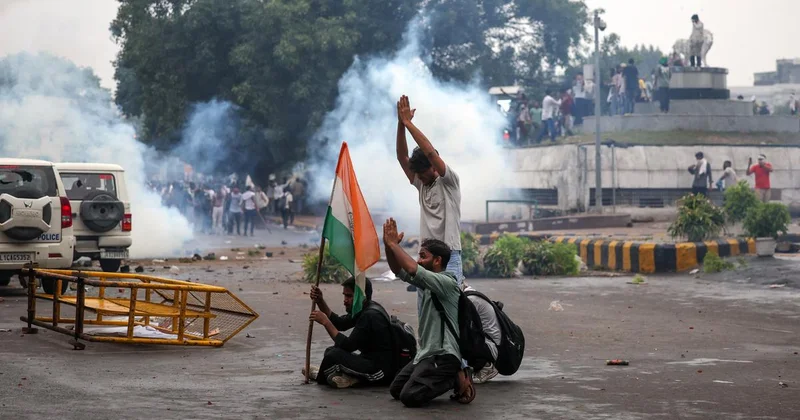
The Supreme Court on Tuesday directed states to release students arrested or detained during the youth protests, against the alleged irregularities in the conduct of competitive examinations, if they had no prior criminal record, Live Law reported.
A bench headed by Chief Justice Surya Kant was hearing a batch of petitions alleging that the police used excessive____ ____force against protesters marching to Parliament in Delhi on July 20.
During the protest, several demonstrators were injured after the security personnel used lathis, fired tear gas and pellet guns to disperse the crowd.
The petitioners also pointed out instances of the police in Bihar using excessive force against protesters who were demonstrating in solidarity with the youth agitation in Delhi.
On Saturday, three protesters were injured after the police opened fire on demonstrators in Bihar’s Siwan district.
Following this, a batch of petitions was filed in the Supreme Court, seeking nationwide guidelines to regulate police action during protests, including a ban on the deployment of plainclothes personnel for crowd-control duties.
The petitioners also sought guidelines to regulate the use of prohibitory orders under Section 163 of the Bharatiya Nagarik Suraksha Sanhita. The provision grants the authorities the power to issue orders in urgent cases of nuisance or apprehended danger.
Further, the petitioners urged the court to order an independent investigation into the police action during the July 20 protest in Delhi.
On Tuesday, the court observed that it would consider setting up a high-powered investigation team to conduct a “fair and independent” inquiry into the allegations of police excesses, The Hindu reported.
“The allegations made by the petitioners prima facie make out a case for an independent probe,” the newspaper quoted Kant as saying. “...the inquiry must be scientific and evidence-based. We do not want only prima facie findings.”
The bench also directed the police authorities to preserve all CCTV footage, drone footage and camera recordings relating to the protests as a measure of “abundant precaution”.
On Monday, the Supreme Court verbally observed that the right to protest peacefully is guaranteed by the Constitution and that excessive use of force by the police on agitators cannot be justified
“Just because there is an agitation does not mean there should be lathi-charge,” said Kant. “Self-evolved discipline is needed, which is essential to the democratic process.”
Edited by Tanya Shrivastava.
We welcome your comments at letters@scroll.in.