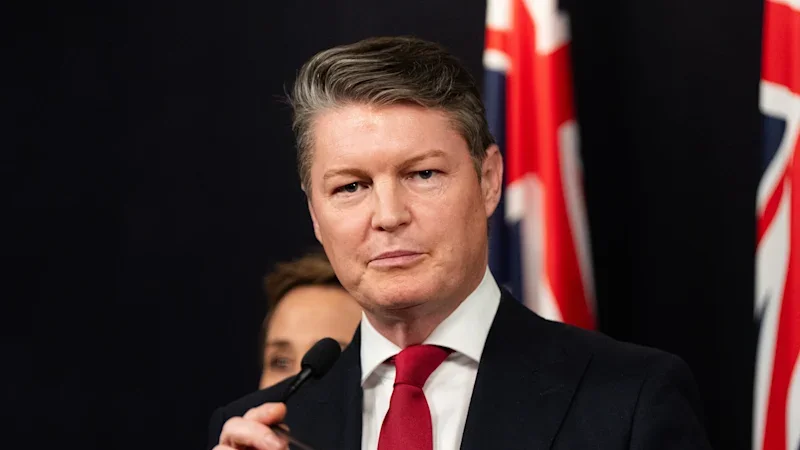
A royal commission into the construction sector will be Ben Carroll’s first act as premier and he will consider alterations to the Suburban Rail Loop, using his elevation to pursue a major reset of the Labor government and attempt to reverse its ailing electoral fortunes.
In a dramatic day at state parliament on Tuesday, Jacinta Allan announced her resignation and chaired a tense caucus room meeting in which Carroll ultimately emerged as the new leader and Victoria’s 50th premier, with Gabrielle Williams as his deputy.
A source close to Allan told The Age she would not recontest her seat of Bendigo East at November’s state election.
Carroll promised a “new direction for government”, particularly on the issues of integrity, community safety and the economy.
“Let me make one thing very clear: I am not Daniel Andrews. I am not Jacinta Allan,” he said. “I will do things differently because different times require a new approach.”
Carroll’s ascension was briefly jeopardised by a surprise leadership tilt from Allan loyalist and Attorney-General Sonya Kilkenny.
Her decision to put her name forward meant Williams was momentarily anointed as the party’s interim leader, as Labor prepared for what could have been a bruising six-week campaign with a vote of rank-and-file members. Kilkenny decided to drop out a short time later.
Carroll and Williams were sworn into their roles at Government House at 12.30pm.
By 1.30pm, Carroll had fronted the media and immediately announced his first act would be the establishment of a royal commission into the construction sector – an issue that was central to his predecessor’s demise.
He said its terms of reference would be exhaustive and a special prosecutor would be appointed to work in parallel with the commission.
Corruption watchdog IBAC would be strengthened with follow-the-money powers before the November election, Carroll said, rather than in 2027 as Allan has planned.
“In my government, integrity will not be optional,” he said.
“Whether in business, politics or the union movement, there will be zero tolerance for those who misuse their positions.
“Every dollar my government spends will be treated with respect. It will be treated carefully, responsibly, and only [spent] where it delivers the greatest value to Victoria and Victorians.”
Despite growing calls for a royal commission from the opposition, the nation’s top crime fighters, anti-corruption experts, the public and even her own party, Allan had in recent weeks remained steadfast in her opposition, including in a plea she made directly to Age readers.
She wrote that a previous royal commission focused on the CFMEU and other trade unions, conducted by former High Court judge Dyson Heydon, led to only one criminal conviction and failed to produce cultural change.
Several Labor ministers had pressed for a royal commission during a tense cabinet meeting on Monday, and ministers including Paul Edbrooke, Colin Brooks and Enver Erdogan told the media ahead of Tuesday morning’s caucus meeting that they supported the measure.
Announcing her resignation at a 9.30am press conference, Allan said she was confident she would have won a vote of Labor Party members but decided to step down to avoid a damaging six-week ballot so close to the next election.
“I saw off two Liberal leaders,” Allan said. “Now I expect my successor will see off the third, and if they don’t, One Nation certainly will. That remains the biggest risk at this election: a One Nation-Liberal coalition government.”
Allan said she was proud of her nearly three years as premier, pointing to a record of building schools, hospitals and the Metro Tunnel rail line.
Most of all, she said she was proud of improving health services for women and girls by holding a landmark inquiry into women’s pain, introducing dedicated health clinics, and making access easier to pain relief and contraceptives.
“If I want to be remembered for one thing, it’s this: I led a government that listened to girls about their health,” Allan said, visibly emotional.
Carroll also flagged for his government a focus on the economy and community safety, saying he had called Victoria Police Chief Commissioner Mike Bush to promise the powers and support needed to tackle crime.
Within cabinet, Carroll played a key role in pushing to introduce tougher conditions for young offenders, but crime remains a key issue for Labor. Firebombings of tobacco stores and nightlife venues are believed to be linked to organised criminals.
Carroll also outlined a more business-friendly approach and said Victoria’s economy was “a partnership between working people, government and business”.
He did not make any immediate commitments about the future of the Suburban Rail Loop, a project he is known to have criticised amid concerns from within Spring Street and beyond that its $34.5 billion first stage is drawing too much government funding.
But when Opposition Leader Jess Wilson asked in parliament if he would cancel the project, he said the matter would be addressed “through a proper cabinet process”.
Carroll, who was sick last week, began to lose his voice during question time as he faced a grilling from the opposition.
Wilson attacked Carroll’s credibility, pointing out that in June he had invoked his young daughter when saying he wouldn’t challenge Allan.
In parliament and to the media, Carroll repeatedly said on Tuesday that the “circumstances had changed” after he was approached by a delegation of MPs urging him to run.
Allan had been hounded by leadership speculation for months, but a grim caucus conference in Ballarat last week and her continued resistance to a royal commission hardened the resolve of her critics to make a move.
Adding to the problem, her office began floating an organised crime body and changes to council rate caps that were seen as last-ditch attempts to save her leadership.
On Sunday, a meeting of factional conveners decided Allan no longer had the majority support of the caucus.
When a delegation of cross-factional MPs and ministers visited her on Monday and told her this, she demanded the six ministers present resign – which they refused. The delegation then visited Carroll and urged him to run for leader, prompting him to tell Allan of his intention to do so.
The meetings kicked off a chaotic 24 hours in which Allan’s backers hit the phones to gauge her support and Carroll called MPs to sound out their position.
Gabrielle Williams, who was part of the delegation, said on Tuesday that it had become abundantly clear the party needed a reset to better align with community expectations.
“That’s what this was all about: making sure that with a new team, we could come in and ensure that we were meeting those concerns where they were at in the Victorian community.” she said.
“Demonstrating that we can deliver the sorts of reform that Victorians expect of us, that we can act and stand by a level of integrity that they fairly expect of their government, and that they can support a Labor government that has delivered extraordinary things for this state, now over 12 years.”
Allan had made it abundantly clear she was not going down without a fight.
Under party rules, if the leadership is declared vacant and there is more than one nominee, a vote must be held of all Victorian Labor financial members, with equal weight to a caucus ballot. This would trigger an election process that could take up to six weeks.
When Allan began to realise she would lose a spill, she wrote to Victorian Labor secretary Steve Staikos telling him to prepare for a ballot of the party membership and that she intended to contest.
On Tuesday morning, Allan’s backers conceded she did not have the numbers in caucus. By 9am she was telling staff she intended to resign. She made the announcement at 9.30am.
As MPs piled into a caucus meeting at 10am, Allan was greeted with applause, and members believed the transition to Carroll would go smoothly.
But Allan’s backers had one last curveball, with Sonya Kilkenny nominating for the leadership and refusing to back down even as MPs argued a six-week campaign would destroy the party.
Allan was one of 15 signatories who backed the bid from Kilkenny for the leadership – infuriating Labor MPs and figures who said her decision to sponsor a challenge contradicted her public statements an hour earlier.
Kilkenny’s move kicked off a tense two-hour meeting. The press scrum huddled outside the room could hear raised voices – including that of Major Events Minister Steve Dimopoulos.
Two MPs, speaking anonymously to detail a confidential party-room process, said the mood was tense and chaotic.
At times, there was confusion about what specific issue they were voting on and how to appoint an interim premier if Carroll and Kilkenny’s stand-off continued after the meeting.
Ahead of caucus events, Labor’s Left and Right factions typically meet an hour beforehand and have their own internal ballots about key issues and who will be nominated for key roles.
But MPs were glued to Allan’s televised resignation during this period, which contributed to confusion about where everyone stood.
Williams and Dimopoulos, both from the Left faction, put their hands up for the deputy role. Williams won with two-thirds of the vote.
Negotiations also had a countdown timer, with parliament due to begin at midday.
Upper house President Shaun Leane and lower house Speaker Maree Edwards left the room without a result to begin preparing for parliamentary business.
Five minutes before midday, an agreement was reached. Kilkenny agreed to withdraw from her leadership bid and Tim Richardson, a supporter of Allan, would be elevated to the ministry.
It will now be up to the Left caucus, who were split over Allan’s leadership, to implement this promise.
One of Carroll’s key jobs on Tuesday night will be to decide on the make-up of the cabinet he will take to the election.
The caucus decides which MPs become ministers, but he has the power to nominate portfolios and could choose to reward key backers and punish Allan loyalists – many of whom occupy the state’s most important positions.
Any decision will be fraught, as the caucus room fracas has demonstrated deep divisions in parts of the party. It will be a challenge, but Carroll is aware that these wounds will need to be healed. When questioned about cabinet positions, he said he would lead a “strong, united team”.
Ben Carroll’s to-do list
- Establish a royal commission into corruption in Victoria’s Big Build. Carroll said this would be his first action as premier.
- Give corruption watchdog IBAC “follow-the-money” powers in this term of government, not after the November election as Allan had planned.
- Finalise the pay deal with public school teachers he has been negotiating as education minister. Teachers walked off the job last week after rejecting his latest offer.
- Decide whether to review the $34.5 billion Suburban Rail Loop East.
- Reshuffle cabinet portfolios and decide whether to keep Jacinta Allan’s loyalists on the frontbench.
- Decide whether to follow through on plans to ditch group voting tickets, a major change to Victoria’s electoral laws that would wipe out micro-parties from the upper house.
- Deliver on his commitment to Victoria Police Chief Commissioner Mike Bush to give the force the powers and resources it needs to drive down crime rates.
More: