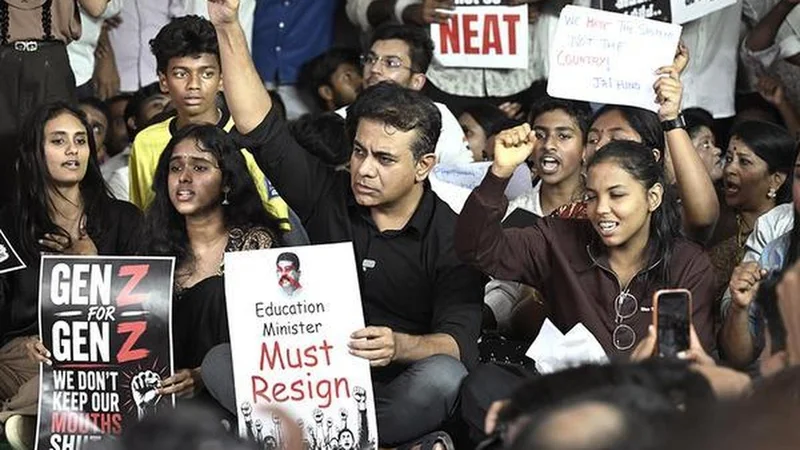
Bharat Rashtra Samithi (BRS) leader K.T. Rama Rao (KTR), said that the protests by students over the leak of the NEET exam paper was “unique” and an “inflexion” point in Indian polity and that the Delimitation Bill, if it is tabled in Parliament, should ensure that the southern States maintain their level of representation in the Lok Sabha.
Speaking to The Hindu during his visit to Delhi, Mr. Rao said that the protests were not just about paper leaks but seemed to be channelling a number of frustrations among the people that needed a trigger point. While anti-incumbency had built up, he said, he conceded that the BJP still had time to recover, but that the lessons for the Opposition were just as dire.
“What you effectively saw was the manifestation of a series of events and not just one isolated incident that resulted in this. They (the BJP) still have time to make amends and maybe win the youngsters back. Also the situation clearly shows that it was not the principle Opposition nor the Opposition block as such, that could inspire confidence, and it had to be a student led, kind of leaderless, rudderless kind of a moment, which just emanated like the Arab Spring had (in 2011). Therefore, it’s unique and it certainly is an inflection point in Indian politics. If you ask me, Prime Minister Modi and his government has never looked as vulnerable as they did in the last 15 days,” he said.
On delimitation Mr. Rao said that it was “unwise” to intertwine women reservation and delimitation the way the government had done in April in the special session to consider the two Bills.
“Women’s reservation can be implemented without linking it or without intertwining it with delimitation. So the fundamental point of Government of India trying to fire the delimitation gun, you know, using a women reservation as a shoulder to lean on is wrong, whereas the Women’s Reservation Act has already been passed by Parliament,” he said. “Government of India needs to realise that they’re sitting on a powder keg. If they mess with the current ratio, where the southern States as a block have 24% representation in Parliament, then most certainly there will be a serious protest erupting in the south,” he said.
He suggested his own formula for doing so. “Why is delimitation done in the first place? Because you want increased participation, representative democracy, more decentralisation, etc.
So the one way to do it, is basically increase the number of MLA seats. If they can go ahead and increase the number of MLA seats across the country, there’s 4000 plus now. That can be enhanced to 6000.
Nobody has a problem. Because then it’s within the geographical confines of one State and when it comes to Parliament, you’re not disturbing the status quo. The second formula could be one where you actually sit across a table, come to the consensus on how this 24% of South can be maintained as is, so that there is parity and balance,” he said.
“There should not be a penalty for good implementation of population policies, you can’t have a noose around our neck, say that this is good for you (southern States), and stifle our voice,” he said.
Published - July 28, 2026 03:03 pm IST