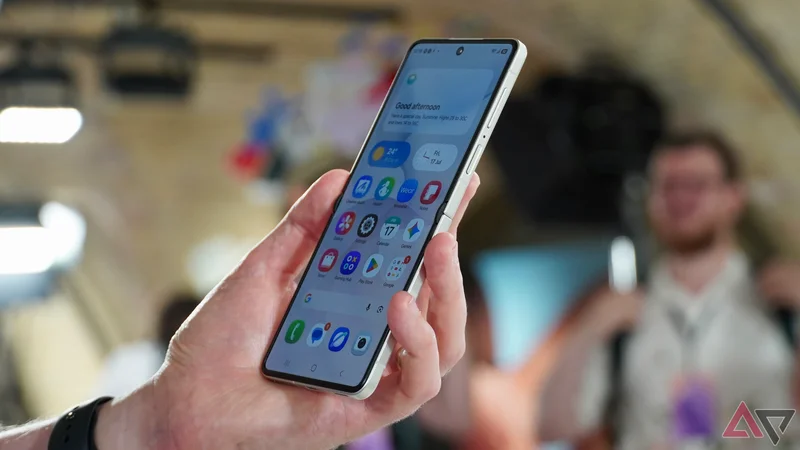
When Samsung announced its new Galaxy Z foldables last week, the one piece of news that caught my attention wasn't the new short and wide form factor, nor was it the Flex Titanium display. No, it was all about batteries.
All three foldables pack silicon-carbon anode batteries along with several other battery design enhancements, which allow them to offer significantly better battery life than last year's foldables.
I've been waiting for a couple of years for Samsung to jump on the silicon battery bandwagon, and now that it has, I can't wait for it to bring this same technology to its other phones. Yes, I'm talking about the upcoming Galaxy S27 next year.
Why silicon-carbon batteries matter
Who doesn't want longer battery life?
For a few years now, silicon-carbon has promised to change the battery game for phones. Silicon anodes can store 10 times more energy in the same footprint as graphite anodes, the traditional material for today's lithium-ion batteries.
That alone answers the question of why I'm all excited to see this technology make it to more phones. I would never, ever say no to the wizardry that would allow my phone to keep the same size and weight, but pack a much more energy-dense battery.
I wish it was as easy as multiplying the current capacity by 10, though. Silicon isn't a stable material and can swell by up to 300% and crack — not a good thing for a phone. To combat that, it's mixed with the more stable carbon to reduce this expansion risk.
I would never say no to a phone of the same size and weight, but with a higher-capacity battery.
Batteries built with a silicon-carbon anode thus have a larger capacity (a higher mAh number), but it's not 10 times more. The reality so far has been somewhere between a 10-40% increase compared to older graphite anode batteries.
That's nothing to scoff at, though. While phones like the Google Pixel 10 Pro XL and Samsung Galaxy S26 Ultra have batteries around 5,000mAh, phones with the silicon-carbon tech have surpassed 7,000mAh.
The Oppo Find X9 Ultra has a 7,050mAh battery, while the OnePlus 15 takes that up to 7,300mAh. Honor crammed a 6,660mAh battery into its foldable Magic V6. All of these numbers are impressive considering these phones didn't add any weight or thickness.
Comparatively, Samsung is being very conservative with its silicon-carbon push. The new Galaxy Z Fold 8 and Z Fold 8 Ultra have 4,800mAh and 5,000mAh batteries, respectively, but that's still a 10-15% upgrade compared to last year's 4,400mAh Z Fold 7.
This is all fantastic news for the Galaxy S27
There's no going back now
Samsung didn't just upgrade one part of its battery tech in its new foldables. The silicon-carbon anode is one part of the equation, but the company says it redesigned the entire system, improved performance, and carefully managed the material's durability.
Samsung’s corporate EVP and deputy head of core component technology, BD Yang, explained:
We embarked on system-level innovation that covers all the components that go into the battery end-to-end, and this allowed us to meet our standards. [...]
Silicon-carbon cells must be carefully managed because the performance and durability can vary depending on cell composition. To make them practical for everyday use, Samsung tuned the full cell system.
I can't imagine that Samsung has gone through all that trouble to keep these batteries limited to its foldable lineup. Surely, all the R&D that went into ensuring the safety, longevity, and reliability of silicon-carbon batteries will be used in other phones soon.
That's why I'm excited about next year's Samsung Galaxy S27 series. I hope the company will bring these higher-capacity batteries to the three phones, without compromising on their weight or thickness. Korean rumors suggest it's at least considering it.
And about time it happened, too! Samsung has stuck with a 5,000mAh battery on its Galaxy S Ultra phones for six years now, and that's getting long in the tooth. It would be very silly to keep the same battery again next year.
When the competition is doing better — much better — and when modern smartphones can locally perform energy-intensive AI tasks all day long, better battery life is not a bonus anymore, but a requirement.
I want my Galaxy S27 Ultra to last more than a day, Samsung
I don't want to spend my day babying my phone's battery life. Nor do I want to keep looking for ways to extend its battery life or processes to kill to ensure it lasts me through an intensive day.
My dream use case would be for my phone to last me through a full travel day: taking 100+ photos, using Maps to get directions, checking my saved notes and apps, all while chatting with my family or friends. So far, both my Galaxy and Pixel phones can't do that.
But when the tech is out there, proven, and when it's already in another Galaxy phone, there's no reason why the Samsung Galaxy S27 series wouldn't have silicon-carbon batteries. Make it happen, Samsung!