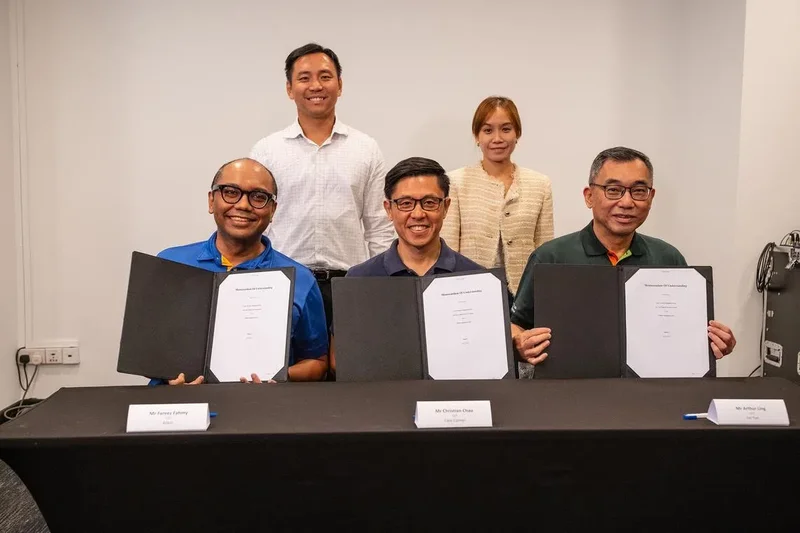
Three social service agencies team up to build tech, supported by $3.9m from Lien Foundation
AI generated
SINGAPORE - Three social service agencies are working together to build and use technology, in a first-of-its-kind collaboration aimed at making it easier for families to get help and reducing administrative work for social workers.
Care Corner Singapore, Allkin Singapore and Fei Yue Community Services announced on July 28 that they have formed the Innovation Collective, backed by a $3.9 million investment over three years from philanthropic organisation Lien Foundation.
Together, the three organisations employ over 1,700 staff and serve over 154,000 people, including underprivileged children, troubled families and vulnerable seniors.
One of the partnership’s goals is to make their clients’ experiences smoother, such as by sharing data across agencies so they do not have to repeat information each time they seek help, and reduce repeated work among social workers.
This development comes weeks after the Ministry of Social and Family Development (MSF) announced it would pump $15 million to support new tech solutions for the sector, including in artificial intelligence.
While the Collective is a ground-up effort that started independent of MSF’s move, Care Corner chief executive Christian Chao said the agencies support the ministry’s push towards innovation and hope to tap the funds in future to pilot and expand their work.
The Lien Foundation investment will partly go towards hiring 10 people across three teams - one for each social service agency. These teams will have expertise in areas such as technology, design and product management.
Beyond individual projects, the teams will share knowledge and work together on solutions. The funds will also cover prototyping tools, user research and leadership workshops.
Lien Foundation first partnered Care Corner in 2022 to build its innovation team before extending the collaboration to Allkin and Fei Yue.
“As social service agencies, we’re in a space where actually, there is no value in competition,” said Chao after the agreement signing at Care Corner’s Learning Festival and Ideathon, held at YWCA Fort Canning.
Chao said many agencies are resource-strapped and typically rely on external vendors for tech solutions, but these may not work in creating complex systems for their services. The Collective is a “very different approach” where the agencies play a more active role in designing solutions, he said.
Lien Foundation’s programme director Luo Ren said many grant schemes require agencies to propose a specific technology before they have fully understood the problem they are trying to solve.
She said their funding gives agencies “breathing room” to figure out problems and experiment with solutions.
The Collective’s first project is to build a system that lets staff view clients’ data across the agencies and make referrals easily. This is meant to address delays in current workflows, as intake and referral processes differ across agencies.
This makes a difference for families who require multiple referrals, such as to mental health and youth services, said Allkin’s chief executive Fareez Fahmy.
The second project will analyse data from the three agencies to identify unmet needs and emerging trends. For example, the agencies could spot areas where more children are not attending student care.
Fei Yue’s chief executive Arthur Ling said this could help social workers, who often find themselves “firefighting” problems that surface in clients’ lives.
“If we have data that allows us to go even higher at the upstream level to prevent the problem, I think that will be very valuable,” said Ling.
If the initiative goes well, Ling said other social service agencies may join in the future.
Senior Minister of State for Social and Family Development Goh Pei Ming, who witnessed the agreement signing, said the Collective is a significant step towards addressing complex social challenges which no agency can tackle alone.
He added that it sends a “very strong signal” about collaboration within the sector.
“This aligns with the direction of Singapore’s broader social service transformation, one where we are willing to seize new ideas, forge new partnerships and stay ahead to anticipate evolving social needs,” said Goh.