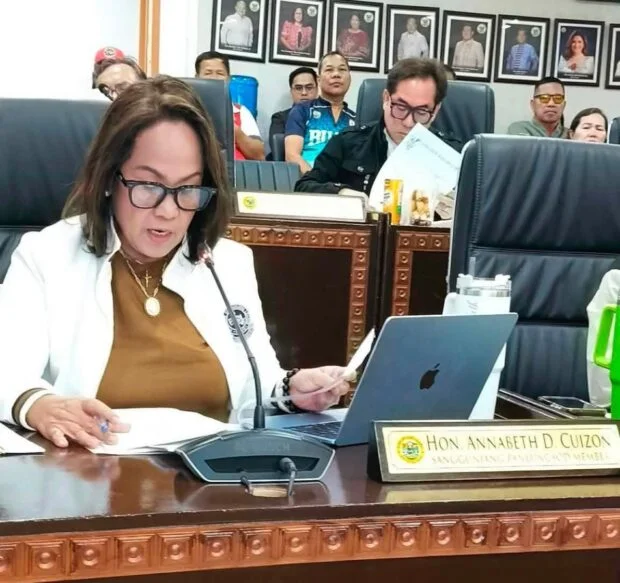
Cuizon welcomes Marcos’ order to scrap systems loss charges
CEBU CITY, Philippines — Lapu-Lapu City Councilor Annabeth Cuizon described President Ferdinand “Bongbong” Marcos Jr.’s pronouncement during his State of the Nation Address (SONA) as a “small win” after he directed Congress to amend Republic Act No. 9136, or the Electric Power Industry Reform Act (EPIRA), and remove the collection of systems loss charges and the corresponding value-added tax (VAT).
“Lipay kaayo ko kay especially kay pagtan-aw nako sa SONA gahapon, pwerte gyud nakong lipaya sa pagsulti nga ipatangtang na ang systems loss kay usa baya na sa gikarga nila sa atong eletric bill nga wala gyud ta’y kalibutan unsa nang systems loss. Nganong kita’y mobayad ana nga pilferage mana,” Cuizon said.
(I am very happy because, especially when I watched the SONA yesterday, I was really delighted to hear that the systems loss charge would be removed. That is one of the charges added to our electricity bill even though we have no idea what it really is. Why should consumers pay for it when it is due to pilferage?)
“Kabaw ka pila na among systems loss karon? Libo kapin,” she added.
(Do you know how much our systems loss charge is now? It is already more than a thousand pesos.)
She said the move would help ease every family’s monthly household expenses.
Cuizon considered the President’s pronouncement an answered prayer and expressed hope that the government would also review the other charges included in electricity bills.
“So mao tong atong ipa-review kung sakto ba na ilang singil,” she said.
(That is why we want those charges reviewed to determine whether they are being imposed correctly.)
Earlier, the councilor filed a resolution urging the Department of Energy (DOE) and the Energy Regulatory Commission (ERC) to conduct a thorough review of the generation charge, transmission charge, and other mandatory government-imposed pass-through charges collected from consumers by the Mactan Electric Company (MECO).
The resolution was prompted by the continued increase in electricity bills in Lapu-Lapu City and the numerous complaints the council had received from MECO consumers.
“Pero kana bang pagpatong ana ba nga wala ta kabaw unsa na….asa na padung,” she explained.
(But those additional charges are imposed without us even knowing what they are or where the money is going.)
Cuizon said she also experienced an unexpected spike in her own electricity bill.
“Diha sab to’y time nga nireklamo ko kay niabot sa P37,000 akong bayranan. Unya giingnan lang ko nga i-installment lang na mam kay dili nila mausab kay mao man gyud kuno akong consumption,” she said.
(There was also a time when I complained because my electricity bill reached P37,000. They simply told me to pay it in installments because they said they could no longer change it, claiming that it reflected my actual consumption.)
However, Cuizon said the increase in her electricity bill was unusual, considering that her previous monthly bills averaged only about P15,000.
Earlier, MECO explained that only 11 percent of the amount it collects goes to the company, while the remaining 89 percent consists of charges remitted to the government and other entities.
As of this writing, Cuizon said the DOE and ERC have yet to respond to her resolution.
Disclaimer: The comments uploaded on this site do not necessarily represent or reflect the views of management and owner of Cebudailynews. We reserve the right to exclude comments that we deem to be inconsistent with our editorial standards.