Each generation of S’poreans must design and pass new laws to deal with new circumstances: SM Lee
AI generated
SINGAPORE - Each generation of Singaporeans must strengthen the legal system it inherits, adapt it to new realities, and pass it on, updated and improved, to the next generation.
Senior Minister Lee Hsien Loong said this on July 28 at the launch of a book series that details 25 years of legal reform in Singapore.
Lee said sound laws, strong institutions and civic trust has served Singapore well, but the rule of law is never a finished project.
“.Whether responding to social change, technological disruption, foreign interference, or a global pandemic, our legal system has been able to renew itself while remaining anchored in enduring principles,” he said.
He added: “The next chapter of Singapore’s legal story is therefore not about preserving what we have inherited, but about building upon these foundations to keep our laws relevant, our Constitution fit for purpose, our institutions trusted, and our society imbued with the values and norms that make the rule of law possible.”
The four-volume book series offers insight into the policy thinking, trade-offs and human effort behind some of the Republic’s most significant legislative changes between 2000 and 2025.
These include the enactment of the Protection from Online Falsehoods and Manipulation Act (POFMA) to tackle online falsehoods, the repeal of Section 377A of the Penal Code to decriminalise sex between men, and the introduction of the Covid-19 (Temporary Measures) Act to deal with urgent issues arising from the pandemic.
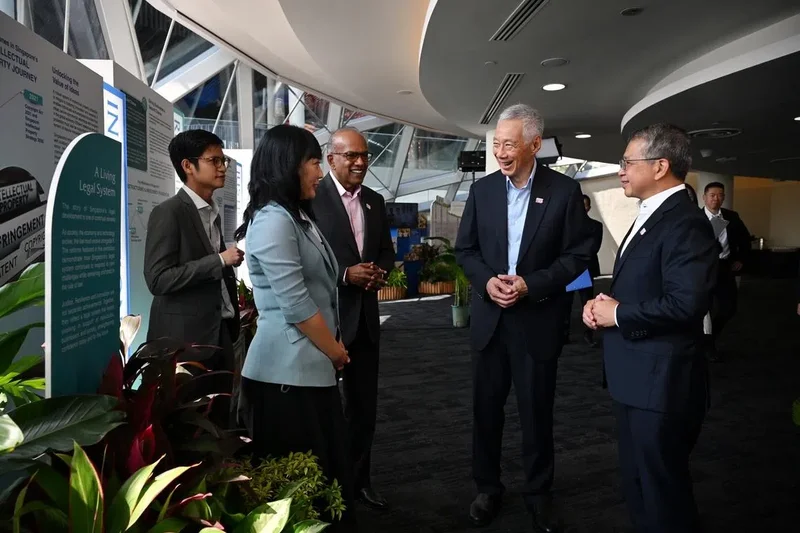
Lee, who was Prime Minister when most of the laws were passed, was the guest of honour at the launch event held at Gardens by the Bay.
Senior Minister K. Shanmugam, who was Law Minister for 17 years; Law Minister Edwin Tong; and Singapore Management University professor Yip Man, the managing editor of the series, also officiated at the event.
The launch was attended by about 200 guests, including representatives from the legal industry, and editors and writers who contributed to the series.
The four volumes cover criminal justice, family law, civil procedure, intellectual property, international dispute resolution and legal innovation.
In his speech, Lee said a defining feature of Singapore’s approach to governance was to keep abreast of social changes, emerging threats, and technological disruptions to sustain the rule of law.
“Each generation must review the system it has inherited, decide what remains fit for purpose, update or repeal those parts which are outdated, and design and pass new laws to deal with new circumstances,” he said.
This book series chronicles one important chapter in that longer journey, he said, as he set out what a good set of laws should achieve to serve Singapore’s needs.
First, they must address enduring national imperatives.
He said that to protect social cohesion in a multiracial and multi-religious society, Singapore implemented policies to foster social mixing and forge a national identity, and embedded key safeguards into its institutions and laws.
The significance of these laws goes beyond the offences and penalties that they define.
One example he cited was the Maintenance of Religious Harmony Act, which provides for restraining orders to be issued against religious leaders to stop acts that could inflame religious tensions.
Since the law came into force in 1992, no restraining order has ever had to be issued because its mere presence encouraged restraint, dialogue and responsible conduct among religious groups.
He said that laws cannot compel people to trust one another or make friends across different groups, but they can set boundaries and deter harmful conduct.
Second, a good set of laws must respond to new and emerging challenges, he said.
POFMA was enacted in 2019 to address the growing problem of online falsehoods. Falsehoods travel further and faster than factual corrections, and can undermine public trust, damage institutions, inflame social divisions, and even jeopardise public health and safety.
The law equips the Government to respond quickly when false statements of fact affecting the public interest spread online.
He said the issuance of correction directions allows the Government’s clarification to be presented alongside the original content, enabling Singaporeans to consider both accounts and make informed judgments for themselves.
State and foreign actors also increasingly seek to influence political discourse in other countries through covert means such as online disinformation campaigns, he said.
Singapore, being a small and open nation, is particularly vulnerable to this modern form of subversion.
The Foreign Interference (Countermeasures) Act was thus introduced in 2021 to strengthen the Republic’s ability to detect, prevent and disrupt foreign interference in domestic politics.
“Today’s threats look very different from those faced by earlier generations. And hence our laws must be updated, in order to remain fit for purpose,” he said.
A third lesson from Singapore’s legal development is that laws must respond quickly in times of crisis, said Lee, citing the Covid-19 pandemic as a “vivid example”.
He noted that legislation is usually the product of extensive and deliberate study, consultation and debate
But when the pandemic spread in early 2020, it quickly became clear that the scale and nature of the disruptions exceeded anything envisioned by existing legal frameworks.
“Public health risks required urgent intervention. Businesses and supply chains were severely disrupted. Individuals found themselves unable to fulfil contracts and obligations through no fault of their own.”
Within nine days, the Government discussed the core ideas, drafted the legislation, and put the Covid-19 (Temporary Measures) Act through Parliament on a Certificate of Urgency in a single sitting.
This swiftly created the legal framework to address urgent issues arising from the pandemic. And as new challenges emerged, the Act was amended eight times in all.
What is noteworthy, he said, was not merely the speed of the response, but that all this was done through established constitutional and parliamentary processes.
“The rule of law was not suspended; we did not simply declare an emergency and rule by decree. Rather, it provided the framework for extraordinary but essential measures to be adopted properly and accountably.”
Fourth, he said, laws must also react to changing societal values, identity and norms.
Such reforms are often the most challenging to implement, he said, citing the repeal of Section 377A in 2022 as a salient example.
Over time, more Singaporeans came to accept that private consensual conduct between adults should not be criminalised.
When the Government judged that the time had come to repeal the section, it held an extensive series of engagements with diverse groups.
“The aim was not to secure unanimity, which would have been impossible. Rather, it was to understand concerns, identify common ground, and seek a path forward that Singaporeans could broadly accept.”
The engagement confirmed that many Singaporeans were worried about the possible impact of a repeal on broader social norms around marriage and family.
Hence besides repealing Section 377A, the Constitution was also amended to affirm Parliament’s authority to define, regulate and support the institution of marriage.
“This approach preserved the ability of future generations to debate and decide these issues through political contest and public discourse as societal norms evolve.”
Lee added that the rule of law flourishes only when legislation is translated into a functioning system that enforces rules, ensures law and order, and enables the efficient conduct of business.
This requires courts that are independent, impartial and efficient; government agencies that respect the laws, and act competently, fairly and consistently to enforce them, and also to comply with them.
And a Parliament where the most important questions are debated thoroughly and openly, and decided through the democratic process, he said.
Ultimately, the rule of law depends on society itself.
“For laws and institutions to be effective in regulating conduct, we need citizens, businesses, public agencies and community organisations alike to embrace values like trust, responsibility, restraint and mutual respect.”
He concluded by noting that future generations will meet many novel and unfamiliar challenges presented by artificial intelligence, new forms of online harm, misinformation and foreign interference, climate change, demographic shifts and geopolitical uncertainty.
“What gives us confidence is not that we possess all the solutions, but that Singapore has shown its ability to adapt thoughtfully and pragmatically to changing circumstances.”
Speaking to ST, Yip said what she hopes everyday Singaporeans will take away from the book series is that the law is not remote.
The professor said the subject of the series is connected to everyday life: when a marriage ends, when a business is in financial trouble and needs to be restructured, and when society is hit by an unprecedented crisis.
“Importantly, behind every change in the law is a team of people - policymakers, practitioners, experts, and members of the public who gave feedback - who thought hard about a real problem from different angles,” she said.