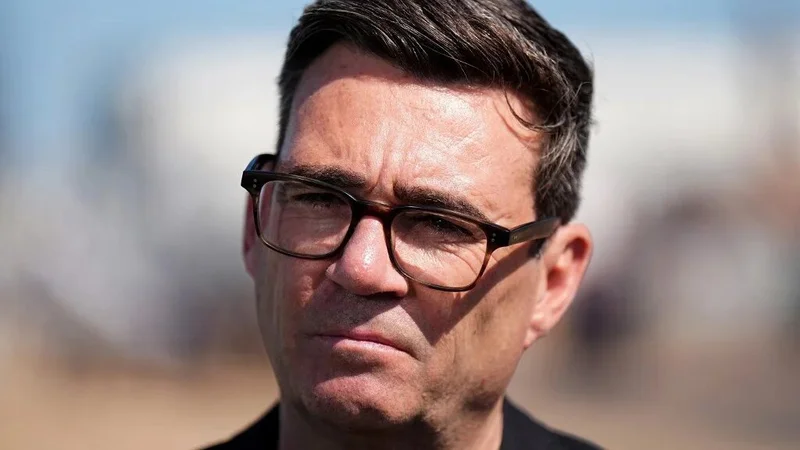
The tough choices Andy Burnham faces on Iran war as US pushes for more UK involvement
Andy Burnham wanted his premiership to be firmly focused on domestic policy. However, in his first week in office, the new prime minister found himself forced to deal with the sharp escalation in the US-Israeli conflict with Iran.
Shortly before becoming premier, Burnham signalled that he would mark a significant departure from Keir Starmer's foreign policy, apologising for Labour's early support for Israel's war on Gaza and saying his government would consider banning goods from Israeli settlements.
The remarks were widely seen as a deliberate bid to win back voters who had abandoned Labour over its foreign policy, particularly on Gaza.
But the resurgent conflict between the US and Iran has meant that Burnham and his new foreign secretary, Ed Miliband, have had to decide how to navigate the war swiftly.
On Sunday night, Burnham spoke by phone with the leaders of Britain's Gulf allies.
In a conversation with UAE President Mohammed bin Zayed Al Nahyan, the British prime minister thanked him for supporting the 200,000 Britons living in the country during the conflict.
Burnham also spoke to the emir of Qatar, Tamim bin Hamad Al Thani, and praised the defence partnership between the two nations, which saw British planes defending Qatar from Iranian missile strikes in February and March.
The prime minister further promised Kuwait's emir, Sheikh Meshal, that the UK supported the country against Iranian strikes.
Burnham's overriding concern is his relationship with US President Donald Trump.
Trump fell out with Starmer earlier this year over his delay in allowing the US to use British bases to launch strikes on Iran. The US president relentlessly mocked and criticised Starmer on social media.
However, a YouGov poll last week showed that a majority of the British public opposed the government allowing the US to use UK bases to launch attacks on missile sites in Iran.
To avoid Trump's ire and a spat with the White House potentially dominating news coverage during the start of his premiership, Burnham would have had to diverge sharply from public opinion on British involvement in the Iran war.
Instead, he decided to continue with Starmer's approach and allow the US to use RAF Fairford, a military base in Gloucestershire, to launch an attack on Iranian missile sites.
Summit on the Strait of Hormuz
According to his critics, Burnham has failed at the first hurdle to stand up to Trump, although he refused in an interview over the weekend to say he trusted the US president and insisted he would call him out when necessary.
Burnham's decision has allowed him to avoid a clash with Trump, but it has exposed the UK to another potential complication.
The government argues that US attacks on Iranian missile sites are "defensive" and that Britain is therefore not involved in any offensive military action against Iran.
Iran, however, sees it differently.
The Islamic Revolutionary Guard Corps (IRGC) accused the UK late last week of being an "accomplice" to the US and said it considered UK bases to be legitimate targets.
In response, Britain's new defence secretary, Wes Streeting, declared that Britain stands "ready to respond to any attacks Iran wishes to wage against this country or our allies and we will continue to do that".
He insisted "we have not joined and will not join offensive US military action in Iran", adding: "That's an area where we have not agreed with the United States. But when it comes to securing maritime freedom and free commercial shipping in the Strait of Hormuz, that's where we are absolutely aligned."
Pete Hegseth, the US defence secretary, spoke to Streeting over the weekend and reportedly urged him to host a summit in London on a multinational maritime coalition to protect shipping through the Strait of Hormuz.
Hegseth reportedly said he would attend the proposed summit. European nations have previously been reluctant to participate in an effort to help reopen the crucial waterway because it would deepen their involvement in the conflict.
The Starmer government's position was that it would send naval assets into the strait after a lasting ceasefire had been secured.
But Streeting said over the weekend that the UK is ready to lead a naval mission "when the conditions are right".
Criticism from the left
It remains unclear whether the summit will go ahead, but the Burnham government may struggle to resist US pressure to deepen its involvement in the war should hostilities escalate.
If it does, the government will open itself up to further criticism from the Green Party, which opposes allowing the US to use British bases to attack Iran.
"The illegal war in Iran should do a lot more than 'concern' Andy Burnham," Green Party leader Zack Polanski remarked on Sunday.
"And if he's not holding back - when is he going to tell Donald Trump that the UK wants nothing to do with this war and to ban the US military from UK soil?"
Burnham also risks drawing the ire of many Labour backbenchers who supported his bid to become prime minister and are already urging him to take a firmer stance on Israel.
'I think Prime Minister Burnham will continue to navigate a similar policy to his predecessor'
-
Chris Doyle, Council for Arab-British Understanding director
Last week, 80 MPs and peers, including many from the Labour Party, called on Burnham to recognise Israel's actions in Gaza as genocide, sanction Israel and ban trade that supports illegal Israeli settlements.
Last year, as Starmer's health secretary, Streeting himself privately accused Israel of war crimes and backed sanctions on the state.
He is now being urged to suspend Britain's long-standing clandestine military agreement with Israel.
"I think Prime Minister Burnham will continue to navigate a similar policy to his predecessor," said Chris Doyle, director of the Council for Arab-British Understanding, "namely that he will not wish to have British forces engage actively on any war on Iran and will continue to allow limited use of RAF Fairford and Diego Garcia".
On the UK's potential role in Hormuz, Doyle said: "There may be some sort of role in terms of de-mining and escorting in a very defensive capacity, but not one that is offensive. I think that'll be where they draw the line."
At the very least, the escalation in the Middle East will prove a severe headache for a British government that wants nothing to do with the conflict but cannot avoid some degree of involvement.