Hidden charcoal reveals the true age of ancient cave paintings
Scientists have finally revealed the true ages of mysterious prehistoric paintings in a famous French cave.
- Date:
- July 28, 2026
- Source:
- CNRS
- Summary:
- A new analysis has precisely dated paintings in Franceâs Font-de-Gaume cave for the first time. Scientists discovered charcoal inside black pigments once thought to contain only minerals, allowing them to use radiocarbon dating. The results show that a bison was painted about 13,000 years ago, while sections of a mask-like figure were added during several widely separated periods.
- Share:
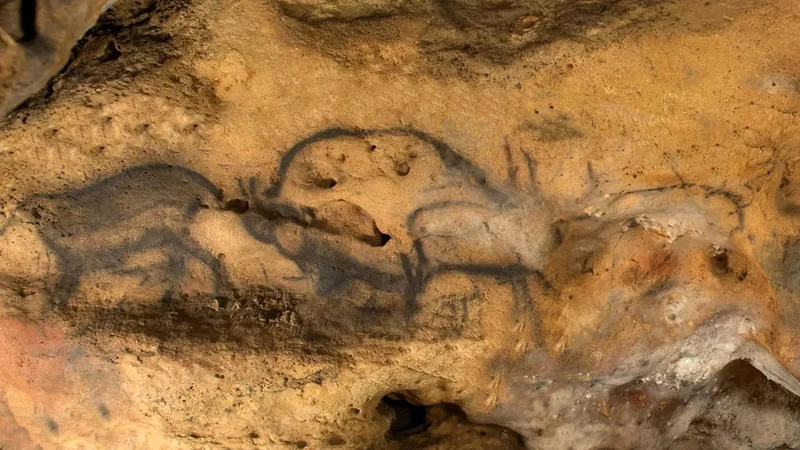
For the first time, scientists have accurately determined the age of prehistoric paintings inside Font-de-Gaume, a celebrated decorated cave near Les Eyzies in Dordogne (southwestern France).
The new findings provide firm dates for two black images, a bison and a masklike figure, and reveal that parts of the artwork were created during widely separated periods. The results could give archaeologists a powerful new way to reconstruct when people entered decorated caves, made paintings, and returned to alter or add to them.
Why Ice Age Cave Paintings Are Difficult to Date
Dordogne is home to some of the best-known prehistoric art in Europe, including the paintings at Lascaux. Yet determining exactly when many of these images were created has remained extremely difficult.
Radiocarbon dating works by measuring carbon-14, a radioactive form of carbon that gradually disappears after an organism dies. Because charcoal is made from burned organic material, it can often be dated using this method. Mineral pigments, however, usually contain no carbon and therefore cannot be analyzed in the same way.
Researchers had long believed that many black paintings in the region were made entirely from iron and manganese oxides. These naturally occurring minerals can produce dark pigments, but they do not contain the organic carbon needed for radiocarbon dating.
As a result, the artwork was generally considered impossible to date directly. However, scientists had never conclusively demonstrated that the pigments contained no carbon at all.
Searching for Charcoal Hidden in the Pigment
To investigate, the researchers analyzed the chemical composition of two black figures at Font-de-Gaume. One depicts a bison, while the other is commonly described as a mask.
The team used Raman microspectrometry and hyperspectral imaging, two techniques that can identify materials without noticeably damaging the artwork.
Raman microspectrometry uses light to examine how molecules vibrate, producing a chemical signature that can help identify pigments and other substances. Hyperspectral imaging records subtle differences in color and reflected light at each point in an image. Scientists can use those measurements to determine which compounds are present.
Hyperspectral imaging is widely used in cultural heritage research because it can reveal features that are difficult or impossible to see with the human eye. It also has applications in biomedical science, agriculture, environmental monitoring, and astrophysics.
Both methods revealed traces of charcoal in the paintings' black pigment.
The charcoal was distributed consistently throughout the black lines of the figures. That pattern was important because it indicated that the carbon was part of the original pigment rather than contamination left by later graffiti, visitors, or tourist activity inside the cave.
Tiny Samples Reveal the Paintings' Ages
Once the charcoal had been confirmed, researchers received exceptional authorization to remove extremely small samples for carbon-14 dating.
Analyzing such limited material is technically challenging. Scientists must collect enough carbon to obtain a reliable measurement while removing as little as possible from the ancient image.
The results confirmed that the bison dates to the Upper Paleolithic, the later portion of the Old Stone Age when anatomically modern humans created many of Europe's most famous cave paintings.
The bison was painted between 13,461 and 13,162 calBP.
CalBP means Calibrated Before Present, with present conventionally defined as the year 1950. Radiocarbon measurements must be calibrated because the amount of carbon-14 in the atmosphere has changed over time. Those variations can be influenced by factors including solar activity and changes in Earth's magnetic field.
The new date places the bison slightly later than previous estimates.
A Mysterious Mask Created Across Different Periods
The mask produced an even more complex result. Samples from separate parts of the figure yielded three different ranges.
One section was dated to between 8,993 and 8,590 calBP. Another was dated to between 15,981 and 15,121 calBP, while a third was placed between 15,297 and 14,246 calBP.
These results suggest that the image may contain elements created at very different times. Rather than being the work of a single artist during one visit, the mask may preserve multiple episodes of artistic activity separated by thousands of years.
That possibility offers a more layered picture of prehistoric cave art. Decorated caves may not always have been completed during a single period. Some could have remained meaningful places that later communities revisited, modified, or reinterpreted.
A New Tool for Understanding Prehistoric Art
The research was led by a scientist from the Laboratoire de développement instrumental et de méthodologies innovantes pour les biens culturels (Chimie ParisTech-PSL/CNRS/Ministère de la Culture). The study was published in PNAS.
The research brought together specialists from several French scientific and cultural institutions.
Contributors included scientists from Laboratoire de mesure du carbone 14 (CEA/CNRS/IRD/ASNR/ Ministère de la Culture), a national platform affiliated with Laboratoire des sciences du climat et de l'environnement (CEA/CNRS/ Université de Versailles Saint-Quentin-en-Yvelines). Researchers from the Histoire naturelle des Humanités préhistoriques laboratory (CNRS/MNHN/Université de Perpignan Via Domitia), the Centre des monuments nationaux, and the Centre de recherche et de restauration des musées de France also participated.
By combining chemical imaging with highly sensitive radiocarbon measurements, the team has developed a method that could be applied to other prehistoric figures previously considered undatable.
More precise dates could help researchers determine which paintings were created during the same period, how artistic styles changed, and whether generations of people repeatedly returned to particular caves. That information may ultimately reveal more about the communities that produced the images and the cultural importance these underground spaces held over thousands of years.
Journal Reference:
- Ina Reiche, Lucile Beck, Ingrid Caffy, Yvan Coquinot, Matthias Alfeld, Anne Maigret, José Tapia, Marc Martinez, Anthony Lescale, Patrick Paillet. Radiocarbon dating and chemical imaging of carbon blackâbased Paleolithic cave art in the Dordogne region (France).Proceedings of the National Academy of Sciences, 2026; 123 (12) DOI: 10.1073/pnas.2524751123
Cite This Page:
ScienceDaily. Retrieved July 28, 2026 from www.sciencedaily.com