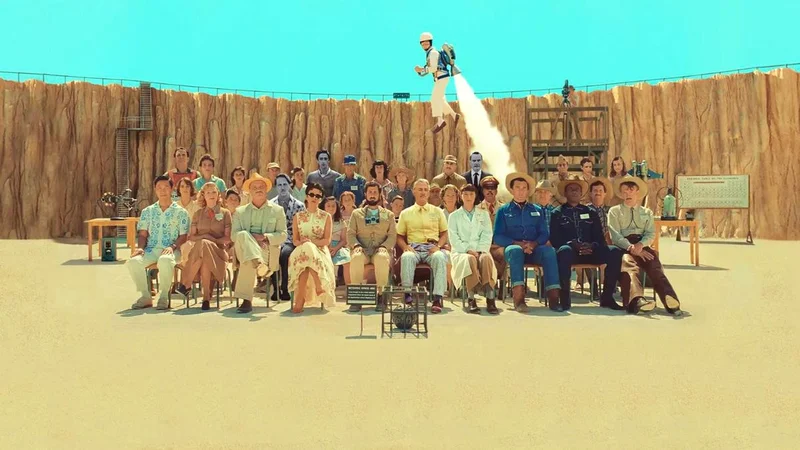
Profound in Pastel: Asteroid City
Directed by Wes Anderson
If there is one thing that is for sure, no “Wes Anderson trend” on social media can ever out-do the auteur filmmaker’s style of filmmaking, something that he has not only perfected, but truly submitted into and the result is a distinguishably original body of work, with connected thematics.
Wes Anderson’s more recent work, Asteroid City, is equally one of his most profound films yet, and much like his other films, the children are adults and adults are children. His whimsical tone, pastel palette and distinct camera movements are elevated in this film, along with his choice of sound and clear inspirations that drive the filmmaker.
When a car breaks down at Asteroid City, a family is confronted to deal with their loss and emotions amidst the backdrop of a science exhibition for children, and a space station that is deeply connected to the landing of an alien at the town that derives its name from an asteroid that struck it.
Here, Anderson brilliantly uses his ensemble cast with the meta theme of it all being a play- So thus the set always feels like a set, and everyone is a cast, so for Anderson, all of his world’s a play. There’s a beautiful mirror that also becomes self-reflective for the filmmaker, it is a film through which he also asks several profound questions of the universe. The answer is never received, as much as the question is imposed, and a life is lived. In the middle of it all, are prodigal children who have strange inventions that they conjure. Although whimsically put, there is a serious impressiveness to the entire thought of scientific thinking here, and the artsy tone of the film goes hand-in-hand with these gadgets. It makes one ask how they can be creative through a scientific approach, as well as design thinking.
The film turns to one that is as fun and musical as it is philosophical. All of the filmmaker’s works find themselves having characters who introspect, deal with loss and through his muted tone of acting, have a very deadpan nature to the performances, which add to the humour as well as poignancy of his films. It is a film that reminds us that childlike eccentricities do not mean the absence of emotion, and perhaps, it may be quite the opposite. There is a wonder in Asteroid City, one that for those who lean into the filmmaker’s style, will resonate on a deeper level.
Food, Father & Son: Chef
Directed by Jon Favreau
It wouldn’t be far-fetched to say that sometimes the best food that one can make stems out of immense passion, and not always the intense meticulousness that comes with the art of cooking. Especially when that passion is mixed with a bond that one so-very desperately seeks to form and mend.
There’s a world-class chef who receives a terrible review. He’s a meme on the internet, in a digital era world where children are teaching their parents the ways of the world. There is a broken marriage, and a son who can so very easily walk on the wrong side of the tracks. There is a terribly maintained food truck, and a sous-chef inspired enough to leave his job to convert it into a food truck and tour the country with his mentor. Chef is a film that brings these various ingredients together and constructs a dish that is part high-octane, and entirely wholesome, while being equally cool about its ways.
As Chef Carl Casper’s frustrations slowly give way to realising why he loved what he did in the first place, he rediscovers his passion alongside his son Percy, a quick learner who in many ways is equally a mentor to his father without explicitly being one. Percy seeks to know, he’s at an inquisitive age, but he also believes he’s just as much of an adult as everyone around him, and it’s when Carl treats like an adult that he realises that his son is mature beyond his years.
Along with Carl and his meticulousness, Percy realises the value of cleanliness in the kitchen, and how to cook for others is a great service and art at once, which must be approached with a great respect for the customer; Do not serve a dish that cannot be better.
Chef is a tender family drama that is equally a road trip movie that discovers food, having moments of laughter, frustration and poignancy. Directed by Jon Favreau, who plays Chef Carl Casper himself, I remember watching the film and constantly finding myself hungry throughout the film. The dishes are not as fancy as they are historic- And through this, the film in some sense directly finds itself dealing with the theme of going back to one’s roots, both through the choice of food shown as well as the father-son (older and younger) bonding theme. There’s rediscovering passion, which goes even beyond cooking.
For me, the film is all about the tenderness of the father-son arc. Carl is a sensitive human being, and he never asks his son to lose the emotional side in him either. The impact of this film is of course tremendous on cinema as well, for there is a remake of the film set in India that stars Saif Ali Khan who plays Roshan Kalra, a celebrated chef. Where Carl makes Cubanos, Roshan creates a fusion of a pizza on roti. It’s fun to see the impact of geography and culture on food when we compare both the films given that they’re made in two different continents altogether.
The film may just inspire you to want to cook yourself- I remember watching this film and immediately wanting to recreate the cheese sandwich that Carl makes for his son. Chef is a great film to remind you that activities are not reserved to gender stereotypes, and are in fact far from it, for food is for all, and to cook is to equally create and experiment.
I Was Born, But…
Directed by Yasujiro Ozu
Between the 1920s and 1930s, there was a rapid economic transformation that saw Tokyo changing. Amidst this backdrop, the great Japanese filmmaker Yasujiro Ozu constructs one of his early silent works, before his transition to sound cinema- A film that explores the act of a child (here, two brothers) questioning their parents actions. The questioning does not stem out of a sense of strong disliking as much as it is observation that influences their daily life and immediate surroundings.
Ozu predominantly worked around familial dynamics throughout his filmography, and his silent Shoshimin Geki (lower-middle-class salarymen film) too delves around these themes. Through the quiet observations, there is a feeling of angst and rebellion that brews in the two brothers, who when bullied, refrain from attending school, but lie to their parents about it. They want to get stronger and look up to their father as an idol, but when they realise that their father never stands up for himself in front of his colleagues and those in positions of power above him, a certain illusion breaks. This is perhaps integral in the very act of growing up. In their angsty confrontation, they find dissatisfaction and go on a hunger strike.
Ozu’s film for all of its confrontation is a tale of reality and accepting it, and thus, seeing our parents as human, and people who too are capable of errors. At the same time, the film with its own sensibilities and perspective of the two young children finds itself showing the everyday humdrum of children and the social values and skills one can learn for everyday life. The film also shows how one can deal with the consequences of bullying. It is a tender-hearted film that is deeply effective, and a vital work in cinema history, which echoes a tale on a larger perspective of Japan’s social structures as well.
Published - July 28, 2026 06:05 pm IST