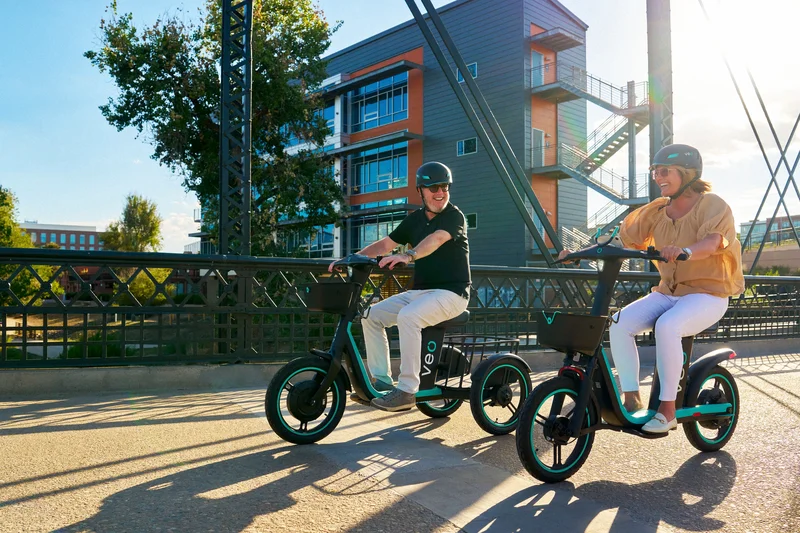
Rideshare micromobility vehicles are a common sight in major cities around the world, whether that’s a bicycle program or electric scooters. Now, a company called Veo is introducing electric tricycles into the mix.
Announced Tuesday at an event in Denver, the company showed off the Rover, a three-wheeled, sit-down electric vehicle designed for anyone to ride on the streets. They are available in Denver for now, but Veo plans to expand the vehicle to cities across the US.
The Rover works like a shared bike or e-scooter. Sign up for the Veo app, pay a fee to unlock the trike, and then ride it around. It’s 2.5 feet wide, which means it can legally fit within bike lanes that are usually three feet wide. The trike has a max speed of 10 miles per hour. Cities tend to cap these kinds of rental bikes and scooters at 15 mph, but Veo chose to go with a slower speed for safety reasons. The Rover uses the same batteries as Veo’s other EV offerings, giving it a range of roughly 45 miles per charge; on the rear is a cargo basket that can hold up to 100 pounds of luggage or groceries.
Veo is a smaller player in the micromobility space, operating in about 60 smaller cities in the US. In May, the city of Denver signed an exclusive contract with Veo to replace the city’s scooters and ebikes made by rival companies Lime and Bird. Now the sole supplier of shared bikes and scooters in Denver, Veo wanted to use the city to show off the newest addition to its micromobility collection.
The Rover is primarily an accessibility play, as three-wheeled vehicles tend to stand on their own and self-balance better than two-wheeled bikes and scooters. City governments sometimes require micromobility companies to provide options for people who need more accessible vehicles. Lime has deployed a free accessible vehicle rental program called Lime Assist that lets users in need rent accessible vehicles for the day. Bird launched its own accessible rentals program in April. Veo offers similar options but wants to make those kinds of vehicles more widely available.
“The expectation is that your local bus or transit provider will offer accessible options for those who are in wheelchairs or can't use certain products,” Alexander Keating, Veo’s vice president of policy and partnerships, tells WIRED. “There's also an expectation for us, from the cities who permit our kinds of programs, to do everything they can to make them accessible.”
Veo says it worked with disability advocates, including the Disability Mobility Initiative, Parkinson's Foundation, and Capitol Hill Village, to design the Rover, along with organizations like the AARP to make something that would appeal to older users, too. The trike’s three-wheeled design means it is self-balancing, so people can hop on without dealing with it falling over or fiddling with a kickstand.
“Our goal is to make sure that no rider has to be treated differently in order to go through more barriers to enter the system,” Keating says.
Like Veo’s other vehicles, the Rover is equipped with an AI-powered voice assistant that can talk to the rider during a ride to share directions, location information, and traffic updates. The software also has other features like lidar sidewalk-detection tech that aims to keep people from bombing down sidewalks on their Veo scooters where they aren't allowed. (Denver locals have noted that the issue hasn’t exactly gone away since Veo took over.)
The software also collects geolocation and ride details from the person on the vehicle. Keating says this information is anonymized, but the company uses this ridership data to help get a handle on what kinds of trips people use them for as it makes plans to expand the trikes into other markets.
Electric bikes are very in right now, and companies like Lectric have already built electric tricycles. Trikes are more accessible for elderly riders, but they can also be heavier and more difficult to steer. How those factors play out and whether more people will want to try them is what Veo wants to figure out in Denver. Keating says, so far, he has been surprised by the response from people who have seen the Rover.
“We want people to think it's cool; that's what gets them on it,” Keating says. “You would think, like, trikes are for kids or trikes are for someone older. I think it might be for everyone. We're going to see.”