- See more Daily Mail on Google - save us as a Preferred Source
Households on benefits where a youngster taking up an apprenticeship will leave them worse off will soon be able to receive a handout worth up to £4,500 a year.
In a bid to remove a disincentive to work in the benefits system, the Government has announced a new bursary to target families on Universal Credit.
It comes as part of a wider package of measures being unveiled by Prime Minister Andy Burnham on Tuesday aimed at tackling Britain's youth unemployment crisis.
Work and Pensions Secretary Pat McFadden insisted the welfare system should be a 'springboard to opportunity, not a barrier to it' as he set out Labour's plans.
A report by a Whitehall advisory committee, published earlier this year, found the benefits system currently distorts the choices on education and training for those aged 16 and over.
It showed that when a young person leaves full‑time education to start an apprenticeship, families can face a sudden loss in income.
The benefit losses affecting parents when their child starts an apprenticeship were calculated to range from around £17 to £340 per week, according to the Social Security Advisory Committee.
The new bursary, worth up to £4,500 a year per household, is aimed at addressing this shortfall and removing the barrier to a young person taking up an apprenticeship.
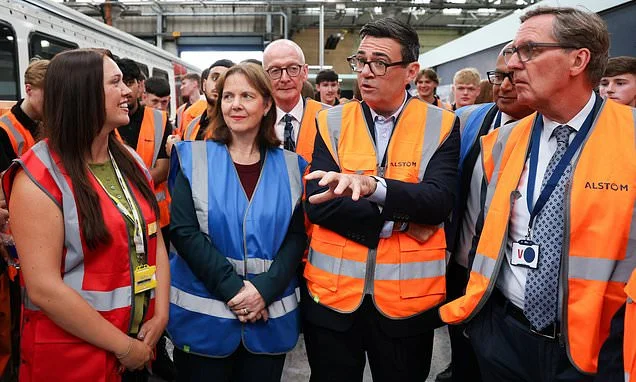
Andy Burnham, pictured with Education Secretary Lucy Powell, visited Alstom Transport in Derby on Tuesday as he pledged action to tackle Britain's youth unemployment crisis
Work and Pensions Secretary Pat McFadden insisted the welfare system should be a 'springboard to opportunity, not a barrier to it' as he set out Labour's plans
Officials pointed to the report's findings that single parents with a disabled child could lose up to £340 per week in benefits when a young person started an apprenticeship. This exceeds the expected apprenticeship salary of £258 per week.
The Department for Work and Pensions said the bursary would be funded through the Growth and Skills Levy, which is paid for by employers whose annual pay bill is more than £3million.
A Government source said the bursaries would only be available to a 'small' group of people, numbering in the 'low thousands' whose families would otherwise be left worse off if they took up an apprenticeship.
Around £30 million has been earmarked to fund the scheme. It applies to 16 and 17-year-olds who are registered as having a disability and are living in a single parent household.
Ministers fear some parents are dissuading youngsters from taking an apprenticeship because they will lose £82 a week in benefits.
The source said: 'This one-off bursary is about overcoming a short-term cost barrier to taking up apprenticeships for some of the most disadvantaged teenagers who may otherwise end up not in education, employment or training.
'Apprenticeships offer great career progression. It’s an investment in their futures and guards against a life on benefits.'
Latest data, published in May, showed the number of young people aged 16-24 neither working nor learning surpassed one million for the first time since 2013, reaching 1.01 million in the three months from January to March.
An interim report by former Labour minister Alan Milburn, also published in May, warned the figure could rise to one in six by 2031 and that Britain risks leaving behind a 'lost generation' of young people ill-prepared for work.
Small and medium-sized enterprises will also have access to financial support worth up to £8,000 for hiring young apprentices, ministers have announced.
Mr McFadden said: 'Every young person deserves the chance to build a future they can be proud of, and our welfare system should be a springboard to opportunity, not a barrier to it.
'By providing bursaries to those who need them most and fully funding apprenticeship training, we are making sure cost is not the reason someone misses out.
'Coupled with up to £8,000 in financial support for employers, this is a serious investment in the next generation and in the future of our economy.'
Mr Burnham on Tuesday said he is 'on a mission' to halt the rise in the number of young people not in education, employment or training - so-called NEETs - as he unveiled plans to open up new technical education routes to 14-year-olds.
Under his plans, pupils from Year 10 onwards will be able to combine core academic subjects, like English and maths, with technical education linked to jobs available in their area.
The changes are 'long overdue', Mr Burnham said, adding that 'it's just not right' that young people not on the university pathway feel 'they're some kind of second-class citizens'.
As part of the package announced on Tuesday, the Government also said it was investing a further £287million to create over 22,000 additional places across colleges and post-16 providers in other areas.
Working across 87 projects in England, this includes expanding construction courses, helping more young people train for careers such as bricklaying, plumbing and decorating.
Education Secretary Lucy Powell said: 'Too many young people face unnecessary barriers to apprenticeships, college places and training. We're investing to change that.
'This Government is determined to help thousands more young people gain the skills, experience, and confidence they need to build successful careers.
'The jobs of the future are already being created – and it's our job to ensure that every young person, wherever they live and whatever their background, has the skills and support they need to succeed.'
Philip Hoare, group chief executive of Balfour Beatty, said: 'Apprenticeships change lives.
'They open doors to skilled careers, help employers build the workforce they need and play a vital role in supporting long-term economic growth.
'We're incredibly supportive of the Government's commitment to removing barriers that prevent young people from accessing these opportunities and increasing support for employers investing in the next generation.
'As a long-standing champion of apprenticeships, Balfour Beatty sees first-hand the difference they make to individuals, businesses and communities across the UK.'
Abdi Mohamed, of disability equality charity Scope, said: 'This bursary is a positive step which removes a real financial barrier for some disabled young people.
'A million disabled people in the UK want to work but face significant barriers getting into and staying in employment, so it's encouraging to see the Government taking practical action.
'Life costs a lot more if you are disabled. No young disabled person should have to turn down an apprenticeship because their family would be financially worse off.'