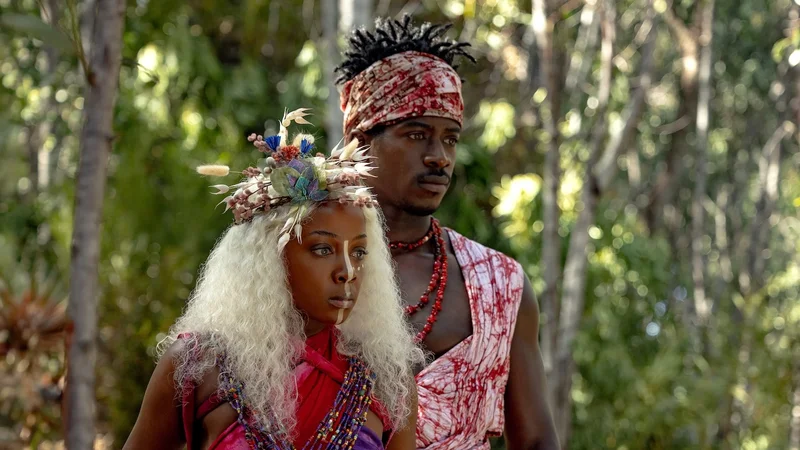
For years, Orïsha existed only in readers' imaginations.
Ever since Nigerian-American author Tomi Adeyemi introduced readers to the West African-inspired fantasy kingdom in Children of Blood and Bone, fans have imagined its palaces, debated its heroes, and envisioned its magic through BookTok, fan art, and fancasts. On Monday night at New York's Brooklyn Academy of Music, audiences finally got their first glimpse of Hollywood's vision of Orïsha as director Gina Prince-Bythewood and members of the cast — including Thuso Mbedu, Regina King, Lashana Lynch, Tosin Cole, and Zackary Momoh — unveiled the film's first trailer.
Ahead of the trailer's public release on Tuesday, Prince-Bythewood and the Children of Blood and Bone cast pulled back the curtain on adapting one of BookTok's defining fantasy novels. Set in Orïsha, the story follows Zélie Adebola (Mbedu), a young divîner determined to restore magic to the kingdom after a brutal king wipes out the maji and outlaws their powers.
During a wide-ranging conversation moderated by writer and actor Lena Waithe, who joked onstage about once serving as Prince-Bythewood's assistant, the director offered a glimpse at the years of research, collaboration, and intention that went into translating that story to the screen. She discussed everything from grounding the film's magic in African history and spirituality to training actors for months of combat and recruiting Nigerian singer-songwriter Tems to shape the soundtrack.
Gina Prince-Bythewood says she had to be ready for Children of Blood and Bone
One of the biggest revelations of the evening was that Prince-Bythewood almost never directed Children of Blood and Bone at all.
The filmmaker revealed she'd been approached to direct the adaptation three separate times over the last seven years. Twice, she turned it down.
Looking back, she said the timing simply wasn't right. "I was not emotionally ready," Prince-Bythewood told Waithe. "And I think actually I didn't know how to make this yet."
It wasn't until after directing Netflix's The Old Guard and the critically acclaimed historical epic The Woman King that she felt she had developed both the technical confidence and emotional perspective to take on Adeyemi's sprawling fantasy universe. "There was something about this third time," she said. "It happened when it was supposed to happen."
"When I read it, I just felt so connected to this young hero who's fighting to find her purpose."
The connection, Prince-Bythewood explained, wasn't just about scale. She found herself deeply identifying with Zélie, the young heroine fighting to reclaim magic in a world that has tried to erase it.
"When I read it, I just felt so connected to this young hero who's fighting to find her purpose," Prince-Bythewood said. At a moment when "so much is going on in the world right now," she added, the novel's themes felt newly urgent. Like her previous films, she hopes audiences leave Children of Blood and Bone understanding what she's trying to say but also "leave with hope."
That sense of purpose also shaped the way Prince-Bythewood viewed the adaptation itself. Rather than simply translating a bestselling novel to the screen, the director saw an opportunity to push fantasy somewhere Hollywood has rarely gone before. "I couldn't say no," she said. "It was something even bigger in a space that we hadn't got to see ourselves in, which is fantasy and big, epic fantasy."
Building Orïsha meant looking beyond Hollywood fantasy
Prince-Bythewood said one of the biggest challenges wasn't simply designing Orïsha. It was deciding what its magic should look and feel like.
The filmmaker never wanted the core kingdom of Children of Blood and Bone to feel like a familiar fantasy world with African influences layered on afterward. Instead, she and Academy Award-winning production designer Hannah Beachler (Black Panther) began with what Prince-Bythewood called a deceptively simple question: "How do we make magic feel cultural?"
The answer led them in unexpected directions. Beachler researched Ethiopian palaces and ancient African civilizations that Prince-Bythewood said have too often been erased from mainstream history. "The beauty of so much of our history is erased," Prince-Bythewood said. "Nobody knows that we had these great civilizations."
"How do we make magic feel cultural?"
Together, they envisioned Orïsha as a fantasy kingdom rooted in Nigeria and Yoruba mythology while embracing cultures from across the African diaspora — a world where, as Prince-Bythewood put it, "all of us" could see ourselves reflected.
That philosophy extended into every department.
Costume designer Charlese Antoinette Jones (Judas and the Black Messiah) brought not only her design experience but also her perspective as an Orisha priestess, helping shape colors and symbolism throughout the film. Hair designer Andrea Mona Bowman (The Piano Lesson) spent months testing how to create Zélie's signature white hair while showcasing a wide range of braids, textures, and styles across the cast. Dialect coach Yetunde Felix-Ukwu (Sinners) developed the film's Orïshan language while ensuring its Yoruba pronunciation remained authentic. Makeup, tattoos, title design, choreography, and even the mythology surrounding the gods of Children of Blood and Bone were approached with the same level of cultural specificity.
Even the film's magic system grew out of unexpected research. When developing the film's production design, Beachler came across studies suggesting that human skin naturally emits tiny amounts of light. For Prince-Bythewood, the discovery sparked an idea.
"When I'm trying to figure out what our magic is going to feel like, the fact that that's a real thing was fascinating," she said. The filmmakers paired that concept with scarification traditions that Prince-Bythewood wanted audiences to see "not as something villainized," but as something beautiful.
That commitment to authenticity also shaped where the movie was filmed. Rather than surrounding actors with digital environments, Prince-Bythewood insisted on shooting "on the continent" in South Africa and building practical sets that performers could physically inhabit. She described the approach as "grounded fantasy," providing actors with complete environments rather than green screens whenever possible. Some locations required three- and four-hour drives followed by steep hikes to remote waterfalls and landscapes millions of years old, experiences Prince-Bythewood believes ultimately found their way onto the screen.
"You want things to feel real," she said. "I wanted to give the actors this 360 world to play in."
Fantasy storytelling begins with people
For all of Children of Blood and Bone's sweeping landscapes, elaborate costumes, and sizable battle sequences, Prince-Bythewood insisted the film could only succeed if audiences first cared about the people at its center.
"The big set pieces, the great action scenes, don't mean anything if you don't care about the characters," she said. "If there's no stakes."
That idea shaped everything from casting to combat training. Prince-Bythewood said she prefers to "turn your actors into athletes," putting performers through months of intensive stunt training so they can perform much of the action themselves rather than relying on doubles. Mbedu, who plays protagonist Zélie, began training six months before filming. Tosin Cole, who plays Zélie's brother Tzain, trained for four months to master his character's axe-fighting — and, according to him, it was one "heavy-ass axe."
"The big set pieces, the great action scenes, don't mean anything if you don't care about the characters."
But the emotional work proved just as important. Cast members described Prince-Bythewood not simply as a director, but as a collaborator, someone who encouraged difficult conversations in pursuit of emotional truth.
Cole recalled spending nearly an hour discussing a single line of dialogue between Tzain and his father, Baba, played by Momoh. Rather than simply having them say "I love you" to one another, the actors questioned whether those words felt true to the relationship they were building. Together with Prince-Bythewood, they ultimately found another way to communicate the emotion.
"It was a little line," Cole said. "But it meant so much in a deeper way... just being true to that world." Those conversations, he added, made the cast feel "free and safe to give everything that we got."
Momoh said the discussion reflected Prince-Bythewood's larger commitment to intentional storytelling. "Regardless of how it went down, I think what we got was beautiful," he said. "We need to see Black men showing love to each other. If it's the thing of saying 'I love you,' or if it's any other way." The fact that the team spent time on this single exchange, he added, spoke to the care Prince-Bythewood brought to every scene. "We see you," Momoh added, addressing Prince-Bythewood directly. "Because you are for us, by us."
Lashana Lynch, who plays Zélie's and Tzain's mother Jumoke, described the director's instincts as "guttural." The actor, who previously worked with Prince-Bythewood on The Woman King, said she trusted the filmmaker to push actors beyond what they believed they were capable of while creating an environment where they felt safe doing so. "We became whole other people off the back of this experience," Lynch said.
Mbedu laughed as she recalled how the director would sometimes remove her own jacket during cold shoots, so the cast wouldn't feel they were suffering alone. "She will never ask us to do something she wouldn't do," Mbedu said.
When Waithe asked the cast how making Children of Blood and Bone had changed them, none of them talked about the scale of the production or the marvel of bringing Orïsha to life. Instead, they spoke about what the story had awakened in themselves.
Cole described rediscovering a deeper sense of purpose through his character. Momoh said portraying a Yoruba father while becoming a father himself reconnected him to his Nigerian ancestry and spirituality. Lynch said the story reminded her that "the magic isn't rooted in fantasy. It's rooted in us," describing the film as a reminder that the magic Black people have carried "since the beginning of time" has endured despite generations of brutality and erasure.
King, meanwhile, who plays Queen Nehanda, zoomed out from the personal to the cultural. She predicted Children of Blood and Bone would become a landmark for fantasy filmmaking.
"I believe there's going to be storytelling on film that was before Children of Blood and Bone and after," she said.
Tems helped shape Orïsha before cameras ever rolled
Before revealing the trailer, Prince-Bythewood saved one final surprise for the audience. Long before cameras rolled, she explained, she'd been writing the screenplay while listening to two songs on repeat: Tems' "Try Me" and Burna Boy's "Alone."
"They were so intrinsic to my writing," she said. And that connection ultimately evolved into one of the night's biggest announcements.
Prince-Bythewood revealed that Tems served as executive producer of the film's soundtrack, calling her the first woman to do so at this scale. Burna Boy joined the project as executive music consultant, while the soundtrack also features three new songs from Tems alongside contributions from Nigerian artists Fireboy DML, BNXN (formerly known as Buju), and Ayra Starr.
Whether this version of Orïsha matches the one readers have carried in their heads remains to be seen when the film arrives in theaters next January. What is clear, however, is the care with which Prince-Bythewood and her collaborators approached the adaptation. More than an exercise in world-building, Children of Blood and Bone became an act of world-believing.
Crystal Bell is the Digital Culture Editor at Mashable, where she leads coverage of the creator economy, internet culture, and digital life. Her work focuses on the people, platforms, and communities shaping modern entertainment, from YouTube creators and livestreamers to fandoms, social media trends, and the evolving relationship between technology and culture. She also oversees the Mashable 101, the publication's annual list recognizing the internet's most influential creators.
Previously, she was the entertainment director at MTV News, where she helped expand the brand's coverage of fan culture, K-pop, and the internet's most passionate communities. Her work has appeared in Teen Vogue, Rolling Stone, PAPER, NYLON, ELLE, Glamour, NME, W, The FADER, and elsewhere on the internet.
She's exceptionally fluent in fandom and will gladly make you a K-pop playlist and/or provide anime recommendations upon request. Crystal lives in New York City with her two black cats, Howl and Sophie.