For the last three years, we’ve all been asking the same question. “Who will build the smartest AI?” Will it be OpenAI, Google, Anthropic, DeepSeek, xAI? etc.
It’s a fascinating race, but I think it’s distracting us from a much bigger story. The more I watch what’s happening around the world, the more convinced I become that the defining question of the next decade won’t be who builds intelligence.
Rather, it will be who gets access?.
We Keep Talking About AI, Yet Governments Keep Talking About Compute.
Over the past year, the headlines have seemed unrelated. The United States has continued tightening export controls on advanced AI chips and semiconductor technology. China has reportedly been considering restrictions on overseas access to some of its most advanced AI models.
On the surface, these appear to be separate policy decisions, and I mean, why wouldn’t they be? One is about chips and the other is about models.
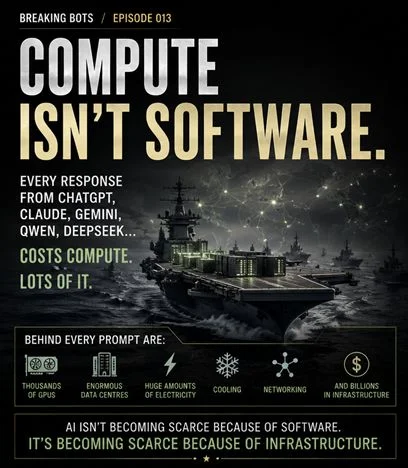
I don’t think they are separate stories; I think they’re both symptoms of the same strategic shift. Governments have realised something the rest of us are only just starting to understand. Artificial intelligence isn’t just software anymore; it’s infrastructure.
Intelligence Has Become a National Resource
For most of computing history, software was infinitely scalable. Think about that for a second, because if someone wrote a great application, anyone with a computer (now a phone) could eventually run it.
AI changes that equation, profoundly, because every prompt you send to ChatGPT, or Claude, Gemini, DeepSeek, Qwen, or whatever is the flavour of this week, you are consuming physical resources. Thousands of GPUs, massive data centres, electricity, cooling systems, high-speed networking, the latest semiconductor manufacturing. The limiting factor isn’t imagination; it’s infrastructure, and in history, infrastructure has never been equally distributed.
History Doesn’t Reward Unlimited Access
Every major industrial revolution eventually arrived at the same question.
Who gets access?
Who gets electricity? Who gets oil? Who gets radio spectrum? Who gets satellite bandwidth? Who gets advanced semiconductors? You get the gist.
Every transformative technology eventually becomes strategic, and it’s always for different, potentially complex reasons. For example, sometimes governments wanted control, and sometimes because supply was limited, and more commonly because both were true at the same time.
Which raises an uncomfortable question: Why should intelligence be different?
The Real Scarcity is Compute, Not AI
We often talk about AI as though intelligence itself is becoming abundant. But in reality, as I have learned, what we’re making abundant is access to interfaces. The intelligence underneath still relies on an enormous amount of scarce infrastructure.
The latest NVIDIA GPUs, TSMC fabrication capacity, Power generation, Land for hyperscale data centres, fibre networks, transformer capacity, skilled engineering talent, and the list goes on. The world isn’t short of ideas, but it could well become short of the infrastructure required to execute them. That’s quite the pickle to be in.
Distribution Is Becoming The Real Battlefield
The internet connected people, and AI has the potential to amplify people. To me, at least in my mind, those are fundamentally different things.
The internet’s biggest challenge became distributing information, and AI’s biggest challenge may become distributing intelligence. That sounds abstract and like a totally random statement, until you ask a practical question. Imagine a future where demand for frontier AI grows faster than the world’s ability to build compute.
Who gets priority? We have seen countries like China limit 90% of airspace to the military, so why won’t distribution be the same for AI. Will countries favour Military systems? Critical infrastructure? Scientific research?Healthcare? Universities? Large corporations? Small businesses? Individual citizens?
To me, there isn’t an obvious answer, and there probably won’t be one answer for every country. That’s why the question becomes so important. I’ve heard people say it will just go to the highest bidder, and that may well be the case in some countries. If history is a teacher, then maybe that amount people are bidding for is only equivalent to 10% of the total, or less.
The World May Not Build One AI Future
Much of today’s discussion assumes AI becomes a universally available utility, and maybe that’s exactly what happens. I use it a lot and can see the benefits, so I hope it does. But history suggests another possibility: different nations having different priorities due to different political systems and different security concerns, and different economic goals.
Those differences shape how strategic resources are allocated, and therefore you need to ask yourself: why would AI be exempt?
Rather than one global intelligence layer, we may see multiple competing ecosystems emerge. An American ecosystem, A Chinese ecosystem, a European sovereign AI, national compute clouds, regional AI alliances.
Each country is bound to have different rules, with different models, different access, and certainly different priorities.
If that happens, we no longer sit around and debate which chatbot is better; we instead sit around and ask which intelligence ecosystem we belong to.
I’m Not Making This About China
It’s tempting to frame all of this as a China story, and I think that’s a mistake, and it would be easy because China happens to be generating headlines today.
The United States has been making strategic AI decisions for years, and Europe is investing heavily in sovereign AI capabilities. The Middle Eastern nations are building some of the world’s largest AI infrastructure projects, and India is rapidly expanding domestic AI capacity.
It’s not East vs West; it’s more about the way the different countries play their hands and approach this very important set of decisions they have to make. Make no mistake though: the world’s largest economies are beginning to treat intelligence as strategic infrastructure. Once that mindset takes hold, the policy decisions become much easier to understand. Personally speaking, I think you can already see this forming everywhere you look.
The Question Nobody Is Asking
Twenty years ago we argued over who owned the data, and today we debate who owns the models. I suspect the next decade will revolve around a different question altogether. Who owns the compute?
Because ownership determines access, and that access will determine innovation. Innovation has always determined economic power, and economic power has always shaped geopolitics. Why would this be any different this time?
If intelligence becomes one of the world’s most valuable resources, then the ability to distribute it may become just as important as the ability to create it and even more so in many aspects. That doesn’t mean we’re heading toward an inevitable AI Cold War, although that is a tasty headline.
We might see compute become so abundant that these concerns fade away and perhaps open-source innovation outpaces centralisation. Perhaps governments deliberately choose openness over control, and I think it's possible for some countries, as we are already seeing early signs of them leaning in this direction.
We currently live in an age that has infinite possibilities, but one thing I think, personally, is that countries will compete over intelligence rather than over software.
And that would mean we have to stop treating intelligence as software and start treating it as infrastructure. If that seems obvious to me, then I am well and truly sure that these countries are already planning for a future where they believe the same thing. Now it just depends on where they think that infrastructure should be distributed and how they believe the usage will shape their country's future.
What do you think?
If frontier AI becomes as strategically important as electricity or semiconductors, should governments treat it as critical national infrastructure, or should access remain as open as possible?
As always, I would love to hear your thoughts.