Exclusive: Does the UK's 'don't talk to the Muslim Council of Britain' policy actually exist?
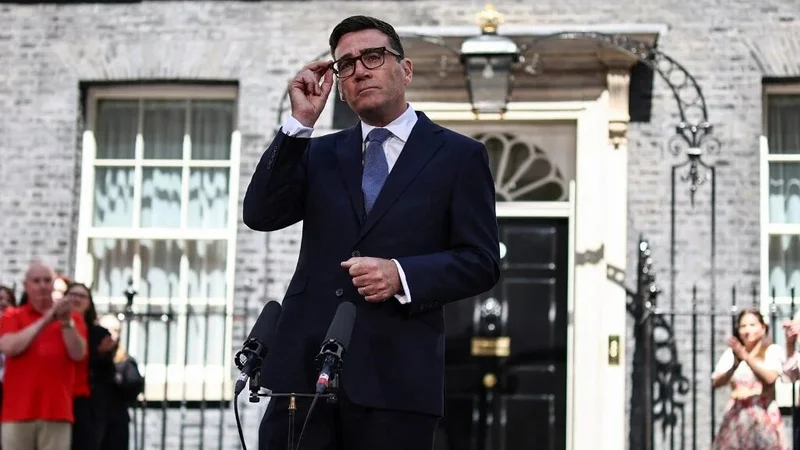
Andy Burnham's government has said it is sticking to a policy of refusing to engage with the Muslim Council of Britain (MCB) that it has inherited from previous governments.
But a Middle East Eye analysis can reveal that the "non-engagement" policy appears to be a phantom, as no written records of an actual policy appear to exist.
No relevant government department has taken responsibility for it - documents seen by Middle East Eye reveal that these departments say they do not hold any information on the alleged policy.
It is unclear which department is even officially responsible for the declared policy, or what the official justification for the boycott of the MCB is.
Multiple sources close to the government said that the new Burnham government is keen to mend relations with British Muslims, many of whom turned away from Labour during Keir Starmer's premiership.
The questions surrounding the origins of the no-contact policy with the MCB come after it was revealed last week that a mosque is attacked in the UK every five days.
But the boycotted MCB is the largest umbrella body claiming to represent British Muslim organisations, with more than 500 affiliates.
The Telegraph reported on Monday that the Burnham government's new equalities minister, Sir Stephen Timms, spoke on a panel alongside an MCB representative last December.
The Telegraph quoted a government spokesperson saying: "There has been no change to our non-engagement policy regarding the Muslim Council of Britain, and there are no plans for ministers to meet with the group.”
But what exactly is the basis of this policy? Does anyone in government know?
In search of the 'non-engagement policy'
A recent response by the Ministry of Housing, Communities and Local Government to a Freedom of Information Act request asking for any policy documents, guidance, finalised briefing notes or submissions to ministers "that set out or refer to a policy of non-engagement with the Muslim Council of Britain" offers no clues.
The response, dated 16 June and seen by MEE, says "the information you requested is not held by the Department".
A Cabinet Office response on 27 May to the same request, also seen by MEE, says "that following a search of our paper and electronic records, we have established that the information you requested is not held by the Cabinet Office".
And a Home Office response on 22 June says: "We can confirm that no information is held that meets the criteria of your request."
MEE has emailed the UK Office for Equality and Opportunity, which is part of the communities ministry, as well as the ministry itself, asking what exactly the non-engagement policy is and what the official justication is for not engaging with the MCB.
A spokesperson for the MCB said: “This so-called policy of non-engagement is a historic relic. It was built to appease those who trade in Islamophobia, and it survives only by recycling decades-old allegations that have never withstood scrutiny."
Prime Minister Burnham himself has previously engaged with the MCB, including giving a speech at an MCB Muslim Leadership Dinner in 2015.
A search for the rumoured policy's origin
So what is the exact origin of this elusive, rumoured policy of non-engagement? It is often reported that the policy has been in place since 2009. But this is untrue.
That year the MCB was indeed briefly boycotted by Gordon Brown’s Labour government after its then deputy secretary general, Daud Abdullah, signed the so-called Istanbul Declaration in Turkey.
According to the government, the declaration called for attacks on Royal Navy vessels if they tried to stop weapons for Hamas entering Gaza.
Abdullah said: "I did not and do not condone calls for attacks on British troops.”
The MCB denounced the statement, which it said was signed by Daud in a strictly personal capacity. Daud resigned and the Labour government resumed engagement with the organisation.
Ministers in the coalition government also held meetings with the MCB between 2010 and 2015. Civil servants continued to meet with the MCB until March 2020.
That was when the organisation produced a dossier outlining what it said was evidence of Islamophobia against more than 300 individuals, including Conservative MPs, councillors, party members and special advisers inside 10 Downing Street.
That same month, civil servants reportedly broke off relations with the organisation - for unknown reasons.
Yet even after that the MCB worked with the Ministry of Defence (MoD) by serving as a referee for imams applying to become military chaplains.
But this was not public knowledge. In late October 2023, the Telegraph revealed that the MCB was working with the MoD.
As a result, in early November that year, government ministers ordered the MoD to cut all ties with the MCB.
In 2024 a major interfaith charity, the Inter Faith Network (IFN), was forced to close after the Conservative government withdrew its funding - because one of its trustees was an MCB member.
Non-Muslims in Liverpool are protecting their local mosque from potential attacks as far-right rallies are expected to take place across the UK this weekend. pic.twitter.com/D5tO5C8GR4
— Middle East Eye (@MiddleEastEye) August 3, 2024
The Labour government under Starmer then adopted the same approach. MEE revealed in July 2024 that the government had not been responding to communications from the MCB throughout the far-right riots which swept the country that summer.
MEE also revealed last July that the government blocked a working group it set up to advise on a possible definition of Islamophobia from consulting the MCB.
The alleged "non-engagement policy" itself has proved impossible to pin down.
The MCB continues to have significant reach among Muslim civil society organisations and its leadership remains democratically elected.
Whether Prime Minister Burnham - who spoke at an MCB dinner years six years after the claimed non-engagement policy began - will change course and engage with the organisation remains to be seen.