Marcos wants laundering, secrecy laws amended
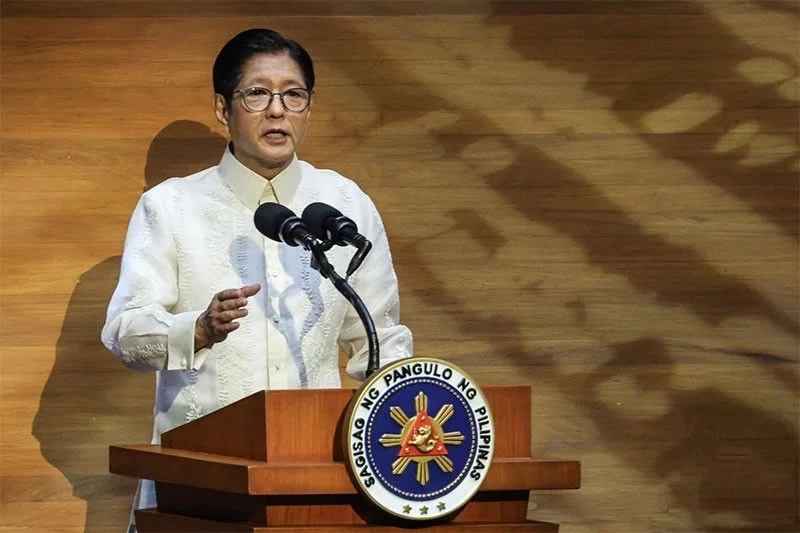
MANILA, Philippines — As corruption issues continue to bedevil his administration, President Marcos said he is pushing for amendments to the laws on bank secrecy and anti-money laundering to help restore public trust and confidence in government institutions.
In a report released after his fifth State of the Nation Address (SONA), Marcos also vowed to be steadfast in upholding “sound economic governance and financial inclusion” amid heightened global tensions and uncertainty.
“We are advancing legislation intended to enhance public confidence and strengthen transparency and accountability in government,” the President said in the 250-page report.
Aside from calling for amendments to the Bank Secrecy Law, the Anti-Money Laundering Act and the Philippine Budgeting Code, the President also called on Congress to approve the proposed Citizen Access and Disclosure of Expenditures for National Accountability Act and the Right to Information Act.
Amendments to the country’s bank secrecy laws are contained in the proposed Banking Reform for Integrity, Good Governance, Honesty and Transparency (BRIGHT) Act, one of the priority bills of the Legislative-Executive Development Advisory Council.
The measure allows the disclosure and examination of bank deposits under certain conditions, including investigations or inquiries by the Office of the Ombudsman, issuance of an order by a competent court in relation to a pending case before it; investigations by the Senate, House of Representatives or any of its committees, including those conducted in aid of legislation and impeachment-related proceedings; supervisory examinations or inquiries conducted by the Bangko Sentral ng Pilipinas and investigations by the Anti-Money Laundering Council, Bureau of Internal Revenue, Securities and Exchange Commission, Philippine Deposit Insurance Corp. and Insurance Commission.
The bill also enumerates sanctions against those who initiate, conduct or use any investigation or examination of accounts without legitimate purpose, for political persecution or harassment, to hamper competition in trade.
Also outlined are sanctions against those who refuse to disclose or report deposits without justifiable reason and against those who unlawfully disclose to any unauthorized person any information or detail regarding a deposit, account or related financial transaction.
Government processes were subjected to intense scrutiny after Marcos ordered an investigation on non-existent and substandard flood mitigation structures during his fourth SONA last year.
P118.5 billion lost to corruption
The finance department has estimated that the Philippine economy may have lost some P118.5 billion annually from 2023 to 2025 to corruption in flood control projects.
The multibillion-peso corruption controversy was the first issue Marcos raised during his penultimate SONA last Monday, with the President disclosing that cases are being readied against his cousin, former speaker Martin Romualdez.
The former speaker has denied involvement in anomalous projects and has vowed to prove his innocence through proper processes.
“We will continue to work tirelessly to deliver an honest and responsive government that is fully accountable to the Filipino people and worthy of their trust. Central to this commitment is our firm stance against corruption,” he said.
“We will relentlessly investigate corrupt practices until justice is secured and perpetrators are held accountable, including those within government ranks. We are committed to pursuing accountability through every available legal mechanism until all cases are resolved.”
Marcos said the uncovering of flood control irregularities and other corrupt practices has affected the perception of the Philippines by the international community and investors.
He cited the latest Corruption Perceptions Index, which saw the country falling four places from 116th in 2022 to 120th in 2025. The report covered 180 countries and territories in 2022 and 182 in 2025.
“We acted swiftly and decisively to curb corrupt practices. At the same time, we continued to strengthen and expand our digital systems, while we empowered the LGUs (local government units) as vital partners in driving national development,” the Chief Executive said.
Marcos reported the launch by his administration of a website that allowed citizens to report questionable projects last August. As of May 31, the website has received 11,927 reports involving flood control projects. Of these, 11,756 were found to have issues – 6,541 were defective, 2,960 were “ghost” or non-existent and 2,255 were unfinished – and were referred to concerned agencies for verification and immediate action.
He added that the Independent Commission for Infrastructure, created in September last year through Executive Order 94, has turned over all documents, pieces of evidence and other findings to the Office of the Ombudsman.
“These included nine referrals covering 65 individuals recommended for the filing of criminal and administrative charges or for further review,” Marcos said.
The President also reported that 6,692 bank accounts have been frozen while P24.7 billion worth of assets have been preserved, seized or surrendered in relation to the controversy.
The administration has also inspected 10,238 flood control projects from Sept. 13, 2025 to Jan. 1 this year, 416 of which were initially found to be substandard or non-existent and were subjected to further technical inspection by the ICI.
Marcos also cited his order for the trade department to revamp the Philippine Contractors Accreditation Board to ensure that only qualified contractors are awarded government projects.
‘Systemic solutions’
Emphasizing the need for “systemic solutions” to corruption, Marcos said his administration is accelerating e-governance initiatives to eliminate opportunities for the misuse of public funds. He said the government aims to fully operationalize the National Single Window, the national platform that will facilitate end-to-end trade-related services, by June 2028.
The government, the President added, is also working on the integration and interoperability of essential government systems within the eGovPH Superapp before 2028.
In the same report, Marcos sought the enactment of laws that would allow his administration to carry out its programs and reforms.
Aside from the anti-corruption bills, the President is seeking the enactment of the proposed eBayad Act, a measure creating the Department of Water Resources and Water Regulatory Commission, amendments to the Rice Tariffication Law, Coconut Farmers and Industry Trust Fund, Fisheries Code, Expanded Government Assistance to Students and Teachers in Private Education Act, Seal of Good Local Governance Act of 2019 and Electric Power Industry Reform Act, the proposed Congressional Commission on Agriculture, Fisheries and Food Security Act, the proposed National Land Use Act, the classroom building acceleration program bill and waste-to-energy bill.
- Latest
- Trending