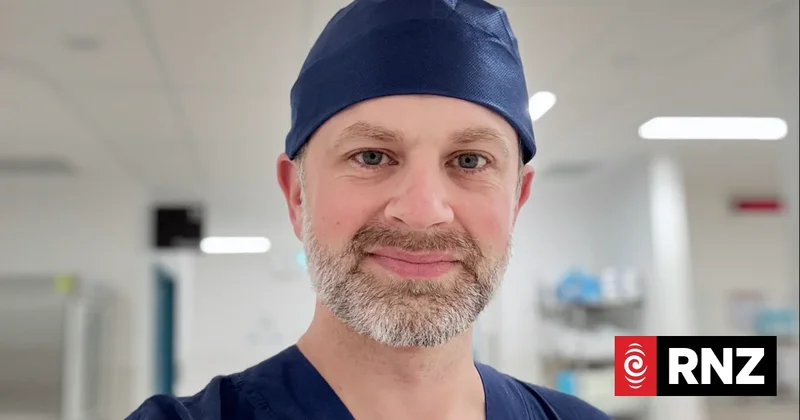
Australian surgeon pledges Kiwi patients' fees towards new vascular compressions research
The new RNZ investigative series All in Her Head has prompted an Australian surgeon to put his Kiwi patients' fees towards new research into a controversial and unfunded condition.
Canberra vascular surgeon Gert Frahm-Jensen has treated nine New Zealanders with multiple abdominal vascular compression syndromes - a rare and controversial condition in which blood vessels are squeezed, causing pain, nausea and, in severe cases, an inability to eat. He said he has consulted on about 20 New Zealand patients seeking treatment.
There are four main types of abdominal vascular compression syndrome, plus one in the pelvis. Having a single compression syndrome is - according to medical literature - extremely rare. But people with the connective tissue disorders hypermobile Ehlers-Danlos syndrome (hEDS) and hypermobility spectrum disorder (HSD) are increasingly being diagnosed with up to all five at once, a trend that is dividing doctors.
The controversy is laid out in detail in All In Her Head, an RNZ podcast and multimedia investigation that examines the debate from all sides.
There is no scientific consensus on the link between hEDS/HSD and multiple abdominal vascular compression syndromes, whether patients can genuinely have more than one, or whether surgery is the answer.
While Health New Zealand will fund surgery to treat a single compression syndrome if needed, surgery to fix multiple compressions at once is not offered publicly or privately. Its official guidance goes further, warning against paying for surgery overseas, describing the operations as "experimental", with results "mostly of no benefit or significant harm".
Vascular Society of Aotearoa chair Kes Wicks said he had seen this in his own patients who had sought surgery overseas. The evidence simply "doesn't exist" to justify treating multiple compressions in hEDS and HSD patients, he said.
AIHH Episode One - The Girl Who Couldn't Eat
Those views, aired in the first episode of All In Her Head, have now prompted Frahm-Jensen, who had already been weighing up a research study, to act.
"We want to do more research on compression disorders... but I guess your podcast has just given us some impetus to really put the gears into motion, so to speak," he told RNZ.
He was "disappointed" in Health NZ's position.
"So I thought, well, why don't I put the fees that New Zealand patients pay me to come here and have surgery? I'll gladly donate that towards this research project until we get some data that can inform practice one way or another."
** New episodes of All In Her Head are out every Wednesday on RNZ, Apple, Spotify iHeart and wherever you get podcasts.*
The study will track outcomes for patients having multiple abdominal vascular compression surgery - not only his own patients, but hopefully those of other doctors too.
"We're hopeful that we can develop a model where we can actually determine in what domains people benefit after surgery," he said.
"If we find that the majority of people do not actually have any benefit after surgery, or they report poor outcomes, then really that is a positive finding in a way, because that stops patients from having potentially major operations with very little improvement.
"And vice versa, if we can show that people actually do have a positive result ... that can really help to drive perhaps some reform, or maybe even some funding for the same research to be done in New Zealand on New Zealand patients," Frahm-Jensen said.
The study still needed to get ethics approval, but he hoped it would be up and running within three to six months.
"If the information turns out to to support treatment of multiple vascular compressions, then maybe that will be enough to shine the spotlight on it in New Zealand, so that these patients don't have to travel internationally to get surgery because it is a luxury for people who can afford it," he said.
'Alarm bells' over surgeries
Frahm-Jensen said he operates on up to three compression syndromes at a time, and will do these in the public health system for Australian patients where warranted.
His willingness to operate puts him at odds with New Zealand's vascular establishment.
Wicks, who has practised for three decades, said he has personally never confirmed a case meeting the threshold for surgery in a hypermobile patient, despite assessing several.
He described patients returning from overseas surgery with unresolved or worsened symptoms, in one case seeking a reversal that isn't medically possible. "That raises alarm bells," he said.
Frahm-Jensen said surgeons like Wicks may be subject to "observership bias" - seeing only the patients whose surgery didn't work, because those with good outcomes don't return to the public system.
His own patients had "mostly positive to moderately positive" results from the surgery, he said, though some had no change in symptoms at all.
Frahm-Jensen has only been offering this surgery for the past 18 months, and will only operate on patients older than 17.
Rachel Weatherly, from Whakatane, had surgery with Frahm-Jensen in September 2025 on two compression syndromes. Her journey is documented in All In Her Head. She now lives pain-free.
Many New Zealand patients instead travel to Germany for similar surgery with Professor Wilhelm Sandmann, who will operate on younger patients and uses slightly different surgical techniques. Health NZ withdrew public funding for his surgery in 2023 after a review found his methods experimental and risky.
Hamilton vascular surgeon Chris Holdaway has travelled to Germany to observe operations performed by Sandmann, with a view to performing similar surgeries in New Zealand but has been unable to get approval from the New Zealand health system to do so.
NZ 'not currently considering' its own research
Dr Frahm-Jensen said New Zealand's health system may actually be well placed to answer some of the unresolved questions around these surgeries. He pointed to New Zealand's reputation for supporting clinical research, including early trials of new medical devices in vascular surgery, as New Zealand had a more streamlined pathway than Australia for trialing new devices.
"I would have thought perhaps New Zealand would actually be ripe for doing this kind of research," he said.
Health NZ did not respond to RNZ's specific questions about the surgery now being offered in Canberra.
In a statement, national chief medical officer Dame Helen Stokes-Lampard said clinicians "always strive to provide effective treatments based on the best available evidence and that are in our patients' best interests, and appropriate for their individual needs". The health service avoided "inappropriate clinical interventions that risk causing unnecessary harm", she said.
Clinicians "regularly consider new and updated scientific evidence" on the benefits and wellbeing of patients within the public health system, in line with Medical Council principles.
The Vascular Society has also called for more research, suggesting Health New Zealand could fund a clinical registry of hEDS/HSD patients to track their condition and treatment outcomes over time.
Health NZ said it was currently doing a stocktake of all its clinical registries.
"While this work is ongoing we are not currently considering establishing any more clinical registries," it said in a statement.