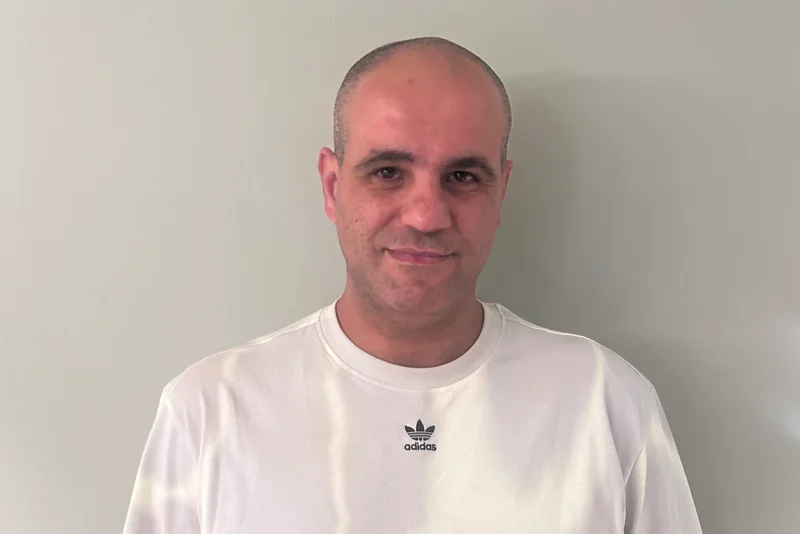
A man who fears persecution in Iran has spent 15 years in the UK battling a failed asylum claim, homeless and unable to lead a normal life, after repeated refusals by the Home Office to allow him to stay.
In the more than a decade he has been trapped in the asylum system, Mostafa Rahmani has not been allowed to work and has refused Home Office accommodation for most of his time in the UK – forced to depend on the kindness of friends to get by.
Mr Rahmani, now 41, he arrived in the UK from Iran in 2011 as a 24-year-old student looking to learn English. He came on a student visa, but claimed asylum a few days after arrival when he says Iranian security forces turned up at his family’s home in Tehran looking for him. He said that he had taken part in anti-government protests in 2011.
Since 2012, he has been involved in an Iranian women’s rights campaign group in the UK, called 8mars, relying on its members for support and friendship. He says he is at risk of persecution and death at the hands of Iran’s security forces if he returns due to his anti-government campaigning. But the Home Office disagrees, saying that Mr Rahmani does not hold a sufficient political profile in the UK or Iran to be considered at such risk.
Mr Rahmani, supported by Birchtree Law Chambers law firm, has had his asylum application rejected several times and is now waiting to hear the Home Office’s verdict of his latest challenge.
Speaking about his time in limbo in the UK, Mr Rahmani told The Independent: “My programme and dreams for my life, for years and years, are all gone.”
He explained: “I used to sleep in the street, and in an Asda parking area, or on buses. Often big apartment blocks have rubbish rooms, and when it was cold I would sleep there. One supermarket was in Wembley, another was in Acton. Sometimes I would stay in churches and they would give me food.
“I made friends and I could go to different places to shower if I needed, around Enfield and Acton.”
“It is only recently that I have been allowed accommodation from the Home Office, but even now it is sometimes better to live on the road than stay in their accommodation. I have to share a bunk bed with a man who talks all the time to his family back in Afghanistan, which makes it hard to sleep. So when that happens, I go out and look for a bus to sleep.”
Iran has been the most common country of nationality among asylum applicants and small boat arrivals to the UK in recent years. Around 63,000 Iranian citizens applied for asylum in the UK in the decade between 2016 and 2025, according to data analysis by the University of Oxford’s Migration Observatory.
Last year, 58 per cent of Iranians were granted asylum the first time they applied. However, those who are refused are unlikely to be sent back as very few Iranians are deported due to the country’s terrible human rights record, and since March 2026, conflict with the US and Israel has engulfed the country and wider Middle East region. In the first three months of 2026, 42 Iranians were forcibly deported from the UK, and 15 people returned voluntarily, Home Office data shows.
Mr Rahmani described his life before the UK, saying: “Back in Iran I had my own car, I had my father to support me, I had a good life, I had my own room. My situation here, it is not comparable to the standard of living that I had. I thought about going back to Iran so many times, but the Iranian government kill and hang people and I know I cannot.
“Most of all I wish for a visa so that I can go abroad to see my mum, who is 70 years old. I hope that I can one day meet my parents in Turkey, before anything happens to them. My friend got his visa after eight years but his mother died before they could reunite – I am worried this will happen to me.”
His friend Leila Parnian, a member of 8mars has known him for 20 years. Speaking about his time in the UK, she explained: “They did not give him a chance to live like a normal person. He doesn’t have a future, a life, kids or work. He’s stuck here. For 15-16 years, they have played with his life and he doesn’t have anything. Not even one room for himself to do what he wants.
“He doesn’t know what to do with his life, he cannot stay here like this. He cannot go back to his country. Every day the Islamic regime is hanging young people. It’s not fair, to play with somebody’s life for nearly 16 years, without any reason.
“He came as a young person and he is now 41, and he has nothing in his hands.”
Rashad Nawaz, director at Birchtree Law which is supporting his asylum application, said: “Having worked on Mr Rahmani’s case I can say he is genuinely committed to his cause and has over a decade consistently informed the secretary of state about his work campaigning for women’s rights in Iran.
“8mars have very clearly stated that his life would be in danger upon return to Iran because of his political activities in the UK. Mr Rahmani puts on a brave face when facing the world but I have witnessed first-hand his mental health deteriorating.
“It is frankly bizarre for the secretary of state to consistently deny Mr Rahmani permission to stay when she cannot remove him to Iran because she accepts Iran has an awful human rights record. I hope sense will prevail and he is given permission to stay."
The Home Office said it does not comment on individual cases.