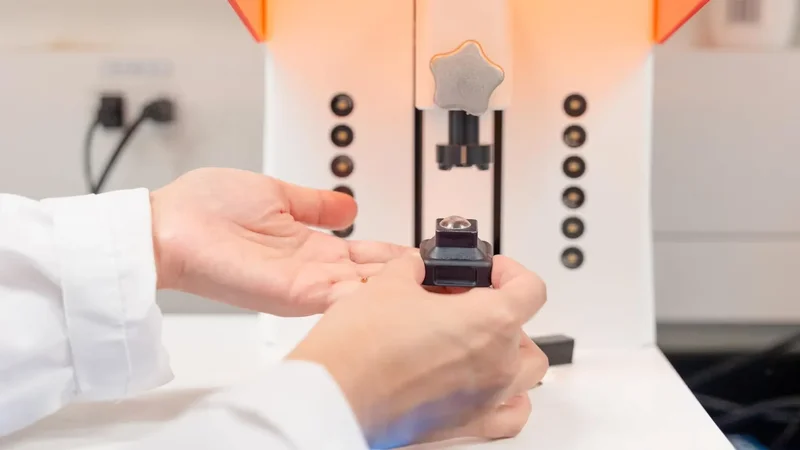
Today’s 3D printers can make everything from parts to fix annoying ceiling fan chains to wheelchairs that can help turtles walk. Now, advanced 3D printing technology is being used to make contact lenses. The breakthrough could help patients with irregularly shaped corneas get personalized lenses with greater speed and affordability.
Searching for a better patient experience
Most people who wear contacts are fitted with soft lenses by an optometrist, who matches measurements of their eyes to a selection of standardized sizes and shapes. But patients with irregularly shaped corneas often require custom hard lenses. These lenses provide better vision correction and support corneal health, but can be costly and time-consuming to manufacture. To solve this, a study recently published in the journal Materials & Design describes a digital manufacturing platform that promises to expand the possibilities for patient-specific lens design.
“We are very excited about this work because it brings us closer to contact lenses that are truly personalized,” Shirley Tang, a study co-author and material chemist at the University of Waterloo in Canada, said in a statement. “Our technology produces lenses with patient-specific surfaces for a precise fit while delivering the optical clarity and mechanical performance expected of commercial contact lenses.”
A perfect match
The platform combines custom design software, a novel silicone material, and advanced 3D printing technology to produce the contact lenses in about 20 minutes. With this speed, the lenses could potentially be prescribed and manufactured during a single visit to the eye doctor.
Since conventional silicone isn’t compatible with 3D printing, the researchers developed a custom hydrophilic silicone formulation. The material can be printed layer by layer, while retaining the properties needed for contact lens applications.
“Our software designs a lens with an inner surface that precisely matches the patient’s cornea and an outer surface that provides the required vision correction,” added study co-author Sayan Ganguly, a research chemist at the University of Waterloo. “The novel hydrophilic silicone material we created, combined with our manufacturing process, produces smooth, transparent lenses that are comfortable to wear.”
One layer at a time
Since this custom lens is built one layer at a time, the team also developed an ultra-thin, non-contact coating. The coating smooths the tiny surface ridges that can form during the printing process. According to the team, the coating improves clarity and comfort without compromising the lens’ customized shape or optical performance.
Laboratory tests also showed the lenses are biocompatible—meaning they are safe for use with living tissue.The team is also preparing their lenses for studies including living organisms. They’re also working on a full patent application for the hydrophilic silicone material.
Tang told CBC News that one of the goals of the work is to greatly reduce the cost of hard lenses, which can range from about $500 to $1,500. She said that the current costs generally come from manufacturing, multiple visits to the optometrist, and the lens fitting.
If the technology eventually reaches the clinic, getting custom contact lenses could be as simple as getting your eyes scanned, waiting a few minutes for the 3D printer to do its magic, and leaving with lenses that are made just for you.