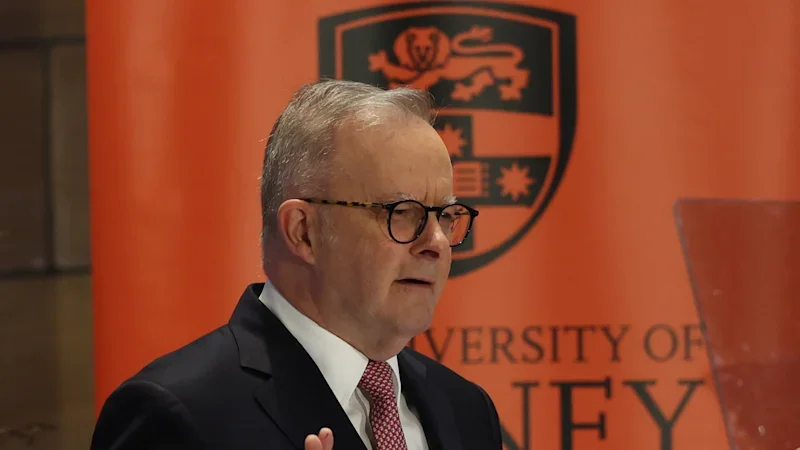
Artificial intelligence disruption to white-collar jobs in the cities risks fuelling the same political upheaval as the decline of manufacturing and coal that contributed to One Nation’s rise.
New research from the University of Sydney warns that after waves of economic change in industrial and regional communities, known particularly in the US as the “rust belt”, a “wired belt” is emerging in well-heeled parts of Australia.
Report authors professor Clinton Free and former adviser to Kevin Rudd, Lachlan Harris, find the Albanese government holds nearly 80 per cent of the 60 seats most exposed to AI, showing that Labor’s modern, highly educated voting coalition faces new-found economic uncertainty.
A fortnight after Albanese vowed to protect jobs from the technological transformation, Free and Harris say this “wired belt” enjoyed decades of economic growth but residents now “face a form of economic upheaval [they] have not experienced for decades, and for which they possess neither a familiar political language nor an established political response”.
Their report, given to this masthead, goes on to state: “AI may therefore create a second political front alongside the economic grievances already reshaping regional Australian politics. The political risk does not require mass unemployment. Regional experience suggests that such pressures can weaken established political loyalties well before a full-scale employment crisis emerges.
“A high-exposure seat may experience automation, augmentation, work redesign or the creation of new roles.”
The report argues that AI could fundamentally alter the life trajectory of white-collar workers by making them feel less secure in their careers. Fewer graduate positions may be on offer, career ladders could flatten, wage growth might shrink, autonomy would be reduced and workers may feel suspicious that profits are flowing to big firms rather than employees.
The prime minister put a spotlight on the opportunity AI presented in a headline speech this month. He talked up the innovation as a way to revive Australia’s poor rate of productivity, which many experts say could be drastically boosted by AI.
Attempting to strike a balance between protecting jobs and attracting billions in data centre investment that is propping up the Australian economy, he said: “We cannot settle for a short-term boom in capital expenditure and construction. We must create a new generation of good, secure jobs.”
Responding to union demands, Labor agreed at its national conference in Adelaide to create the Fair AI Taskforce to give workers and AI experts a say in how Australia grapples with the technology.
On July 13, more than 200 economists, Nobel laureates, and tech luminaries from AI firms warned of “large-scale job displacement” and an Industrial Revolution-style transformation. However, a report from Department of Employment and Workplace Relations recently found that the technology had not yet had a major effect on employment. It detected early signs that job growth was weaker in areas most affected by AI, however.
The extent to which a relatively small nation such as Australia can shape the way AI permeates the workforce and society is also unclear.
The Trump administration has favoured a laissez-faire approach. China has been pressuring firms to avoid layoffs at the same time as pushing to introduce the technology into key sectors to enhance productivity. The AI gold rush and a contest between the US and China to develop cutting-edge models has fostered anxiety among experts and unions about uncontrolled labour market effects.
Free and Harris, the report authors, use Census data and figures from Jobs and Skills Australia to create an AI exposure index for Australian electorates.
The “wired belt” includes seats that are on average more highly educated, mortgage-exposed electorates where analysts, administrators, finance professionals, marketers, programmers, writers, consultants, public servants and other graduate professionals are concentrated.
People in these areas have higher incomes, are more likely to include overseas-born residents and have higher rates of mortgage stress due to high property prices.
The top 15 seats on the index include Bradfield (teal), Wentworth (teal), Warringah (teal), Bennelong (Labor), Sydney (Labor), Kooyong (teal), Mitchell (Liberal), Canberra (Labor), Macnamara (Labor), Goldstein (Liberal), Melbourne (Labor), Grayndler (Labor), Berowra (Liberal), Chisholm (Labor), and Parramatta (Labor).
“Any AI jobs shock would therefore run through metropolitan electorates that have provided much of the moderate ballast in federal politics,” the report states.
“In the coming decades, the careers of many federal MPs in east-coast capital city electorates may sink or swim on the tides of the AI jobs policy debate. A recent national poll conducted by Redbridge Group found One Nation support was strongest in lower AI-exposed rural and provincial electorates and weakest in highly AI-exposed inner-metropolitan seats.”
Acknowledging the huge level of uncertainty in forecasting the future, the authors say that the “experience of the extreme political disruption currently playing out in regional Australia (see the recent Farrer by-election) suggests that once the economic disruption begins, it will lead to a significant shift in the voting patterns of directly impacted workers”.
“In other words, in this scenario, political change in Australia will only accelerate for the foreseeable future.”