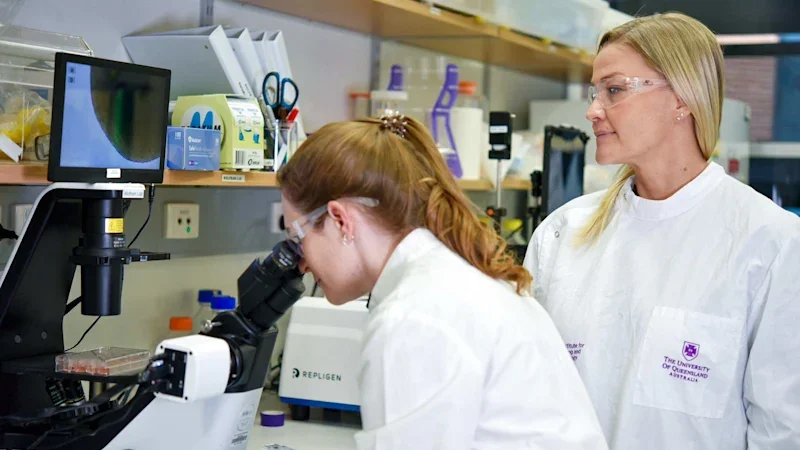
A Queensland researcher’s accidental discovery could lead to a new treatment for common viruses, with the potential to disrupt some of the world’s deadliest viral infections, including Ebola and hantavirus.
University of Queensland neuroscientist and biochemist Dr Merja Joensuu was researching the neurological pathways of children affected by hereditary spastic paraplegia, a group of rare genetic disorders, when she made the breakthrough.
“We were studying how processes work inside the human brain when I noticed the disruption in a pathway that numerous human viruses rely on to speak from one cell to the next,” Joensuu said.
“That was a lightbulb moment.
“We realised that if we interfere with that pathway, we might be able to stop viruses from forming properly.”
Viruses are microscopic particles that need a host, such as a human, to survive.
Once inside the host, they hijack cells, using cellular machinery to reproduce. Depending on the type of virus and the host’s immunity, this leads to infection and causes people to become sick.
Unlike bacterial infections, most viruses do not respond to antibiotics, and antivirals have limited efficacy, depending on the type of infection.
“[With antivirals] there is always a risk that if you target the virus itself, the virus will mutate,” Joensuu said. “And then your antiviral strategy is no longer effective.”
A multinational research team, including Joensuu’s collaborator, Professor Giuseppe Balistreri from the University of Helsinki, followed the hunch and searched for a compound that could inhibit the pathway that viruses take once inside the host.
They found one, an inhibitor of the human enzyme N-myristoyltransferase 1 (NMT1), which is being trialled as a cancer treatment and helps direct where proteins are located and how they function within human cells.
“Viruses can’t reproduce on their own, so they hijack human cells to make new copies,” Balistreri said.
“This drug disrupts how the cell functions, causing new viruses to be assembled incorrectly.
“The virus doesn’t know this and keeps making and releasing less-effective versions of itself, which would give the immune system time to clean up the infection.”
For the drug to be effective, Joensuu said it would need to be taken before a person becomes infected, or shortly after infection.
“Let’s say if you’re attending a concert or a place where you have a lot of people in a very small area, it could be a preventative medication that you take,” she said.
Laboratory studies testing the drug against a range of viruses in cell cultures, including SARS-CoV-2 which causes COVID-19, RSV, and vesicular stomatitis virus, which causes disease in cattle, horses and occasionally humans, have found infection levels dropped up to 90 per cent after two days.
“The reduction is quite striking,” Joensuu said.
“The study also suggests this strategy could potentially work on viruses with high mortality rates and long incubation times, like Ebola and hantavirus.”