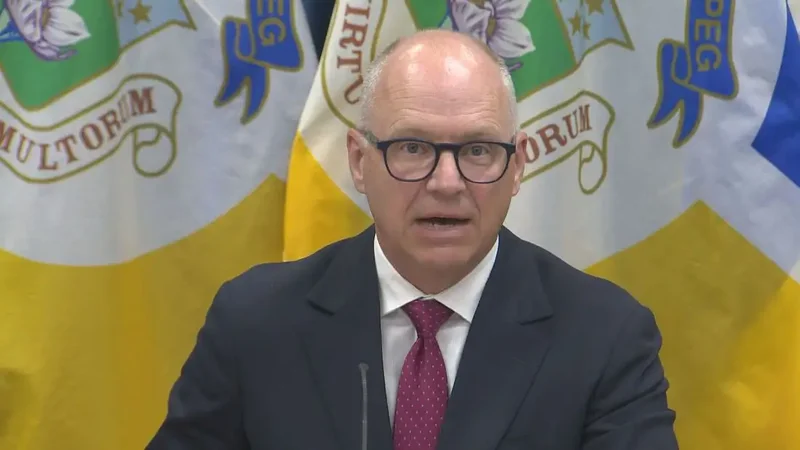
Winnipeg city council will consider a third-party report proposing a new community response program for mental health or wellness-related 911 calls, Mayor Scott Gillingham said.
Gillingham released the Winnipeg Community Crisis Response Model report at a news conference Tuesday morning, where he spoke alongside the report’s author, as well as the chiefs of the Winnipeg Police Service and the Winnipeg Fire Paramedic Service (WFPS).
The study had several recommendations, all based on coordinating a system that would connect 911 calls concerning mental health or addiction to community-based responders when appropriate.
“Every day our 911 dispatchers receive calls from Winnipeggers who are in distress, dealing with complex mental health struggles, addiction or wellness concerns,” Gillingham said.
“Right now, the system defaults to sending police, firefighters or paramedics, because really, that’s the only option that are available at this moment,” he continued, noting those services may not be the right fit for people in crisis.
“Everyone agrees that we cannot keep relying on the status quo.”
The report, which was commissioned by the mayor, has five recommendations.
First, the report says, the city must ensure people who are struggling have multiple ways to access community-based support — including 911. When emergency services are called, a dispatching service would connect the callers with an appropriate response team.
Teams would provide mobile crisis intervention and support immediately, then follow up with the person who was struggling. The response teams should consist of crisis responders, social workers and mental health and addictions professionals, among others, the report said.
Get breaking National news
Those efforts, combined with strengthening existing programs and partnerships, support the proposed approach and would ensure people receive appropriate care, according to the report.
Gillingham described the program as a “smarter way forward” for the city to manage “non-emergent, lower risk situations.” He was joined by Maria Cotroneo, the author of the report and principal of Pensa Consulting Inc.
“What this work confirmed is that Winnipeg doesn’t need to build an entirely new system. We already have strong organizations, dedicated professionals, and community partners doing exceptional work every single day,” Cotroneo told reporters.
“Community is not simply a stakeholder in this model, it is a primary response partner.”
Wellness checks have been the most common citizen-generated call type for five straight years, the report said.
It also stated more than 10,000 calls made to emergency services annually could be diverted to this alternative response.
Gillingham said urgent calls, including those involving violence, medical emergencies or crimes, would still be handled by traditional emergency services. He said the proposed plan would free up time for first responders to manage other responsibilities.
- Online passport renewals now open for Canadians ‘whenever it is convenient’
- Manitoba’s first supervised consumption site to fully open Aug. 11
- Ford government chastises Carney government for giving into ‘fringe group’ over island airport expansion
- LeBlanc heads to U.S. to talk tariffs as Trump casts more doubt on CUSMA
“Today’s report has the potential to give (public safety communicators) another important option when (a) community-based crisis team is best positioned to help,” said Winnipeg police Chief Gene Bowers, adding that many of the mental health calls he has attended were not violent.
“I think this is a positive step, definitely, in the mental health realm for people who need the services.”
The report’s recommendations would build upon the police and WFPS’s downtown safety programs, Bowers said.
Ryan Sneath, chief of the Winnipeg Fire Paramedic Service, said the report’s proposal would strengthen existing community programs that manage addictions and mental health crises.
“This model builds on those strengths by improving coordination between 911, health-care partners and those community agencies. It creates clearer pathways so non-emergency calls can be directed to teams trained to deescalate, stabilize and have short-term follow-up with individuals,” Sneath said.
By providing an alternative to WFPS, he said the program would allow firefighters and paramedics to focus on critical situations and continue their specialized duties.
“This is about making sure we can provide the most appropriate response to our community and assure that emergency responders are available when people truly need them the most,” Sneath added.
This community-led response has not been brought to Winnipeg city council yet, but the mayor said he will bring the topic forward in September.
“I believe council is going to support this,” Gillingham said. He said he is “fully committed to seeing this through,” if re-elected as mayor in the municipal election set for the following month.
The mayor will seek council’s endorsement of the report’s recommendations to endorse the model and work toward partnering with the Manitoba government for funding, governance and implementation, he said. Currently, he said, the proposal is under consideration by the province.
Detailed figures on how much the program could cost the city will become available as details on partnerships and investments are ironed out, the report’s author said.