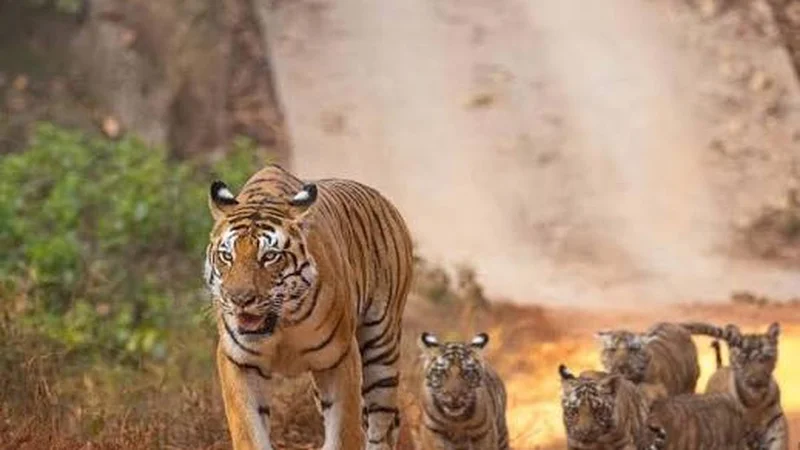
India’s tiger conservation story is widely regarded as one of the world’s most extraordinary wildlife recoveries — a species brought back from near extinction through sustained political commitment, scientific management, and decades of on-ground protection. Since the launch of Project Tiger in 1973, the country’s network of protected areas has expanded from nine reserves covering 18,278 sq km to 58 reserves spanning 84,488 sq km, accounting for nearly 2.6% of India’s landmass. India’s tiger population has risen from 1,411 in 2006 to 3,682 in 2022, firmly establishing the country as home to over 70% of the world’s wild tigers. This success has now created a new conservation frontier — the growing proportion of tigers living outside protected areas.
Although national datasets do not conclusively link rising tiger numbers with increasing human-tiger conflict, forest departments across several landscapes report a steady escalation in such incidents. As territorial carnivores require extensive home ranges, tigers disperse naturally when core habitats reach saturation. Consequently, more tigers are moving beyond protected boundaries into human-dominated fringes. According to the National Tiger Conservation Authority, 35-40% of India’s tiger population now lives outside designated Tiger Reserves. This reality has prompted the Ministry of Environment, Forest and Climate Change to launch the Tigers Outside Tiger Reserves (TOTR) initiative.
Beyond protected boundaries
The growing tiger population reflects healthy breeding groups, functional habitats, and well-connected forest corridors. However, when tigers move beyond protected areas into landscapes interwoven with villages, farms, roads and other human infrastructure, interactions with people become inevitable, leading to human fatalities, livestock depredation, accidental encounters, prolonged rescue operations, and heightened public anxiety. Each incident carries ecological, social, and political consequences, placing enormous pressure on forest departments and district administrations.
The objective of the TOTR is to establish a scientifically grounded, landscape-based framework for conserving tigers outside protected areas while safeguarding human lives and livelihoods. Rather than responding to conflict only after it occurs, the initiative seeks to shift the approach from reactive crisis management to proactive, science-driven governance built on technology, preparedness, and community participation.
The TOTR is being launched as a targeted pilot rather than a nationwide rollout, recognising that long-term policy must be anchored in evidence generated under real field conditions.
The All-India Tiger Estimation (2022) recorded tiger presence across 212 forest divisions. Based on this assessment, 40 forest divisions across nine States have been selected for the first phase of the TOTR implementation. The participating States include Uttarakhand, Uttar Pradesh, Rajasthan, Madhya Pradesh, Maharashtra, Karnataka, Tamil Nadu, Telangana and Assam.
The TOTR rests on two complementary pillars. The first focuses on reducing human-tiger conflict and strengthening field protection. This includes upgrading communication systems, deploying rapid response teams, improving rescue infrastructure, and ensuring coordinated action during emergencies. The second pillar emphasises long-term coexistence. Conservation outside protected areas cannot succeed without the trust and participation of local communities. Awareness programmes, community engagement, timely compensation and treating villagers as partners are central to the initiative. Tigers and people now co-occur across vast shared landscapes, making structured coexistence essential for long-term stability.
Among these, streamlined and timely compensation mechanisms are critical. Although States have their own frameworks, delays often erode public trust and fuel resentment. States must simplify procedures and invest in sustained outreach to build confidence among rural families living alongside tigers.
The role of States
Participating States will also need to invest strategically in both technology and institutional capacity. The programme rightly emphasises the use of modern conservation tools such as camera traps, GPS-enabled monitoring systems, drones and AI to strengthen surveillance, improve early warning systems and enable evidence-based decision-making. However, technology alone cannot resolve human-tiger conflict. Its effectiveness will ultimately depend on the strength of the institutions that support it. Building public confidence requires well-trained forest staff, veterinarians, and rescue teams capable of responding rapidly in conflict situations.
The TOTR underscores a broader national imperative: strengthening the governance of shared landscapes where ecological processes and human livelihoods intersect daily. The initiative signals a shift from viewing tiger conservation solely through the lens of protected areas to recognising the wider mosaic of reserve forests and other lands that now support dispersing tigers.
If executed with the same determination that made Project Tiger a global benchmark, the TOTR could become India’s defining conservation initiative of the century proving that people and large carnivores can share space safely.
Supriya Sahu is a senior administrator currently serving in the Government of Tamil Nadu. She has worked extensively on environmental policy, ecosystem restoration, wildlife and biodiversity conservation, climate action and human-wildlife coexistence. She is the recipient of the UNEP Champions of the Earth Award 2025
Published - July 29, 2026 01:07 am IST