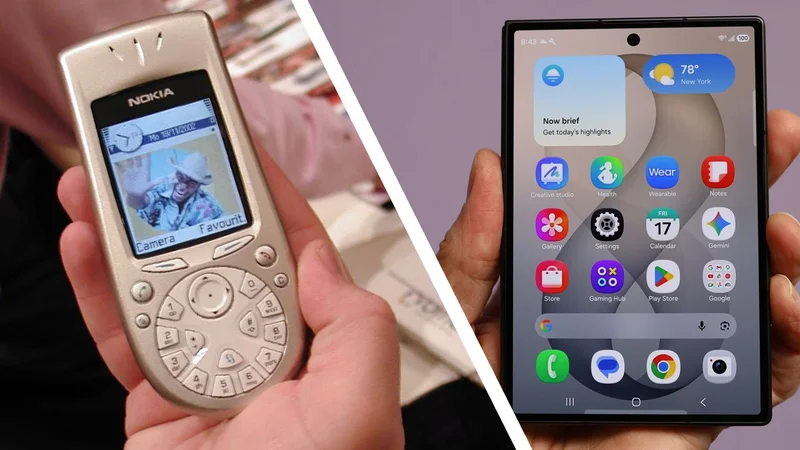
Confusion is the typical first reaction. They hold the new Samsung Galaxy Z Fold 8 in their hands, marveling at the passport-sized cover screen, and ask without irony or sarcasm, "Is this new?"
I'm finding that people think the Z Fold 8's design is both familiar and completely alien. They roll it over in their hands and, initially, appear unaware that it also unfolds to reveal a far larger, and yet also oddly shaped, inner display.
It's, for all intents and purposes, the Nokia Feature phone of modern foldables. It's a completely new device featuring modern hardware, components, tech innovation, and AI that also somehow harkens back to an era of weird Nokia phones that proudly peacocked their oddball aesthetics.
Back in the early oughts when most thought the state of cellphones had been well-worked out and we'd settled on small-ish screens and an endless array of keyboard styles, Nokia was king of the hill. There was no one-size-fits-all in the world of cell phones. Your phone's physical design was an expression of your personal style. The tiny Nokia 31000 had virtually nothing in common with a T-Mobile Sidekick or a BlackBerry 7230. Nokia's designs, though, were fun (if not always practical — looking at you, Nokia N-Gage) and they made us think differently about mobile phones and what we should expect when using them.
The Samsung Galaxy Z Fold 8, which Samsung unveiled last week in London at Samsung Upacked (and that I'm carrying today), is perhaps serving a similar function now, trumpeting the very existence of foldable phones and why they might matter to you.
Why the Nokia Effect matters
In my discussions with Samsung about why they made the Galaxy Z Fold 8, it became quite clear that this was a phone and form factor designed to attract customers disinterested or dissatisfied with the current relatively vanilla set of folding phone options, not only available from Samsung, but also from its rivals at Motorola, Oppo, and Huawei.
After all, you had either the candybar style that opens into a mini tablet or the communicator flip-style. Camera arrays might all look different, but the basic size and shapes are all the same. And none of them were moving the market — foldables held just 1.6% of the global smartphone market in 2025. None of them appear to be making people stop and think. There was, until now, no Nokia Effect.
Sign up for breaking news, reviews, opinion, top tech deals, and more.
The Samsung Galaxy Z Fold 8, though, is fun to show off. I've seen people stop, smile, scratch their heads, and be generally interested in a way they weren't with recent Folds and Flips or even the new Galaxy Z Fold 8 Ultra I'm also carrying around. One coworker called it "dreamy". How often have you heard someone describe a smartphone like that?
They notice, for instance, that in its folded size, the Galaxy Z Fold 8 is a much better fit for smaller hands, and how it actually fits all the way in a pocket (not for nothing, the 201g size doesn't hurt for portability, either). Even opened and in portrait mode, the 7.6-inch display is more palmable than the Z Fold 8 Ultra's 8-inch display.
Weird and wonderful
Its inherent cuteness is an unintentional nod to the phones of a bygone era. When folded, the cover display and even the back with its smaller camera array say, "Look at me, I'm adorable."
Samsung will be leaning into this, and where the Z Fold 8 Ultra is a mobile multi-tasking and content capture and creation workhorse, the Z Fold 8 is a friend who tells you stories in a compact form. It's a lean-back reading experience, and a less letterboxed full-screen video viewing companion.
And yet, it's also a better confidant, letting you share your thoughts and texts in a virtual keyboard that's wider and more comfortable to use than one on even the Galaxy S26 Ultra or iPhone 17 Pro Max.
What Samsung has almost miraculously done with the Galaxy Z Fold 8 is create a foldable that will finally get people talking. Further, it's done so months before Apple enters the foldable ring. Imagine that, a knockout punch delivered by Samsung before the fight begins.
It won't be that easy, of course; I fully expect Apple to deliver something truly extra on the foldable front. It should share this unusual form factor, especially since Samsung is probably supplying the display. Samsung has told us that it's unconcerned about Apple's entry and actually welcomes it. Maybe that's just pole-position talk.
Will the freshness of this form factor evaporate when the iPhone Ultra arrives? Maybe, or maybe it'll be too late for Apple because surely Samsung has already cracked the code. All it had to do was take a look back and remind itself why people loved weird cellphone designs and how that might, if not shape, at least inform its expansion of the Z Fold line.
A 38-year industry veteran and award-winning journalist, Lance has covered technology since PCs were the size of suitcases and “on line” meant “waiting.” He’s a former Lifewire Editor-in-Chief, Mashable Editor-in-Chief, and, before that, Editor in Chief of PCMag.com and Senior Vice President of Content for Ziff Davis, Inc. He also wrote a popular, weekly tech column for Medium called The Upgrade.
Lance Ulanoff makes frequent appearances on national, international, and local news programs including Live with Kelly and Mark, the Today Show, Good Morning America, CNBC, CNN, and the BBC.