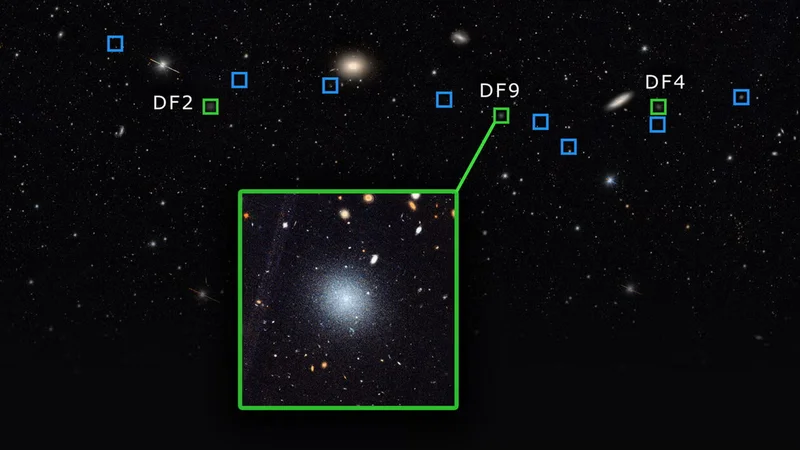
In a string of a dozen small galaxies hung in the sky like a row of cosmic fairy lights, astronomers have discovered a small, ghostly galaxy without any dark matter. The rare discovery offers additional evidence that violent galactic collisions can knock this invisible substance loose from visible matter.
Dark matter acts like cosmic glue, accumulating in "halos" in which galaxies form. It makes up about 85% of all the matter in the cosmos, meaning all the stars and other celestial objects we see account for a small fraction of the universe's mass. And as astronomer Vera Rubin observed, despite its invisible nature, dark matter seems essential to explain the apparent movement of stars around their galactic centers.
Yet in a study published June 16 in The Astrophysical Journal, astronomers report that a dwarf galaxy called DF9 may be devoid of dark matter, joining a couple of other apparently dark-matter-devoid dwarfs (DF2 and DF4) previously discovered in the same string of tiny, faint galaxies.
"The most surprising aspect is that this finding indicates that an entire trail of galaxies including DF2, DF4, and DF9 formed together in an extreme event producing galaxies not alike any we've ever seen before — the first of its kind," Michael Keim, an astrophysicist at Yale's Graduate School of Arts and Sciences and the study's first author, told Live Science via email. "As a result, they have a ghostly appearance, bright clusters of stars, and a lack of dark matter."
Following a trail of galactic crumbs
To study DF9, the researchers used the Keck Cosmic Web Imager at the W. M. Keck Observatory atop the dormant Mauna Kea volcano in Hawaii. The dwarf galaxy is situated within a long trail of a dozen similarly small, diffuse galaxies in the NGC 1052 field, nearly 70 light-years from Earth.
To calculate the mass of DF9, the researchers measured the motion of its stars by analyzing changes in their wavelengths. The analysis revealed that DF9 has a measly mass of approximately 100 million suns, which is consistent with its visible mass in stars. If it contained the expected amount of dark matter, it would be exponentially heavier, harboring a mass of more than 10 billion suns, the researchers said in a statement.
As revealed over the past decade, at least two of DF9’s nearby galactic siblings also appear to lack dark matter.
Get the world’s most fascinating discoveries delivered straight to your inbox.
"If DF2, DF4, and DF9 were the only galaxies known, one would not conclude there is any need for dark matter," the researchers wrote in the paper. These three galaxies do not display a mass-based discrepancy based on their visible and invisible matter; their mass, determined by the gravitational motion of their stars, matches their mass as measured by the light emitted from these same stars.
But this is hardly typical among most observed galaxies, especially the tiniest ones. Counterintuitively, low-mass dwarf galaxies such as these often have the highest fraction of dark matter. Because they are not as massive, they have lower escape velocities, allowing supernovas and other "feedback mechanisms," like intense black hole winds, to eject their gas more easily. This mass expulsion typically results in dark matter halos around galaxies that are 100 times more massive than all of a dwarf galaxy's stars, the researchers said.
Dark matter deficiency is linked to a violent past
The team likened this lineup of dwarf galaxies to a miniature version of the Bullet Cluster, located nearly 4 billion light-years from Earth. The collision of two galaxy clusters that created the Bullet Cluster is considered the most energetic event known since the Big Bang, astronomers say, and the massive mashup is responsible for separating the system's gas from its dark matter.
Violent galaxy mergers are widespread in space, suggesting such galaxies without dark matter also may be more common throughout the cosmos than once thought.
"The Bullet Dwarf event in which DF9 is thought to have formed is named after the famous Bullet Cluster wherein the gas of two entire clusters of galaxies was separated out in a similar manner as this 'Bullet Dwarf' collision, so indeed this can occur at much larger scales," Keim explained via email. "But collisions between giant clusters are far less frequent than collisions of individual galaxies."
Yet being able to glimpse DF9 and its linearly laid-out counterparts still required an element of fortune. "High-speed collisions are, nevertheless, somewhat rare," Keim added. "DF9 is 67 million light years away from Earth; based on cosmological simulations, we would expect just 7 or so similar collisions to have occurred within that distance."
Related stories
Additionally, celestial bodies are always in flux, so finding galaxies devoid of dark matter is difficult for other reasons. For example, they may exist in dense regions, where they are harder to view through the obscuring dust, gas and starlight surrounding them. Or, they may merge with other galaxies that do have dark matter.
The strange separation between dark matter and visible matter in the galaxies of the NGC 1052 field warrants further study, the researchers said. Finding any leftover gas from the collision would provide the "smoking gun" evidence for the collisional origin of this faint string of galaxies.
The astronomers are conducting follow-ups with other observatories, including the new MOTHRA facility, the "world's largest all-lens telescope," which is under construction in Chile. With an array of 1,140 telephoto lenses, "its line mapping sensitivity on large scales — like that of the trail — will be at least an order of magnitude deeper than any other facility," Keim added.
Keim, M. A., Van Dokkum, P., Shen, Z., Danieli, S., & Pasha, I. (2026). A Third Galaxy Missing Dark Matter along a Trail of Galaxies in the NGC 1052 Field. The Astrophysical Journal, 1004(2), 210. https://doi.org/10.3847/1538-4357/ae6b8d
Ivan is a long-time writer who loves learning about technology, history, culture, and just about every major “ology” from “anthro” to “zoo.” Ivan also dabbles in internet comedy, marketing materials, and industry insight articles. An exercise science major, when Ivan isn’t staring at a book or screen he’s probably out in nature or lifting progressively heftier things off the ground. Ivan was born in sunny Romania and now resides in even-sunnier California.