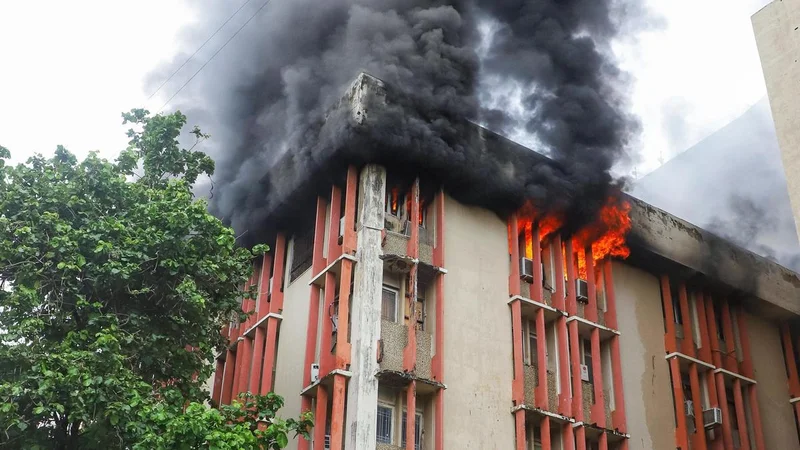
On June 22, 2026, 15 people gasped to death in a burning building in Aliganj, Lucknow. Trapped behind smoke-filled corridors and sealed exits, they never had a chance. The commercial establishment operating from a residential neighbourhood was a veritable death trap — pigeonhole-sized workstations crammed into an unauthorised structure with no viable fire escape.
It was not merely a building that caught fire, but a system that failed. A tragedy waiting to happen, aided by those whose job it was to prevent it.
All this happened, while the TV channels discussed animatedly U.S.-Iran parleys, where India played no role, and analysts dissected the number of Members of Parliament defecting to the Eknath Shinde-led Shiv Sena. Not aware if there was ever a mention of a collapse of political ethics and morality. But then, do ethics, morality and professionalism figure in urban governance today? Major fires have erupted in cities across India in 2026 on account of failures of urban regulation — signifying abject greed and mismanagement.
On June 3, a fire in a bed and breakfast facility, Malviya Nagar, Delhi, was also caused by illegal construction with no emergency exit. In February, a Bhiwadi garment plant, Rajasthan, which caught fire was an illegal firecracker-manufacturing unit behind closed doors; the fire in a cracker manufacturing unit in Virudhunagar, Tamil Nadu, took place when the factory was running illegally on a Sunday.
Yet, amidst the horror, emerged stories of extraordinary courage. In Delhi’s Malviya Nagar fire, a mattress shop owner reportedly emptied his entire stock onto the street to cushion those jumping from the burning building. Young residents rushed forward without waiting for instructions, while police personnel administered CPR, evacuated victims and continued rescue efforts despite injuries to themselves. Such acts of humanity stand in sharp contrast to the institutional failures.
Historical data trends suggest that India sees approximately 13,000-15,000 fire deaths annually, with the summer of 2026 projected to be one of the worst due to extreme heatwaves triggering electrical fires. In the first quarter of 2026, 39 people have died in fires in Delhi alone, even before the summer peak began.
Violations without consequences
The problem extends far beyond Aliganj and Malviya Nagar. Death traps of varying forms exist in countless urban settlements across India. They may differ in appearance but share a common characteristic: everyone knows the violations exist, yet they continue.
This is what makes the present crisis particularly troubling when India today possesses technological capabilities unimaginable even a decade ago. Satellite imagery can identify encroachments. Drones can map illegal constructions. Geographic Information Systems can track land use changes. Digital property databases can identify violations. Artificial intelligence can flag anomalies and real-time dashboards can monitor compliance.
Is it really difficult for a municipal commissioner, a development authority official, a State government functionary or the Lieutenant Governor to call for a list of establishments operating without licences, fire clearances or in myriad violations of building norms?
The difficulty lies elsewhere. It lies in political pressure and vote-bank calculations and in the thriving informal economies that governments are reluctant to confront and where urban laws and regulations are routinely violated. But, most importantly, it lies in corruption.
Could the fire in Lucknow have been averted? Yes. In 2016, a notice for demolition was given but within two months was withdrawn. It was clearly a political decision. The property stood out as a symbol of political patronage under benign oversight of officials, right in the midst of a prominent locality of the capital. This sends out a message to the lower officials, the enforcers, who then entrench a system of their own beneficiaries, overlooking various violations for monetary benefits.
The Special Investigation Team (SIT) formed to investigate the fire comprised two senior officers, from the IAS and the IPS from the State of Uttar Pradesh, with the report to be submitted to another IAS officer of the government. The head of Lucknow land development Authority is also an IAS officer. In such a situation, can the inquiry yield anything purposeful. If a calamity of this kind results only in a conversation between a closed loop of bureaucrats, can there ever be any meaningful reform? No. But it was certainly possible if the Minister of Urban Development and the head of the capital land development authority were indicted for this tragedy.
This pattern is visible across the country. In Noida, a young professional lost his life after falling into a waterlogged, poorly protected urban hazard. In Indore, celebrated nationally for cleanliness, deaths linked to contaminated water supply raise disturbing questions about basic civic safeguards. Bengaluru, India’s technology capital, repeatedly grinds to a halt after heavy rains. Mumbai, India’s financial capital, continues to struggle with flooding despite decades of investment and repeated expert recommendations.
A common thread
Different cities. Different governments. Different political parties, but the same outcome. The real concern is the absence of accountability and governance deficit. What happened after Delhi’s basement coaching centre tragedy? Arrests were made. Committees were constituted. Headlines were generated. Yet, illegal and unsafe basement operations continue to flourish in many cities.
How many inquiry reports have fundamentally altered urban governance? How many officials have faced meaningful consequences years after disasters? How many systemic reforms have followed repeated tragedies? India has actually become adept at managing outrage and far less effective in preventing a recurrence of man-made tragedies.
At the heart of the problem lies a governance structure that nobody wishes to discuss honestly. For over three decades, since the 74th Constitutional Amendment, India has spoken of empowering urban local bodies. Yet, most city governments remain weak. Every Chief Minister is the de facto mayor for all cities in his/her State and municipal corporations have responsibility without authority. Elected representatives have visibility without power. Important functions remain scattered across development authorities, municipal corporations, public works departments, water boards, transport agencies and numerous specialised bodies.
A flooded road belongs to one agency, a drain to another, land to a third and enforcement to a fourth. Citizens, meanwhile, simply see government. This fragmentation has created a dangerous accountability vacuum.
Fix governance first
The answer therefore is not another scheme. Indian cities are already overflowing with schemes, missions, projects and programmes. Every few years a new initiative comes up with a new acronym and fresh funding. The problem is not the absence of schemes, but the absence of governance. A number of well-meaning schemes lie buried under corruption and mismanagement. Cities require empowered local institutions, professional urban management, clear accountability and fearless enforcement. Technology must become an instrument of compliance rather than a showcase of modernisation. Most importantly, governments must find the political courage to dismantle entrenched systems of tolerated illegality. Officers, the enforcers, look away fearing a clash with political vested interests.
The victims of Lucknow and Delhi fires did not die because India lacks fire safety laws. They died despite those laws. That is the distinction policymakers must understand. Urban governance is ultimately measured not by the number of projects inaugurated, smart-city dashboards installed or schemes announced, but by the number of tragedies prevented. The real test of governance is whether an ordinary citizen can work, live, study, shop or sleep in a building without fear of dying because somebody chose to ignore the rules.
Will this tragedy become yet another file, another enquiry and another forgotten headline? Or will it finally compel us to confront the uncomfortable truth that India’s cities are not merely growing beyond their capacity but are increasingly failing the very citizens they were meant to serve?
Yashovardhan Azad is a retired Indian Police Service officer who has served as the Central Information Commissioner, Secretary – Security, Government of India, and Special Director, Intelligence Bureau
Published - July 29, 2026 12:16 am IST