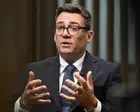
Andy Burnham has promised “problem-solving, not point-scoring” before a speech on social care in which he will set out his strategy for resolving one of the most intractable issues in British politics.
The prime minister has invited Kemi Badenoch, the Conservative leader, and Ed Davey, the Liberal Democrat leader, to discuss how to enact urgent reform on social care, as he attempts to find common ground across party lines. It is understood that both will be represented.
However, the suggestion that the main Westminster parties could finally reach consensus to fix the crisis that has eluded a generation of political leaders in England already appeared optimistic after the Tories imposed their own red lines and amid negative headlines about inheritance tax.
Several Labour MPs also expressed concern over how to manage the financial burden of a reformed care sector.
Before his speech on Wednesday, Burnham said: “We need a different kind of politics: problem-solving, not point-scoring. Nowhere is that more urgent than social care. For decades, governments have kicked this issue down the road because they’ve seen it as too risky, too difficult, and too complicated.
“Politicians might have different views but I’m serious about fixing this issue and to do that, we have to find common ground and listen to others to find a way forward. It’s time to draw a line under people playing politics when the human cost of that means carers struggling, families paying the price and our NHS buckling under the strain.”
The prime minister is expected to stop short of unveiling plans for a new social care system in this speech, instead confirming plans, first revealed by the Guardian, to speed up the independent review led by Louise Casey that has been considering possible options.
Lady Casey, who will launch the Big Conversation on Care on Wednesday to give the public their chance to share their views on the future of adult social care in England via an online platform, has warned that money alone won’t fix the problem.
However, Burnham’s push for a solution is set against a tightening economic backdrop with the economic thinktank NIESR warning of “very difficult trade-offs” in the autumn budget if the Iran war keeps oil prices and inflation high.
He is understood to be committed to exploring a new system that would be free at the point of use, the same principle as the NHS. He is understood to regard other options, such as a care costs cap, as less attractive, though they would be significantly cheaper for the taxpayer.
A middle-ground option would be a model similar to Scotland’s, where personal care costs are paid by the state but other costs, such as accommodation and food in care homes, are borne by individuals and their families.
Whichever option the government eventually pursues is likely to involve significant extra investment over the long term, most likely through increases in taxation.
When Burnham first proposed a universal system of social care as health secretary under Gordon Brown, he suggested replacing inheritance tax with a 10% levy on all estates. At the weekend he did not to rule out this option, which could raise as much as £18bn.
Before visiting a care home on Wednesday, Burnham said: “This comes down to a choice. We can carry on passing the problem to the next generation, or we can face it head on and work together to build a care system that gives people dignity, security and the support they deserve.
“This is about bringing back hope that we can finally fix the difficult issues that have been ignored for too long, and making Britain believe again. That’s why I’m making this choice and I’m prepared to put everything I’ve got behind it.”
An average of 13,600 people a day were stuck in hospital beds last month despite being medically fit to leave, including some delayed because of the availability of adult social care, underlining the pressure on the NHS.
While Labour MPs have broadly welcomed the prospect of reform, several cautioned that there would have to be serious consideration of how to protect people from losing their homes to care costs or penalising those who had already saved for retirement and care with new taxes.
One minister said the prime minister “must exercise a lot of care” in managing the sensitive trade offs between the quality of care versus the cost and who pays for it.
“There are no easy answers, and I don’t think we can just dive straight into saying ‘this is the solution and this is what’s going to happen’, because we have a prime minister and in many ways a government … with no specific mandate on a specific measure.”
A centrist Labour MP said: “It’s vital that the UK at least tries to do something because we will never be able to contain the rising costs of the NHS. Our ability to genuinely improve the quality of health care will be stymied if we don’t have a quality social care service that relieves pressure.”
Others on the party’s left urged the government to consider adopting a full NHS-style system that would rely on some taxation, but would also highlight that Burnham’s premiership is ready to not just “talk the talk but also walk the walk”.
“If we’re talking big and bold we shouldn’t shy away from this option. It took from 1945 to 1948 to get the NHS up and running. We’ve still got years to start the process but we have to really try to shake this broken system,” one said.
“Andy doesn’t have the goodwill from the electorate that Keir did in 2024 because we messed it up over the last two years so people feel betrayed and ignored,” another added. “This is a moment where we now have to prove ourselves.”
The Conservatives confirmed that Kemi Badenoch would be unable to attend the meeting with Burnham, as she was having pre-planned minor surgery, and would send the shadow health secretary, Stuart Andrew, in her place.
A Tory source said: “If Burnham was serious about working cross-party he would have given us more than 18 hours’ notice for a 30-minute meeting during recess and the invitation wouldn’t have been immediately press released. It’s almost like it’s only being done for show.”
Nigel Farage, who has not been invited to attend as he is not currently a sitting MP and Reform has just seven seats, accused Burnham of “conspiring behind closed doors with the failed political establishment”.
The Reform leader and candidate for Clacton added: “If Andy Burnham is serious about putting politics aside to solve Britain’s biggest problems, it’s remarkable that he’s chosen to ignore the party that led over 300 national opinion polls and represents thousands of councillors and millions of Britons across the country.”
Davey said: “There have been 22 failed attempts at reforming social care since 1997. To see the 23rd effort work, we need to do things differently.
“My party has been pushing for cross-party talks on care for years because it is the only way to build a solution that actually works. For carers and for our country, nothing matters more so I look forward to meeting the prime minister tomorrow to begin these talks.
“Our priorities are clear: family carers must be at the heart of any proposals, everyone should be able to get care regardless of means and no one should lose their home or life savings on catastrophic care costs.”