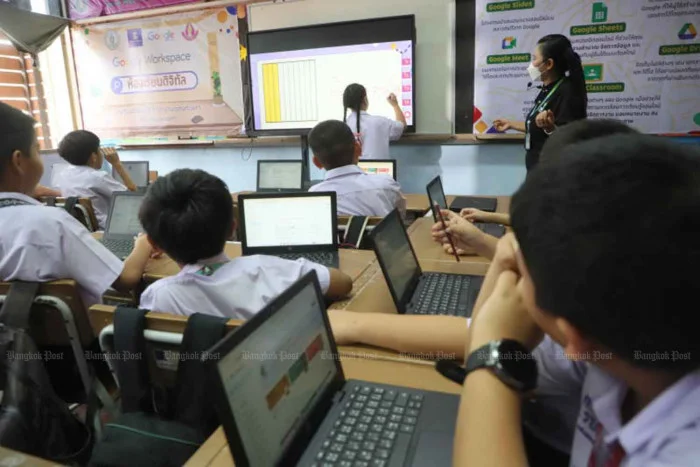
Thailand's education system may be rapidly embracing artificial intelligence, with millions of students already using AI-assisted learning and almost all teachers under the Office of the Basic Education Commission (Obec) trained to integrate the technology into classrooms.
But education officials say AI adoption alone will not determine the country's future competitiveness.
While schools are making steady progress in preparing students for an AI-driven world and future international assessments, Thailand still faces a bigger challenge: producing enough industry-ready workers to meet the demands of a changing economy.
The contrast highlights the two sides of Thailand's human capital agenda -- transforming how students learn while ensuring graduates possess the practical skills employers need.
AI washes over classrooms
Among Thailand's 6.5 million students, AI-adaptive learning has reached 3,326,065 learners through 160,507 trained teachers, while more than 93,000 students have developed skills to build AI ecosystems suited to local needs.
"The technical baseline for Thai students heavily relies on teacher competency in AI adoption," said Eakasit Piyasangtong, director of the Bureau of Academic Affairs and Educational Standards, noting that about 94% of Obec teachers have completed AI training.
Teachers are encouraged to help students develop their own ideas before using AI, rather than relying on it for answers. Officials warn that misuse of AI can weaken critical thinking and leave students unable to assess the accuracy of AI-generated content.
Mr Eakasit said AI literacy has become increasingly important as misinformation and AI-generated content proliferate online. New AI tools for educators therefore encourage students to question, analyse and synthesise information instead of accepting machine-generated responses at face value.
Education authorities measure AI competency across five areas: analysing and verifying information, writing effective prompts, selecting appropriate AI tools, applying theory in practice, and taking responsibility for outcomes.
Thailand is also aligning AI literacy with the OECD's emerging innovation domains ahead of the revised Programme for International Student Assessment (Pisa) in 2029.
According to Mr Eakasit, future Pisa assessments will place greater emphasis on media and AI literacy, focusing on real-world analysis rather than purely academic performance because AI-generated information is increasingly shaped by online "bubble chambers" and personal bias.
Officials believe the reforms could strengthen human capital and contribute to producing an estimated 1.2 million STEM graduates for high-skilled jobs. They also stress the need to prepare students for AI-driven workplaces while addressing concerns over excessive digital consumption and children's psychological and social well-being.
Vocational education weak
Despite progress in basic education, vocational education continues to lag behind the country's workforce ambitions.
Under the Ministry of Education's 2026-2030 "All for Education" framework, Thailand aims to upskill nearly 1 million workers to meet Industry 4.0 standards. Yet only about 150,000 of the country's 1 million vocational students are considered industry-ready.
Officials cite several structural barriers. Poverty and high dropout rates prevent many students from pursuing higher qualifications, with many entering the workforce at around 18 to support their families.
Curricula have also struggled to keep pace with advances in ICT and automotive technology, leaving nearly half of graduates from public and private vocational institutions inadequately prepared for industry, particularly outside Bangkok and the Eastern Economic Corridor.
Employers also report persistent gaps in English proficiency, digital literacy and complex problem-solving.
Workforce for the future
To close the gap, the Office of the Vocational Education Commission is replacing traditional rote learning with competency-based, standards-driven education.
Reforms begin this year with the China-Thailand "210 Majors" Vocational Project, while partnerships with Japan, Germany and Finland will continue supporting curriculum development in ICT, automation and hospitality.
A new "School-in-Factory" model will combine classroom learning with extended paid apprenticeships. Private-sector support and investment in data centres are expected to expand access to advanced laboratories, AI technologies and big data facilities.
The reforms also aim to raise the attractiveness of vocational education by highlighting strong employment prospects and higher earnings for post-secondary diploma graduates. Disadvantaged students will continue receiving support through the Equitable Education Fund's High Vocational Innovation Scholarship for careers in automation and STEM fields.
The programme will continue through 2030, including governance reforms in 2027, teacher training reforms in 2028, nationwide classroom AI deployment and preparation for Pisa 2029 before the planned nationwide expansion of Thailand's high-skilled workforce by 2030.
Officials say Thailand's education reforms will be judged by whether schools and vocational institutions can produce graduates with the AI literacy, practical skills and adaptability to compete in a rapidly evolving economy.