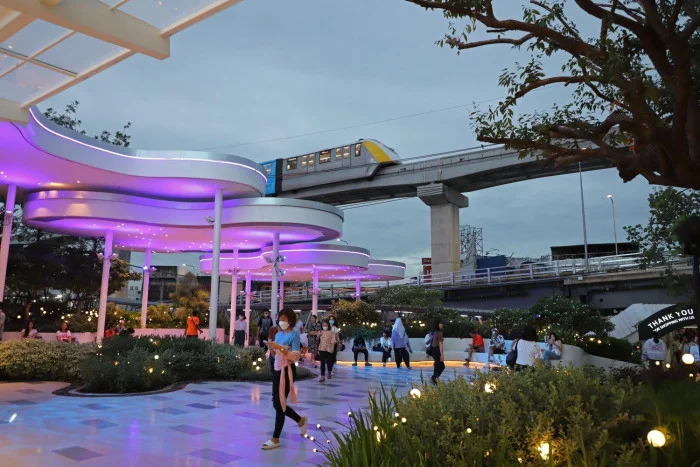
Land prices near Bangkok's expanding mass transit lines are continuing to rise, with eastern and outer suburban locations posting the strongest gains, even as the overall land price index slipped from the previous quarter.
The Real Estate Information Center (REIC) reported that the price index of vacant land in Greater Bangkok was 441 points in the second quarter of 2026, up 6.2% year-on-year but down 1.8% quarter-on-quarter.
The quarterly decline followed a 1.4% increase in the first quarter, suggesting that land prices have begun to stabilise after several years of rapid appreciation.
The strongest annual price growth was recorded in Phra Khanong-Bang Na-Suan Luang-Prawet, where land prices surged 36.3% from a year earlier, supported by expanding residential and commercial development.
The Bang Khen-Sai Mai-Don Mueang-Lak Si-Min Buri-Nong Chok-Khlong Sam Wa-Lat Krabang area ranked second, posting 21.1% annual growth as development continued to spread towards Bangkok's eastern fringe.
Land prices in Muang Nonthaburi- Pak Kret increased by 17.2%, followed by Samut Sakhon at 16% and Mueang Pathum Thani-Lat Lum Kaeo-Sam Khok at 11.8%.
These locations largely reflect expanding suburban growth corridors where infrastructure investment and new residential development continue to support land demand.
The REIC index also showed land values rising most rapidly along mass transit routes already operating or approaching completion.
Land along the Green Line extension (Khu Khot-Lam Luk Ka) recorded the highest increase among mass transit corridors, climbing 17.6% year-on-year to an index of 361 points.
Although the extension remains a future project, surrounding areas continue to attract residential development as investors anticipate long-term connectivity improvements.
The Pink Line (Khae Rai-Min Buri) ranked second, with land prices increasing 9.7% to an index of 319 points after full commercial operations began.
The Orange Line (Thailand Cultural Centre-Min Buri) is currently under construction and ranked third with annual growth of 7.4%, bringing its land price index to 489 points.
Land along both the Sukhumvit Skytrain Line and Airport Rail Link rose by 7.3%, reaching index levels of 504 and 460, respectively.
The Yellow Line (Lat Phrao-Samrong) completed the top five, with land values increasing 6.3% year-on-year to an index of 451 points.
Among the mass transit corridors, the Sukhumvit Skytrain Line remained the most expensive location in absolute terms, followed by the Orange Line and Airport Rail Link.
REIC's quarterly data showed land prices along several mature mass transit routes softened from the first quarter despite remaining higher than a year earlier, reflecting a more balanced market after previous rapid gains.
The Greater Bangkok land market has continued to benefit from transport infrastructure, particularly projects extending urban development towards outer districts, where land remains relatively more affordable than inner-city locations.
The latest figures indicate that while overall price growth has moderated, areas benefiting from new mass transit investment continue to outperform the broader market, especially locations positioned for future residential expansion and mixed-use development.