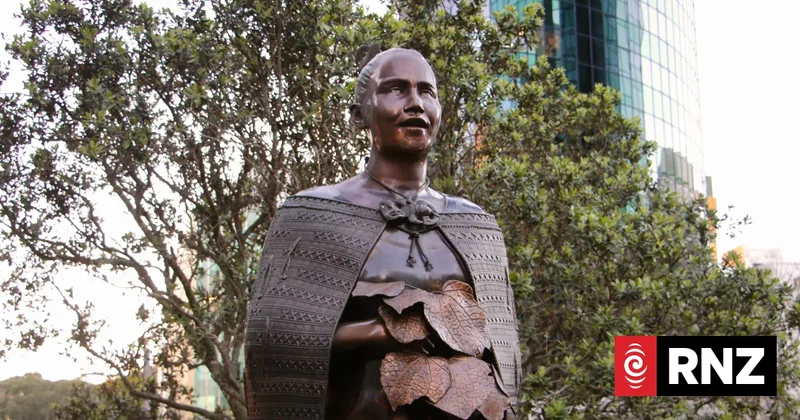
New Māori art is bringing tangata whenua narratives into the heart of Tāmaki Makaurau, ready to welcome in thousands of visitors who will descend on one of Auckland's busiest streets.
People will now be able to see and touch two new taonga toi (public art) which were blessed and unveiled at a formal dawn ceremony led by Ngāti Whātua Ōrākei early on Wednesday morning.
When the City Rail Link (CRL) is open, thousands of train passengers will arrive at street level through the north-eastern exit from Te Waihorotiu Station, and immediately be welcomed by toi Māori.
Wāhine is a 3.7 metre bronze sculpture of a Māori woman performing a karanga (call of welcome), and is created by master carver Arekatera 'Katz' Maihi and weaver Beronia Scott.
Maihi (Ngāti Whātua) told RNZ the statue will allow Māori to see themselves in the centre of Auckland.
"It's important to have this type of mahi in the public spaces because we all hear the current debates around the country, and this is just a total reminder that you can say whatever you want, you can take away what you want, but you'll never move us. We're going nowhere, we're here forever."
Maihi said since Wāhine will likely be the first thing people see as they exit the new Te Waihorotiu Station he had to incorporate the welcoming process into its design.
"It was all about utilising our practices and our tikanga in these spaces."
Beronia Scott (Ngāti Whātua Ōrākei) said the inspiration for the korowai (cloak) that Wāhine wears came from a korowai they have at the marae.
"I've always been told by master weavers that a korowai is called korowai because of the hukahuka (tassels). A lot of people get that mixed up, they think everything's korowai, so that's why I didn't put anything else on it besides the hukahuka, so that they have to say the right word."
Maihi said the statue will be a "friend" for the statue that currently stands at Te Komititanga, the public square in front of Waitematā train station, creating an equal balance of tāne and wāhine.
"That also is the reason why I decided I wanted to really acknowledge our wāhine. They've been missing from this sort of space.
"I te tuatahi he tohu maumahara, he tohu whakanui ki ngā mahi o ngā wāhine katoa i roto i tō tātau nei hapori o Tāmaki nei. E hoki ake ngā whakaaro ki ngā kuia o mua tae noa ki ēnei rangi, ō mātau nā whaea e mahi ana i ngā mahi."
"The wāhine artists, Māori, it's hard to see, hard to find them. So my cousin [was] grabbing me, and I'm very reluctant to do all of this stuff. I'm all good weaving, I'm fine there, I'm all good in that space, but I think wāhine and Māori especially need to be acknowledged," Scott said.
"She stands on a low plinth, scaled and oriented to meet the gaze of manuhiri (visitors) as they ascend the ramp from the underground station."
Further along Victoria Street West on the corner Queen Street stands Horotiu, a 7.2-metre-long tuna kūwharuwharu (longfin eel) cast in silicon bronze and depicted spiralling downward from Puna Kauariki, the celestial spring.
Renowned Māori sculptor and carver Chris Bailey (Ngāti Paoa, Te Aupōuri) said the towering bronze tuna was designed to reconnect people with the history beneath one of Auckland's busiest intersections.
"I want to say that it was a mana whenua collective that shoulder tapped me to be part of this," he told RNZ.
"They said, 'We don't care what you do, bro, as long as it's unmistakably Māori, if you don't understand English or Māori language.' I think they were thinking about everyone that comes down here."
He said the decision to create a tuna kūwharuwharu came after researching what Te Waihorotiu looked like before Tāmaki Makaurau was urbanised.
"The reason why I came up with a tuna kūwharuwharu, or longfin tuna, is the fact that Horotiu used to come down through here."
Bailey said every whakairo should reflect the history of the place where it stands.
"Whenever I do whakairo, we have to look at the whakapapa of the whenua, so that it relates to the area."
Rangahau (research) into the area's geological history showed a volcanic eruption had diverted the Waihorotiu stream thousands of years ago, creating wetlands that were once abundant with tuna.
"In order to come up with what we did come up with, a tūna, we looked at the geographical footprint of this place, pre-European, and that told us that a volcanic eruption occurred, pushing a big lava flow down here, which is why we use this water feature as a bit of lava, and dammed up Horotiu up by Aotea Square, and that became a big, like a swamp area, and it drained off down around the corner and come down here.
"And we realised that the tūna were just, there was just heaps and heaps of life here, back in the day, pre-European."
He said the waterway had never truly disappeared.
"With my partner [Sally Smith] who I collabed with, she was an architect working on these two towers, and the engineers on these towers were continuously pushing the water out of the basements. And with that in mind, and the creative process, I thought, holy heck, that's Horotiu. It's still pushing its way.
"Even though this whole place is compressed with infrastructure, Horotiu is still trying to push its way into the present."
Surrounded by his mokopuna, Bailey hoped the mahi toi would serve as a meeting place and create lasting memories for future generations.
"I was looking through some of our photographs. Some of our photographs at home, and we've got photos of me at the zoo with my sisters sitting on the mouth of this big dragon.
"I thought to myself, man, we've got to make one of these, but we'll make it in our own flavour - an iconic piece or a wayfinder where people can come and take photos and say, 'I'll meet you at the eel.'"
He hoped tamariki growing up in Aotearoa would have memories of the sculpture similar to those he had of climbing on public artworks as a tamaiti.
"When I grew up, there weren't any Māori sculptures around the place.
"They were all celebrating Pākehā cricket guys or guys that had survived the Second or First World War, and all kudos to that. I understand that. This is our time now.
"This is our time now… keep more Māori putting their creative thumbprint into the whenua for us."
An opening date for the City Rail Link has yet to be confirmed.